

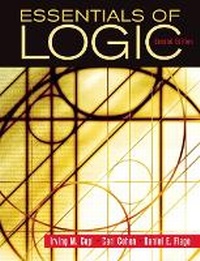
Essentials of Logic
2nd Edition
Published on 17. July 2006
Book
Paperback/Softback
464 pages
978-0-13-238034-8 (ISBN)
Description
Rendered from the 11th Edition of Copi/Cohen, Introduction to Logic, the most respected introductory logic book on the market, this concise version presents a simplified yet rigorous introduction to the study of logic. It covers all major topics and approaches, using a three-part organization that outlines specific topics under logic and language, deduction, and induction. For individuals intrigued by the formal study of logic.
Reviews / Votes
"One of the strengths of Copi has always been the number of exercises, and the addition of even more exercises is even better."-Robert Kimball, University of Louisville
"I think the examples are the major strong suit of the text. There are plenty of them, many are very entertaining, others are modern and poignant, still others are historically enlightening. Excellent job."
-Norman Schultz, Metropolitan State College of Denver
More details
Edition
2nd edition
Language
English
Place of publication
New York
United States
Publishing group
Taylor & Francis Inc
Target group
Professional and scholarly
Dimensions
Height: 232 mm
Width: 178 mm
Weight
1200 gr
ISBN-13
978-0-13-238034-8 (9780132380348)
Copyright in bibliographic data and cover images is held by Nielsen Book Services Limited or by the publishers or by their respective licensors: all rights reserved.
Schweitzer Classification
Other editions
Additional editions
Irving Copi | Carl Cohen | Daniel Flage
Essentials of Logic
E-Book
12/2016
2nd Edition
Routledge
€128.99
Available for download
Irving Copi | Carl Cohen | Daniel Flage
Essentials of Logic
E-Book
12/2016
2nd Edition
Routledge
€128.99
Available for download

Persons
Irving Copi, Carl Cohen, Daniel Flage
Content
Table of ContentsPreface Acknowledgments CHAPTER 1 Basic Logical Concepts1.1 What Logic Is1.2 Propositions and Sentences1.3 Arguments, Premises, and Conclusions1.4 Arguments and Explanations1.5 Recognizing Arguments A. Premise- and Conclusion-Indicators B. Arguments in Context C. Premises Not in Declarative Form D. Unstated Propositions1.6 Deduction and Validity1.7 Validity and Truth1.8 Induction and Probability1.9 Analyzing Arguments A. Paraphrasing B. Diagramming Arguments C. Interwoven Arguments1.10 Complex Argumentative PassagesEssentials of Chapter 1 CHAPTER 2 Informal Fallacies2.1 What Is a Fallacy?2.2 Fallacies of Relevance R1. Argument from Ignorance (argumentum ad ignoratiam) R2. Appeal to Illegitimate Authority (argumentum ad verecundiam) R3. Argument Against the Person (Personal Attack, argumentum ad hominem) R4. Appeal to Emotion (Mob Appeal, argumentum ad populum) R5. Appeal to Pity (argumentum ad misericordiam) R6. Appeal to Force (argumentum ad baculum) R7. Irrelevant Conclusion (ignoratio elenchi; non sequitur)2.3 Fallacies of Presumption P1. Complex Question P2. False Cause (post hoc, ergo propter hoc; non causa pro causa) P3. Begging the Question (petitio principii) P4. Accident P5. Converse Accident (Hasty Generalization)