

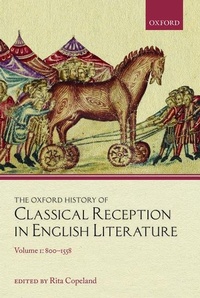
The Oxford History of Classical Reception in English Literature
Volume 1: 800-1558
Published on 7. May 2020
Book
Paperback/Softback
776 pages
978-0-19-885917-8 (ISBN)
Description
The Oxford History of Classical Reception in English Literature (OHCREL) is designed to offer a comprehensive investigation of the numerous and diverse ways in which literary texts of the classical world have stimulated responses and refashioning by English writers. Covering the full range of English literature from the early Middle Ages to the present day, OHCREL both synthesizes existing scholarship and presents cutting-edge new research, employing an international team of expert contributors for each of the five volumes.
OHCREL endeavours to interrogate, rather than inertly reiterate, conventional assumptions about literary 'periods', the processes of canon-formation, and the relations between literary and non-literary discourse. It conceives of 'reception' as a complex process of dialogic exchange and, rather than offering large cultural generalizations, it engages in close critical analysis of literary texts. It explores in detail the ways in which English writers' engagement with classical literature casts as much light on the classical originals as it does on the English writers' own cultural context.
This first volume covers the years c.800-1558, and surveys the reception and transformation of classical literary culture in England from the Anglo-Saxon period up to the Henrician era. Chapters on the classics in the medieval curriculum, the trivium and quadrivium, medieval libraries, and medieval mythography provide context for medieval reception. The reception of specific classical authors and traditions is represented in chapters on Virgil, Ovid, Lucan, Statius, the matter of Troy, Boethius, moral philosophy, historiography, biblical epics, English learning in the twelfth century, and the role of antiquity in medieval alliterative poetry. The medieval section includes coverage of Chaucer, Gower, and Lydgate, while the part of the volume dedicated to the later period explores early English humanism, humanist education, and libraries in the Henrician era, and includes chapters that focus on the classicism of Skelton, Douglas, Wyatt, and Surrey.
OHCREL endeavours to interrogate, rather than inertly reiterate, conventional assumptions about literary 'periods', the processes of canon-formation, and the relations between literary and non-literary discourse. It conceives of 'reception' as a complex process of dialogic exchange and, rather than offering large cultural generalizations, it engages in close critical analysis of literary texts. It explores in detail the ways in which English writers' engagement with classical literature casts as much light on the classical originals as it does on the English writers' own cultural context.
This first volume covers the years c.800-1558, and surveys the reception and transformation of classical literary culture in England from the Anglo-Saxon period up to the Henrician era. Chapters on the classics in the medieval curriculum, the trivium and quadrivium, medieval libraries, and medieval mythography provide context for medieval reception. The reception of specific classical authors and traditions is represented in chapters on Virgil, Ovid, Lucan, Statius, the matter of Troy, Boethius, moral philosophy, historiography, biblical epics, English learning in the twelfth century, and the role of antiquity in medieval alliterative poetry. The medieval section includes coverage of Chaucer, Gower, and Lydgate, while the part of the volume dedicated to the later period explores early English humanism, humanist education, and libraries in the Henrician era, and includes chapters that focus on the classicism of Skelton, Douglas, Wyatt, and Surrey.
More details
Series
Language
English
Place of publication
Oxford
United Kingdom
Target group
College/higher education
Dimensions
Height: 234 mm
Width: 156 mm
Thickness: 41 mm
Weight
1150 gr
ISBN-13
978-0-19-885917-8 (9780198859178)
Copyright in bibliographic data and cover images is held by Nielsen Book Services Limited or by the publishers or by their respective licensors: all rights reserved.
Schweitzer Classification
Other editions
Additional editions
Book
02/2016
Oxford University Press
€404.50
Shipment within 15-20 days
Person
Edited by Rita Copeland, Rosenberg Chair in the Humanities and Professor of Classical Studies, English, and Comparative Literature, University of Pennsylvania
Rita Copeland is Rosenberg Chair in the Humanities at the University of Pennsylvania, and a Fellow of the Medieval Academy of America. Her fields of research include the history of rhetoric, literary theory, and medieval learning. She is a founder of the journal New Medieval Literatures, and co-founder of Toronto Series in Medieval and Early Modern Rhetoric. In addition to many articles, she has published the following books: Rhetoric, Hermeneutics, and Translation in the Middle Ages (1991), Criticism and Dissent in the Middle Ages (1996), Pedagogy, Intellectuals and Dissent in the Later Middle Ages (2001), Medieval Grammar and Rhetoric: Language Arts and Literary Theory, AD 300-1475 (with Ineke Sluiter) (2009), and The Cambridge Companion to Allegory (with Peter Struck) (2010).
Rita Copeland is Rosenberg Chair in the Humanities at the University of Pennsylvania, and a Fellow of the Medieval Academy of America. Her fields of research include the history of rhetoric, literary theory, and medieval learning. She is a founder of the journal New Medieval Literatures, and co-founder of Toronto Series in Medieval and Early Modern Rhetoric. In addition to many articles, she has published the following books: Rhetoric, Hermeneutics, and Translation in the Middle Ages (1991), Criticism and Dissent in the Middle Ages (1996), Pedagogy, Intellectuals and Dissent in the Later Middle Ages (2001), Medieval Grammar and Rhetoric: Language Arts and Literary Theory, AD 300-1475 (with Ineke Sluiter) (2009), and The Cambridge Companion to Allegory (with Peter Struck) (2010).
Content
List of Contributors
Abbreviations
1: Rita Copeland: Introduction
2: Rita Copeland: The Curricular Classics in the Middle Ages
3: Marjorie Curry Woods: Experiencing the Classics in Medieval Education
4: Rita Copeland: The Trivium and the Classics
5: Winston Black: The Quadrivium and Natural Sciences
6: James Willoughby: The Transmission and Circulation of Classical Literature: Libraries and Florilegia
7: Nicolette Zeeman: Mythography and Mythographical Collections
8: Rita Copeland: Academic Prologues to Authors
9: Jan M. Ziolkowski: Virgil
10: Suzanne Conklin Akbari: Ovid and Ovidianism
11: Alfred Hiatt: Lucan
12: Winthrop Wetherbee: Statius
13: Marilynn Desmond: Trojan Itineraries and the Matter of Troy
14: Ian Cornelius: Boethius' De consolatione philosophiae
15: Charles F. Briggs: Moral Philosophy and Wisdom Literature
16: Cam Grey: Historiography and Biography from the Period of Gildas to Gerald of Wales
17: Ad Putter: Prudentius and the Late Classical Epics of Juvencus, Proba, Sedulius, Arator and Avitus
18: Dallas G. Denery II: John of Salisbury, Academic Scepticism, and Ciceronian Rhetoric
19: Emily Steiner: Alliterative Poetry and the Time of Antiquity
20: Alastair Minnis: Other Worlds: Chaucer's Classicism
21: Andrew Galloway: Gower's Ovids
22: Robert R. Edwards: John Lydgate and the Remaking of Classical Epic
23: Daniel Wakelin: Early Humanism in England
24: James Carley and Agnes Juhasz-Ormsby: Survey of Henrician Humanism
25: David R. Carlson: John Skelton
26: Nicola Royan: Gavin Douglas' Eneados
27: Cathy Shrank: Finding a Vernacular Voice: The Classical Translations of Sir Thomas Wyatt
28: James Simpson: The Aeneid Translations of Henry Howard, Earl of Surrey: The Exiled Reader's Presence
Select Bibliography of Ancient Sources
General Reference Works for Reception
Studies on Ancient Authors and Classical Reception
Medieval: Primary Sources
Medieval: Secondary Sources
Early Humanism: Primary Sources
Early Humanism: Secondary Sources
Abbreviations
1: Rita Copeland: Introduction
2: Rita Copeland: The Curricular Classics in the Middle Ages
3: Marjorie Curry Woods: Experiencing the Classics in Medieval Education
4: Rita Copeland: The Trivium and the Classics
5: Winston Black: The Quadrivium and Natural Sciences
6: James Willoughby: The Transmission and Circulation of Classical Literature: Libraries and Florilegia
7: Nicolette Zeeman: Mythography and Mythographical Collections
8: Rita Copeland: Academic Prologues to Authors
9: Jan M. Ziolkowski: Virgil
10: Suzanne Conklin Akbari: Ovid and Ovidianism
11: Alfred Hiatt: Lucan
12: Winthrop Wetherbee: Statius
13: Marilynn Desmond: Trojan Itineraries and the Matter of Troy
14: Ian Cornelius: Boethius' De consolatione philosophiae
15: Charles F. Briggs: Moral Philosophy and Wisdom Literature
16: Cam Grey: Historiography and Biography from the Period of Gildas to Gerald of Wales
17: Ad Putter: Prudentius and the Late Classical Epics of Juvencus, Proba, Sedulius, Arator and Avitus
18: Dallas G. Denery II: John of Salisbury, Academic Scepticism, and Ciceronian Rhetoric
19: Emily Steiner: Alliterative Poetry and the Time of Antiquity
20: Alastair Minnis: Other Worlds: Chaucer's Classicism
21: Andrew Galloway: Gower's Ovids
22: Robert R. Edwards: John Lydgate and the Remaking of Classical Epic
23: Daniel Wakelin: Early Humanism in England
24: James Carley and Agnes Juhasz-Ormsby: Survey of Henrician Humanism
25: David R. Carlson: John Skelton
26: Nicola Royan: Gavin Douglas' Eneados
27: Cathy Shrank: Finding a Vernacular Voice: The Classical Translations of Sir Thomas Wyatt
28: James Simpson: The Aeneid Translations of Henry Howard, Earl of Surrey: The Exiled Reader's Presence
Select Bibliography of Ancient Sources
General Reference Works for Reception
Studies on Ancient Authors and Classical Reception
Medieval: Primary Sources
Medieval: Secondary Sources
Early Humanism: Primary Sources
Early Humanism: Secondary Sources