

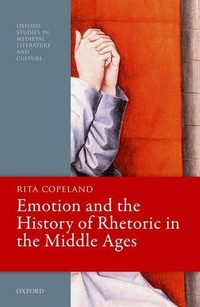
Emotion and the History of Rhetoric in the Middle Ages
Published on 18. November 2021
Book
Hardback
432 pages
978-0-19-284512-2 (ISBN)
Description
Rhetoric is an engine of social discourse and the art charged with generating and swaying emotion. The history of rhetoric provides a continuous structure by which we can measure how emotions were understood, articulated, and mobilized under various historical circumstances and social contracts. This book is about how rhetoric in the West, from Late Antiquity to the later Middle Ages, represented the role of emotion in shaping persuasions. It is the first book-length study of medieval rhetoric and the emotions, coloring that rhetorical history between about 600 CE and the cusp of early modernity. Rhetoric in the Middle Ages, as in other periods, constituted the gateway training for anyone engaged in emotionally persuasive writing. Medieval rhetorical thought on emotion has multiple strands of influence and sedimentations of practice. The earliest and most persistent tradition treated emotional persuasion as a property of surface stylistic effect, which can be seen in the medieval rhetorics of poetry and prose, and in literary production. But the impact of Aristotelian rhetoric, which reached the Latin West in the thirteenth century, gave emotional persuasion a core role in reasoning, incorporating it into the key device of proof, the enthymeme. In Aristotle, medieval teachers and writers found a new rhetorical language to explain the social and psychological factors that affect an audience. With Aristotelian rhetoric, the emotions became political. The impact of Aristotle's rhetorical approach to emotions was to be felt in medieval political treatises, in poetry, and in preaching.
Reviews / Votes
Professor Copeland's text is a surprisingly readable history that builds upon itself logically, engaging the reader even as it carries them through dense lines of arguments and swaths of narrative. * Shea Mccollough, English, Washington University in St. Louis, Comitatus * In this rich and wide-ranging study,...Emotion and the History of Rhetoric in the Middle Ages synthesizes multiple research fields to serve multiple audiences. * Studies in the Age of Chaucer * In this rich and wide-ranging study, Rita Copeland pursues two concepts of the relationship between rhetoric and emotion from Antiquity to the end of the medieval period...The volume can serve as a history of medieval rhetoric. * Jonathan Newman, Studies in the Age of Chaucer * Copeland has given us a convincing and conceptually rich account of Western medieval rhetoric that will also serve as an invaluable resource more broadly for historians of literature, culture, and thought. * Jonathan Morton, Medium AEvum * The book opens up the field and advances the question of emotions in rhetorical theory and practice, reaffirming, furthermore, the inseparability of political and literary texts in the later Middle Ages. * Tina Montenegro, Speculum: A Journal of Medieval Studies *More details
Series
Language
English
Place of publication
Oxford
United Kingdom
Target group
Professional and scholarly
Product notice
sewn/stitched
Cloth over boards
Dimensions
Height: 226 mm
Width: 155 mm
Thickness: 33 mm
Weight
794 gr
ISBN-13
978-0-19-284512-2 (9780192845122)
Copyright in bibliographic data and cover images is held by Nielsen Book Services Limited or by the publishers or by their respective licensors: all rights reserved.
Schweitzer Classification
Other editions
Additional editions
Rita Copeland
Emotion and the History of Rhetoric in the Middle Ages
E-Book
11/2021
1st Edition
OUP eBook
€33.99
Available for download
Rita Copeland
Emotion and the History of Rhetoric in the Middle Ages
E-Book
11/2021
1st Edition
OUP eBook
€33.99
Available for download
Person
Rita Copeland is Professor of Classical Studies, English, and Comparative Literature and Sheli Z. and Burton X. Rosenberg Professor of Humanities at the University of Pennsylvania. She is author or editor of eight booksand is a General Editor of the five-volume Cambridge History of Rhetoric. She has received grants and fellowships, including the Guggenheim, American Council of Learned Societies, National Endowment for the Humanities, and American Philosophical Society.
Content
Introduction
1: Before the Middle Ages: Emotion from Invention to Style
2: Christian and Literary Rhetorics of the Early Middle Ages: Emotion as the Property of Style
3: Emotion in the Rhetorical Arts and Literary Culture c. 1070-c.1400
4: Aristotle's Rhetoric in the Latin West: The Fortunes of the Path?
5: De regimine principum: Emotion, Persuasion, and Political Thought
6: Political Poetics and the Aristotelian Turn: Dante, Chaucer, and Hoccleve
7: Preaching, Emotion, and the Aristotelian Turn
Epilogue: Mixed Rhetorics
1: Before the Middle Ages: Emotion from Invention to Style
2: Christian and Literary Rhetorics of the Early Middle Ages: Emotion as the Property of Style
3: Emotion in the Rhetorical Arts and Literary Culture c. 1070-c.1400
4: Aristotle's Rhetoric in the Latin West: The Fortunes of the Path?
5: De regimine principum: Emotion, Persuasion, and Political Thought
6: Political Poetics and the Aristotelian Turn: Dante, Chaucer, and Hoccleve
7: Preaching, Emotion, and the Aristotelian Turn
Epilogue: Mixed Rhetorics