

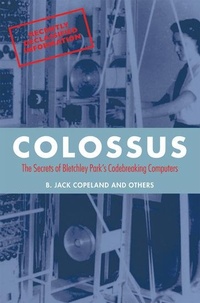
Colossus
The secrets of Bletchley Park's code-breaking computers
Published on 18. March 2010
Book
Paperback/Softback
480 pages
978-0-19-957814-6 (ISBN)
Description
At last - the secrets of Bletchley Park's powerful codebreaking computers.
This is a history of Colossus, the world's first fully-functioning electronic digital computer. Colossus was used during the Second World War at the Government Code and Cypher School at Bletchley Park, where it played an invaluable role cracking enemy codes. Until very recently, much about the Colossus machine was shrouded in secrecy, largely because the codes that were employed remained in use by the British security services until a short time ago. This book only became possible due to the declassification in the US of wartime documents.
With an introductory essay on cryptography and the history of code-breaking by Simon Singh, this book reveals the workings of Colossus and the extraordinary staff at Bletchley Park through personal accounts by those who lived and worked with the computer. Among them is the testimony of Thomas Flowers, who was the architect of Colossus and whose personal account, written shortly before he died, is published here for the first time. Other essays consider the historical importance of this remarkable machine, and its impact on the generations of computing technology that followed.
This is a history of Colossus, the world's first fully-functioning electronic digital computer. Colossus was used during the Second World War at the Government Code and Cypher School at Bletchley Park, where it played an invaluable role cracking enemy codes. Until very recently, much about the Colossus machine was shrouded in secrecy, largely because the codes that were employed remained in use by the British security services until a short time ago. This book only became possible due to the declassification in the US of wartime documents.
With an introductory essay on cryptography and the history of code-breaking by Simon Singh, this book reveals the workings of Colossus and the extraordinary staff at Bletchley Park through personal accounts by those who lived and worked with the computer. Among them is the testimony of Thomas Flowers, who was the architect of Colossus and whose personal account, written shortly before he died, is published here for the first time. Other essays consider the historical importance of this remarkable machine, and its impact on the generations of computing technology that followed.
Reviews / Votes
Copeland's book is a masterpiece. * George Dyson, author of Turing's Cathedral * Review from previous edition Copeland and other contributors have rightly done Flowers and the Tunny code-breakers proud An engaging book that will be essential reading for historians of twentieth-century technology and warfare. * Nature * formidably detailed * Guardian * compelling compilation * New Scientist *More details
Language
English
Place of publication
Oxford
United Kingdom
Illustrations
Various line drawings and 16pp black and white plate section
Dimensions
Height: 233 mm
Width: 156 mm
Thickness: 45 mm
Weight
755 gr
ISBN-13
978-0-19-957814-6 (9780199578146)
Copyright in bibliographic data and cover images is held by Nielsen Book Services Limited or by the publishers or by their respective licensors: all rights reserved.
Schweitzer Classification
Other editions
Additional editions
E-Book
03/2010
1st Edition
OUP eBook
€14.49
Available for download
E-Book
02/2006
OUP eBook
€14.49
Available for download
Book
04/2003
Oxford University Press
€24.76
Article exhausted; check different version
Person
Jack Copeland is Professor of Philosophy at the University of Canterbury in New Zealand and Director of the Turing Archive for the History of Computing, and has been studying the history of Bletchley Park since 1992.
He is a contributor to Scientific American and his previous publications include Artificial Intelligence, (Blackwell, 1993), Logic and Reality (OUP, 1996), Turing's Machines (OUP, forthcoming), The Essential Turing (OUP, 2004), and Alan Turing's Automatic Computing Engine (OUP, 2005).
He is a contributor to Scientific American and his previous publications include Artificial Intelligence, (Blackwell, 1993), Logic and Reality (OUP, 1996), Turing's Machines (OUP, forthcoming), The Essential Turing (OUP, 2004), and Alan Turing's Automatic Computing Engine (OUP, 2005).
Content
1. A Brief History of Cryptography from Caesar to Bletchley Park ; 2. How It Began: Bletchley Park Goes to War ; 3. The German Tunny Machine ; 4. Colossus, Codebreaking, and the Digital Age ; 5. Machine Against Machine ; 6. D-Day at Bletchley Park ; 7. Intercept! ; 8. Colossus ; 9. Colossus and the Rise of the Modern Computer ; 10. The PC-User's Guide to Colossus ; 11. Of Men and Machines ; 12. The Colossus Rebuild ; 13. Mr Newman's Section ; 14. Max Newman-Mathematician, Codebreaker and Computer Pioneer ; 15. Living with Fish: Breaking Tunny in the Newmanry and the Testery ; 16. From Hut 8 to the Newmanry ; 17. Codebreaking and Colossus ; 18. Major Tester's Section ; 19. Setter and Breaker ; 20. An ATS Girl in the Testery ; 21. The Testery and the Breaking of Fish ; 22. Dollis Hill at War ; 23. The British Tunny Machine ; 24. How Colossus was Built and Operated-One of Its Engineers Reveals Its Secrets ; 25. Bletchley Park's Sturgeon-The Fish That Laid No Eggs ; 26. Geheimschreiber Traffic and Swedish Wartime Intelligence ; A1 Timeline: The Breaking of Tunny ; A2 The Teleprinter Alphabet ; A3 The Tunny Addition Square ; A4 My Work at Bletchley Park ; A5 The Tiltman Break ; A6 Turingery ; A7 Dc-Method ; A8 Newman's Theorem ; A9 Rectangling ; A10 The Motor Wheels and Limitations ; A11 Motorless Tunny ; A12 Origin of the Fish Cypher Machines