

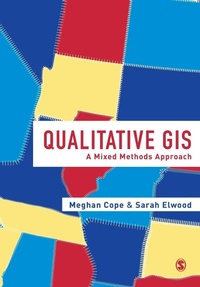
Qualitative GIS
A Mixed Methods Approach
1st Edition
Published on 9. July 2009
Book
Paperback/Softback
192 pages
978-1-4129-4566-0 (ISBN)
Description
Geographic Information Systems are an essential tool for analyzing and representing quantitative spatial data. Qualitative GIS explains the recent integration of qualitative research with Geographical Information Systems
With a detailed contextualising introduction, the text is organised in three sections:
Representation: examines how researchers are using GIS to create new types of representations; working with spatial data, maps, and othervisualizations to incorporate multiple meanings and to provide texture and context.
Analysis: discusses the new techniques of analysis that are emerging at the margins between qualitative research and GIS, this in the wider context of a critical review of mixed-methods in geographical research
Theory: questions how knowledge is produced, showing how ideas of 'science' and 'truth' inform research, and demonstrates how qualitative GIS can be used to interrogate discussions of power, community, and social action
Making reference to representation, analysis, and theory throughout, the text shows how to frame questions, collect data, analyze results, and represent findings in a truly integrated way. An important addition to the mixed methods literature, Qualitative GIS will be the standard reference for upper-level students and researchers using qualitative methods and Geographic Information Systems.
With a detailed contextualising introduction, the text is organised in three sections:
Representation: examines how researchers are using GIS to create new types of representations; working with spatial data, maps, and othervisualizations to incorporate multiple meanings and to provide texture and context.
Analysis: discusses the new techniques of analysis that are emerging at the margins between qualitative research and GIS, this in the wider context of a critical review of mixed-methods in geographical research
Theory: questions how knowledge is produced, showing how ideas of 'science' and 'truth' inform research, and demonstrates how qualitative GIS can be used to interrogate discussions of power, community, and social action
Making reference to representation, analysis, and theory throughout, the text shows how to frame questions, collect data, analyze results, and represent findings in a truly integrated way. An important addition to the mixed methods literature, Qualitative GIS will be the standard reference for upper-level students and researchers using qualitative methods and Geographic Information Systems.
Reviews / Votes
'An important and meaningful, even an innovative, resource in its field of inquiry. It makes a major contribution to geography by describing, presenting and analyzing the way in which qualitative information may be included in geographic information systems. GIS technology in general is not merely a tool for processing quantitative or qualitative spatial data. Qualitative GIS in particular constitutes a knowledge base with philosophical (ontological and epistemological) foundations. The incorporation of qualitative methods into GIS produces a whole that is "greater than the sum of its parts". Moreover, the book contributes to our understanding of the process in the social sciences by giving a visual presentation of social and spatial phenomena, and thus its contribution goes beyond the geographic discipline' -Geography Research Forum
'Qualitative GIS is coming of age, and this definitive collection explains why it deserves broad attention. These carefully selected essays by leading researchers, organized around a broad conception of qualitative GIS that extends beyond multi-media data integration to embrace new software tools and interpretive, situated epistemologies, will push readers to rethink not only their preconceptions about qualitative GIS, but also about GI science and critical GIS. GIS researchers, practicioners, observers and users will find much to chew on here' - Professor Eric Sheppard, University of Minnesota, USA
More details
Language
English
Place of publication
Thousand Oaks
United States
Target group
College/higher education
Professional and scholarly
Dimensions
Height: 244 mm
Width: 170 mm
Thickness: 11 mm
Weight
345 gr
ISBN-13
978-1-4129-4566-0 (9781412945660)
Copyright in bibliographic data and cover images is held by Nielsen Book Services Limited or by the publishers or by their respective licensors: all rights reserved.
Schweitzer Classification
Other editions
Additional editions
E-Book
07/2009
1st Edition
SAGE Publications Ltd
from
€44.69
Available for download
Book
07/2009
1st Edition
SAGE Publications Inc
€227.50
Shipment within 10-20 days
Persons
Dr. Meghan Cope is an urban social geographer. She is mainly interested in the ways that social, economic, political, and environmental processes influence cities and communities, as well as the ways that people's everyday lives create meaningful spaces and places within, or even against, the larger-scale processes operating on them. Her focus has always been on social/spatial processes of marginalization and disempowerment, for example, through gender, race/ethnicity, class, youth, etc. She is especially motivated by issues such as employment, households and neighborhoods, welfare, public space, poverty, discrimination, and identity. She is also a qualitative researcher who uses ethnography and other methods to learn about the geographic meanings and processes that matter to marginalized groups. Over the past 10 years she has developed an associated interest in critical perspectives on Geographic Information Systems (GIS) and have explored methods of combining qualitative research with GIS (Cope & Elwood, 2009). Sarah Elwood is a professor of geography at University of Washington and cofounder of the Relational Poverty Network with Victoria Lawson. Her research contributes to relational poverty studies, critical GIScience and digital geographies, visual politics and mixed methods, and urban geography. Current activities include research on poverty politics of creative activisms around homelessness, feminist and critical race theorizations of digital geographies, and a collaborative public scholarly project on horizons of critical poverty studies under emerging national populisms. She is the coeditor of Relational Poverty Politics (University of Georgia Press, 2018), Crowdsourcing Geographic Knowledge (Springer, 2012) and Qualitative GIS (SAGE, 2009) and author of journal articles in Progress in Human Geography, Annals of the Association of American Geographers, International Journal of Geographic Information Science, and others. She holds an MA and PhD in geography from the University of Minnesota and a BA in Geography from Macalester College.
Content
Introduction: Qualitative GIS: Forging mixed methods through representations, analytical innovations, and conceptual engagements - Sarah Elwood and Meghan Cope
Non-quantitative GIS - Marianna Pavlovskaya
PART ONE: REPRESENTATIONS
Metadata as a site for imbuing GIS with qualitative information - Nadine Schuurman
Multiple representations, significations, and epistemologies in community-based GIS - Sarah Elwood
Geographic information technologies, local knowledge, and change - Jon Corbett and Giacomo Rambaldi
PART TWO: ANALYTICAL INTERVENTIONS AND INNOVATIONS
Grounded Visualization and scale: A recursive analysis of community spaces - LaDona Knigge and Meghan Cope
Computer-Aided Qualitative GIS: A software-level integration of qualitative research and GIS - Jin-Kyu Jung
PART THREE: CONCEPTUAL ENGAGEMENTS
Affective visual geographies and GIScience - Stuart Aitken and Jim Craine
Towards a genealogy of qualitative GIS - Matthew W Wilson
Conclusion: For Qualitative GIS - Meghan Cope and Sarah Elwood
Non-quantitative GIS - Marianna Pavlovskaya
PART ONE: REPRESENTATIONS
Metadata as a site for imbuing GIS with qualitative information - Nadine Schuurman
Multiple representations, significations, and epistemologies in community-based GIS - Sarah Elwood
Geographic information technologies, local knowledge, and change - Jon Corbett and Giacomo Rambaldi
PART TWO: ANALYTICAL INTERVENTIONS AND INNOVATIONS
Grounded Visualization and scale: A recursive analysis of community spaces - LaDona Knigge and Meghan Cope
Computer-Aided Qualitative GIS: A software-level integration of qualitative research and GIS - Jin-Kyu Jung
PART THREE: CONCEPTUAL ENGAGEMENTS
Affective visual geographies and GIScience - Stuart Aitken and Jim Craine
Towards a genealogy of qualitative GIS - Matthew W Wilson
Conclusion: For Qualitative GIS - Meghan Cope and Sarah Elwood