

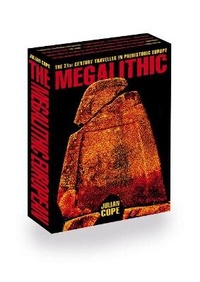
The Megalithic European
The 21st Century Traveller in Prehistoric Europe
Published on 18. October 2004
Book
Hardback
496 pages
978-0-00-713802-9 (ISBN)
Description
Julian Cope's long-awaited follow up to The Modern Antiquarian, his bestselling and critically acclaimed guide to ancient Britain. The Megalithic European takes us on a breathtaking journey around prehistoric Europe's first temples.
Contents
* The Megalithic European is a monumental colour guide to the standing stones and ancient temples of prehistoric Europe.
* In a 6-year personal odyssey (leaving no stone unturned) Julian Cope covers 300 of the important sites of Northern Europe and the Mediterranean.
* The book looks further, revealing several thousand years of information which scholars have previously ignored, to the Classical temples of the Eastern Mediterranean and Aegean Seas.
* Section 1: a series of essays, looking at the universal desire of all settlers: to celebrate and mythologize the landscape in which they have chosen to live, highlighting comparisons with British settlements.
* Section 2: a gazeteer of the many ancient sites in Europe that Julian Cope has personally visited, from Ireland to the Netherlands, from Crete to Denmark, discussing many areas outside the European arena, from Mount Ararat in Armenia to Mount Fuji in Japan, via the celebrated Mount Olympus of the Greek Myths to the legendary Tree of Yggdrasil of the Norse Myths.
Contents
* The Megalithic European is a monumental colour guide to the standing stones and ancient temples of prehistoric Europe.
* In a 6-year personal odyssey (leaving no stone unturned) Julian Cope covers 300 of the important sites of Northern Europe and the Mediterranean.
* The book looks further, revealing several thousand years of information which scholars have previously ignored, to the Classical temples of the Eastern Mediterranean and Aegean Seas.
* Section 1: a series of essays, looking at the universal desire of all settlers: to celebrate and mythologize the landscape in which they have chosen to live, highlighting comparisons with British settlements.
* Section 2: a gazeteer of the many ancient sites in Europe that Julian Cope has personally visited, from Ireland to the Netherlands, from Crete to Denmark, discussing many areas outside the European arena, from Mount Ararat in Armenia to Mount Fuji in Japan, via the celebrated Mount Olympus of the Greek Myths to the legendary Tree of Yggdrasil of the Norse Myths.
Reviews / Votes
ON THE MODERN ANTIQUARIAN:'Insightful essays...Terrific and daft in equal measure.' MAIL ON SUNDAY
'Not only a joy, but a useful field guide.'
THE GUARDIAN
'A handsome traveller's text...A remarkable fusion of scholarship, practical advice and visionary insight.' THE EXPRESS
'A sumptuous technicolour delight. Erudite, playful and provocative.' MOJO
'A strange and marvellous artefact, remarkable for its seriousness as much as its frivolity.' WEEKEND REVIEW, THE INDEPENDENT
'Utterly unique...opens a real window on Britain's prehistory.' THE TIMES
'A ripping good read.' THE TIMES
'Immensely detailed and sumptuously illustrated...an essential guide' THE DAILY TELEGRAPH
More details
Language
English
Place of publication
London
United Kingdom
Publishing group
HarperCollins Publishers
Illustrations
(Full colour throughout)
Dimensions
Height: 286 mm
Width: 203 mm
Thickness: 42 mm
Weight
2320 gr
ISBN-13
978-0-00-713802-9 (9780007138029)
Copyright in bibliographic data and cover images is held by Nielsen Book Services Limited or by the publishers or by their respective licensors: all rights reserved.
Schweitzer Classification
Person
Julian Cope shot to fame with the band Teardrop Explodes during the Punk era. He has continued to make albums and produce other performers. He is hailed as a visionary by those people who recognise his genius and a madman by those who find him perlexing. He has written three books all of which have received ecstatic reviews. His most recent book , The Modern Antiquarian established itself as a classic travel guide to ancient Britain. It sent ripples through the world of archaeology and spawned a BBC documentary of the same name. It book remained in the bestseller lists for many weeks.