

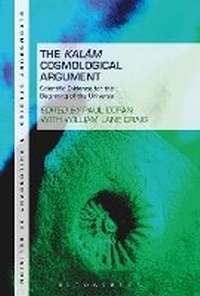
The Kalam Cosmological Argument, Volume 2
Scientific Evidence for the Beginning of the Universe
Published on 16. November 2017
Book
Hardback
376 pages
978-1-5013-3587-7 (ISBN)
Description
The ancient kalam cosmological argument maintains that the series of past events is finite and that therefore the universe began to exist. Two recent scientific discoveries have yielded plausible prima facie physical evidence for the beginning of the universe. The expansion of the universe points to its beginning-to a Big Bang-as one retraces the universe's expansion in time. And the second law of thermodynamics, which implies that the universe's energy is progressively degrading, suggests that the universe began with an initial low entropy condition.
The kalam cosmological argument-perhaps the most discussed philosophical argument for God's existence in recent decades-maintains that whatever begins to exist must have a cause. And since the universe began to exist, there must be a transcendent cause of its beginning, a conclusion which is confirmatory of theism. So this medieval argument for the finitude of the past has received fresh wind in its sails from recent scientific discoveries.
This collection reviews and assesses the merits of the latest scientific evidences for the universe's beginning. It ends with the kalam argument's conclusion that the universe has a cause-a personal cause with properties of theological significance.
The kalam cosmological argument-perhaps the most discussed philosophical argument for God's existence in recent decades-maintains that whatever begins to exist must have a cause. And since the universe began to exist, there must be a transcendent cause of its beginning, a conclusion which is confirmatory of theism. So this medieval argument for the finitude of the past has received fresh wind in its sails from recent scientific discoveries.
This collection reviews and assesses the merits of the latest scientific evidences for the universe's beginning. It ends with the kalam argument's conclusion that the universe has a cause-a personal cause with properties of theological significance.
Reviews / Votes
The two volumes of Copan's The Kalam Cosmological Argument, without a doubt, constitute an excellent collection of essays that for years to come will be the place to start for those interested in a profound analysis of the problems and merits of the Kalam cosmological argument. * Reading Religion * A universe which burst into existence must have a Creator-so says the ancient Argument. It sets the scene for these fascinating, expert writings about the Big Bang and its magnificent consequences. * John Leslie, Fellow of the Royal Society of Canada and author of Universes * To a cosmologist, the interesting thing about the beginning of the universe is that no one ordered it. No one tried to make a universe with a beginning, and yet time and again, while seeking to describe our universe, scientists found a cosmic beginning in their models. This volume wrestles with the implications of cosmological theories-the interaction between Craig and Pitt alone is worth the price of admission, as is Vilenkin's commentary on the state of the universe. Highly recommended. * Luke Barnes, Postdoctoral Researcher at the Sydney Institute for Astronomy, University of Sydney, Australia *More details
Series
Language
English
Place of publication
New York
United States
Publishing group
Bloomsbury Publishing Plc
Target group
College/higher education
Dimensions
Height: 229 mm
Width: 152 mm
Weight
671 gr
ISBN-13
978-1-5013-3587-7 (9781501335877)
Copyright in bibliographic data and cover images is held by Nielsen Book Services Limited or by the publishers or by their respective licensors: all rights reserved.
Schweitzer Classification
Other editions
Additional editions
Paul Copan | William Lane Craig
The Kalam Cosmological Argument, Volume 2
Scientific Evidence for the Beginning of the Universe
E-Book
11/2017
1st Edition
Bloomsbury Academic USA
€39.49
Available for download
Persons
William Lane Craig is a Professor of Philosophy at Talbot School of Theology and at Houston Baptist University, USA. He has authored or edited over forty books, including Theism, Atheism, and Big Bang Cosmology (1995), God, Time, and Eternity (2001); and God Over All (2016), as well as over 150 articles in journals such as The Journal of Philosophy, American Philosophical Quarterly, Philosophical Studies, Philosophy, and British Journal for Philosophy of Science.
Paul Copan is the Pledger Family Chair of Philosophy and Ethics at Palm Beach Atlantic University, USA. His past publications include Creation Out of Nothing: A Biblical, Philosophical, and Scientific Exploration (with William Lane Craig; 2004), The Rationality of Theism (co-edited with with Paul K. Moser; 2003), The Routledge Companion to Philosophy of Religion (co-edited with Chad V. Meister; 2007; 2nd ed. 2012) and Philosophy of Religion: Classic and Contemporary Issues (co-edited with Chad V. Meister; 2007). He has authored and edited several other books and contributed essays and written reviews for journals such as The Review of Metaphysics, Faith and Philosophy, Philosophia Christi, and Trinity Journal.
Paul Copan is the Pledger Family Chair of Philosophy and Ethics at Palm Beach Atlantic University, USA. His past publications include Creation Out of Nothing: A Biblical, Philosophical, and Scientific Exploration (with William Lane Craig; 2004), The Rationality of Theism (co-edited with with Paul K. Moser; 2003), The Routledge Companion to Philosophy of Religion (co-edited with Chad V. Meister; 2007; 2nd ed. 2012) and Philosophy of Religion: Classic and Contemporary Issues (co-edited with Chad V. Meister; 2007). He has authored and edited several other books and contributed essays and written reviews for journals such as The Review of Metaphysics, Faith and Philosophy, Philosophia Christi, and Trinity Journal.
Content
Acknowledgments
Foreword
Introduction
Paul Copan (Palm Beach Atlantic University, USA)
Inductive Arguments
2.3 The Inductive Argument based on Expansion of the Universe
1. The Kalam Cosmological Argument
William Lane Craig (Talbot School of Theology, USA) and James Sinclair (Warfare Analyst, USA)
2. Why the Big Bang Singularity Does Not Help the Kalam Cosmological Argument for Theism
J. Brian Pitts (University of Notre Dame, USA)
3. On Non-Singular Spacetimes and the Beginning of the Universe
William Lane Craig (Talbot School of Theology, USA) and James Sinclair (Warfare Analyst, USA)
4. The Beginning of the Universe
Alexander Vilenkin (Tufts Institute of Cosmology, USA)
2.4 The Inductive Argument based on Thermodynamic Properties of the Universe
5. A Dying Universe: The Long-Term Fate and Evolution of Astrophysical Objects
Fred C. Adams (University of Delaware, USA) and Gregory Laughlin (University of California, Santa Cruz, USA)
6. Heat Death in Ancient and Modern Thermodynamics
Gabor Kutrovatz (Eoetvoes Lorand University, Hungary)
7. Entropy and Eschatology: A Comment on Kutrovatz's Paper "Heat Death in Ancient and Modern Thermodynamics"
Milan M. Cirkovic (University of Novi Sad, Serbia)
8. The Generalized Second Law Implies a Quantum Singularity Theorem
Aron C. Wall (Institute for Advanced Study, USA)
Part 3. Therefore, the Universe has a Cause
9. Libertarian Agency and the Craig/Gruenbaum Debate about Theistic Explanation of the Initial Singularity
J. P. Moreland (Talbot School of Theology, USA)
10. Causation and the Logical Impossibility of a Divine Cause
Quentin Smith (Western Michigan University, USA)
11. Beyond the Big Bang
William Lane Craig (Talbot School of Theology, USA)
Permissions
Index
Foreword
Introduction
Paul Copan (Palm Beach Atlantic University, USA)
Inductive Arguments
2.3 The Inductive Argument based on Expansion of the Universe
1. The Kalam Cosmological Argument
William Lane Craig (Talbot School of Theology, USA) and James Sinclair (Warfare Analyst, USA)
2. Why the Big Bang Singularity Does Not Help the Kalam Cosmological Argument for Theism
J. Brian Pitts (University of Notre Dame, USA)
3. On Non-Singular Spacetimes and the Beginning of the Universe
William Lane Craig (Talbot School of Theology, USA) and James Sinclair (Warfare Analyst, USA)
4. The Beginning of the Universe
Alexander Vilenkin (Tufts Institute of Cosmology, USA)
2.4 The Inductive Argument based on Thermodynamic Properties of the Universe
5. A Dying Universe: The Long-Term Fate and Evolution of Astrophysical Objects
Fred C. Adams (University of Delaware, USA) and Gregory Laughlin (University of California, Santa Cruz, USA)
6. Heat Death in Ancient and Modern Thermodynamics
Gabor Kutrovatz (Eoetvoes Lorand University, Hungary)
7. Entropy and Eschatology: A Comment on Kutrovatz's Paper "Heat Death in Ancient and Modern Thermodynamics"
Milan M. Cirkovic (University of Novi Sad, Serbia)
8. The Generalized Second Law Implies a Quantum Singularity Theorem
Aron C. Wall (Institute for Advanced Study, USA)
Part 3. Therefore, the Universe has a Cause
9. Libertarian Agency and the Craig/Gruenbaum Debate about Theistic Explanation of the Initial Singularity
J. P. Moreland (Talbot School of Theology, USA)
10. Causation and the Logical Impossibility of a Divine Cause
Quentin Smith (Western Michigan University, USA)
11. Beyond the Big Bang
William Lane Craig (Talbot School of Theology, USA)
Permissions
Index