

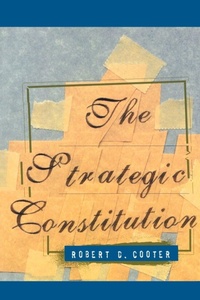
The Strategic Constitution
The Strategic Constitution
Will be published approx. on 7. April 2002
Book
Paperback/Softback
440 pages
978-0-691-09620-9 (ISBN)
Description
Making, amending, and interpreting constitutions is a political game that can yield widespread suffering or secure a nation's liberty and prosperity. Given these high stakes, Robert Cooter argues that constitutional theory should trouble itself less with literary analysis and arguments over founders' intentions and focus much more on the real-world consequences of various constitutional provisions and choices. Pooling the best available theories from economics and political science, particularly those developed from game theory, Cooter's economic analysis of constitutions fundamentally recasts a field of growing interest and dramatic international importance. By uncovering the constitutional incentives that influence citizens, politicians, administrators, and judges, Cooter exposes fault lines in alternative forms of democracy: unitary versus federal states, deep administration versus many elections, parliamentary versus presidential systems, unicameral versus bicameral legislatures, common versus civil law, and liberty versus equality rights. Cooter applies an efficiency test to these alternatives, asking how far they satisfy the preferences of citizens for laws and public goods.
To answer Cooter contrasts two types of democracy, which he defines as competitive government. The center of the political spectrum defeats the extremes in "median democracy," whereas representatives of all the citizens bargain over laws and public goods in "bargain democracy." Bargaining can realize all the gains from political trades, or bargaining can collapse into an unstable contest of redistribution. States plagued by instability and contests over redistribution should move towards median democracy by increasing transaction costs and reducing the power of the extremes. Specifically, promoting median versus bargain democracy involves promoting winner-take-all elections versus proportional representation, two parties versus multiple parties, referenda versus representative democracy, and special governments versus comprehensive governments. This innovative theory will have ramifications felt across national and disciplinary borders, and will be debated by a large audience, including the growing pool of economists interested in how law and politics shape economic policy, political scientists using game theory or specializing in constitutional law, and academic lawyers.
The approach will also garner attention from students of political science, law, and economics, as well as policy makers working in and with new democracies where constitutions are being written and refined.
To answer Cooter contrasts two types of democracy, which he defines as competitive government. The center of the political spectrum defeats the extremes in "median democracy," whereas representatives of all the citizens bargain over laws and public goods in "bargain democracy." Bargaining can realize all the gains from political trades, or bargaining can collapse into an unstable contest of redistribution. States plagued by instability and contests over redistribution should move towards median democracy by increasing transaction costs and reducing the power of the extremes. Specifically, promoting median versus bargain democracy involves promoting winner-take-all elections versus proportional representation, two parties versus multiple parties, referenda versus representative democracy, and special governments versus comprehensive governments. This innovative theory will have ramifications felt across national and disciplinary borders, and will be debated by a large audience, including the growing pool of economists interested in how law and politics shape economic policy, political scientists using game theory or specializing in constitutional law, and academic lawyers.
The approach will also garner attention from students of political science, law, and economics, as well as policy makers working in and with new democracies where constitutions are being written and refined.
Reviews / Votes
"For anyone looking for a textbook that provides a systematic introduction to the economic analysis of constitutional law in an accessible manner while covering a wide range of topics, it would ... be hard to find a more suitable book... [It] will encourage students to think about constitutional analysis from a new perspective in an engaging way."--Georg Vanberg, Law and Politics Book Review "Cooter has written a very useful book... It is important to identify the general principles--the engineering principles if you like--that underlie the structure of effective constitutions. And that is just what the author has done."--Michael C. Munger, Regulation "A clear and comprehensive introduction to modern work in political economy and rational choice as it applies to the strategic analysis of government structure. The book blends normative and positive concerns in an enlightening way... The book has an admirable emphasis on constitutional structure and on the strategic opportunities created by alternative ways of organizing government."--Susan Rose-Ackerman, Political Science Quarterly "The Strategic Constitution comprehensively analyzes constitutional issues. The result is impressive. Scholars seeking a stronger grasp of constitutional issues, and teachers seeking an economically sound theoretical foundation for teaching constitutional law, will find this book quite useful."--Donald J. Boudreaux, American Law and Economics "A tour de force through a large number of fields of economic theory, ranging from social choice to fiscal federalism, written by one of the most distinguished fellows of the law-and-economics branch of professionalism."--Journal of Economics "Robert D. Cooter has written a marvelous book. The Strategic Constitution is truly a tour de force, applying economic analysis to virtually the full range of constitutional issues that arise in a democracy and doing so in a way that is both engaging and sprinkled with humor... The book deserves to be standard reading for those with a serious interest in the fit between constitutions and democratic values."--Stephen Brooks, DemocratizationMore details
Language
English
Place of publication
New Jersey
United States
Target group
Professional and scholarly
College/higher education
Product notice
Paperback (trade)
Illustrations
21 tables, 63 line illus.
Dimensions
Height: 234 mm
Width: 156 mm
Thickness: 24 mm
Weight
658 gr
ISBN-13
978-0-691-09620-9 (9780691096209)
Copyright in bibliographic data and cover images is held by Nielsen Book Services Limited or by the publishers or by their respective licensors: all rights reserved.
Schweitzer Classification
Other editions
Additional editions
Robert D. Cooter
The Strategic Constitution
E-Book
08/2020
1st Edition
Princeton University Press
€73.49
Available for download
Person
Robert D. Cooter is Herman F. Selvin Professor of Law at Boalt Hall, University of California, Berkeley. He is past president of the American Law and Economics Association and has published extensively in both fields. He is coauthor, with Thomas Ulen, of the widely translated textbook, Law and Economics.
Content
DETAILED CONTENTS ix LIST OF ILLUSTRATIONS xv LIST OF TABLES xvii PREFACE AND ACKNOWLEDGMENTS xix CHAPTER 1. Taking Consequences Seriously: Introduction 1 PART I: PROCESSES OF GOVERNMENT: VOTING, BARGAINING, ADMINISTERING 15 CHAPTER 2. Voting 17 CHAPTER 3. Bargaimng 51 CHAPTER 4. Administering 79 PART II: THE OPTIMAL NUMBER OF GOVERNMENTS 101 CHAPTER 5. Intergovernmental Relations CHAPTER 6. Government Competition 127 CHAPTER 7. Ministries and Agencies PART III: OPTIMAL DIVISION OF POWERS CHAPTER 8. Specialization 173 CHAPTER 9. Separation of Powers 211 PART IV: OPTIMAL RIGHTS 241 CHAPTER 10. The Value of Rights 243 CHAPTER 11. Philosophies of Rights: Liberty and Redistribution 261 CHAPTER 12. Property Rights 279 CHAPTER 13. Free Speech 309 CHAPTER 14. Civil Rights 333 CHAPTER 15. Summary and Conclusion 359 BIBLIOGRAPHY 381 GENERAL INDEX 399 INDEX OF NAMES 409