

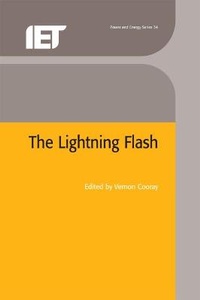
The Lightning Flash
Published on 15. November 2003
Book
Hardback
598 pages
978-0-85296-780-5 (ISBN)
Description
This unique book provides the reader with a thorough background in almost every aspect of lightning and its impact on electrical and electronic equipment. The contents range from basic discharge processes in air through transient electromagnetic field generation and interaction with overhead lines and underground cables, to lightning protection and testing techniques. This book is of value to anyone designing, installing or commissioning equipment which needs to be secured against lightning strikes, as well as being a sound introduction to research students working in the field.
Reviews / Votes
'this is a good technical book on electrical discharges and lightning mechanisms. Teachers in power engineering would find this book a useful addition to a power engineering course. Students and those interested in lightning and gaseous breakdown will find this book very easy to read and well worth the price of the book.' -- John J. Shea * Electrical Insulation Magazine *More details
Series
Language
English
Place of publication
Stevenage
United Kingdom
Target group
College/higher education
Professional and scholarly
Dimensions
Height: 234 mm
Width: 156 mm
ISBN-13
978-0-85296-780-5 (9780852967805)
Copyright in bibliographic data and cover images is held by Nielsen Book Services Limited or by the publishers or by their respective licensors: all rights reserved.
Schweitzer Classification
Other editions
New editions
Vernon Cooray
The Lightning Flash
Book
01/2014
2nd Edition
Institution of Engineering and Technology
€225.50
Shipment within 3-4 weeks
Additional editions
Vernon Cooray
The Lightning Flash
E-Book
01/2009
1st Edition
Institution of Engineering and Technology
€168.89
Available for download
Person
Vernon Cooray is Full Professor in Electricity at the Division for Electricity and Lightning Research, The Angstroem Laboratory, Uppsala University, and is responsible for postgraduate studies in the field of Atmospheric Electrical Discharges. Professor Cooray is the Swedish member of CIGRE-WG33.01 (lightning location), CIGRE-WG33.02 (interaction of electromagnetic fields with power lines) and CIGREWG33.04 (soil ionisation) and is the chairman of the CIGRE-WG33.03 (lightning interception). He is also a member of the scientific committee of the International Conference on Lightning Protection. Professor Cooray has conducted experimental and theoretical research work in electromagntic compatibility, electromagnetic wave propagation, lightning physics, lightning protection and discharge physics, has authored and coauthored more than 150 scientific papers, and is the author of a popular book in Swedish (Blixt ock Aska - Sa fungerar naturens fyrverkeri, Hallgren & Fallgren) on lightning.
Content
Chapter 1: Charge structure and geographical variation of thunderclouds
Chapter 2: Thunderstorm electrification mechanisms
Chapter 3: Mechanism of electrical discharges
Chapter 4: The mechanism of the lightning flash
Chapter 5: Computation of electromagnetic fields from lightning discharge
Chapter 6: Mathematical modelling of return strokes
Chapter 7: The effects of propagation on electric radiation fields
Chapter 8: Interaction of electromagnetic fields generated by lightning with overhead electrical networks
Chapter 9: Lightning and EMC
Chapter 10: Principles of protection of structures against lightning
Chapter 11: Electrical aspects of lightning strike to humans
Chapter 2: Thunderstorm electrification mechanisms
Chapter 3: Mechanism of electrical discharges
Chapter 4: The mechanism of the lightning flash
Chapter 5: Computation of electromagnetic fields from lightning discharge
Chapter 6: Mathematical modelling of return strokes
Chapter 7: The effects of propagation on electric radiation fields
Chapter 8: Interaction of electromagnetic fields generated by lightning with overhead electrical networks
Chapter 9: Lightning and EMC
Chapter 10: Principles of protection of structures against lightning
Chapter 11: Electrical aspects of lightning strike to humans