

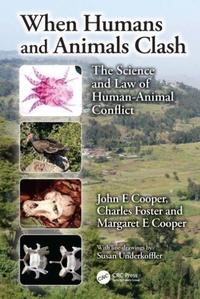
When Humans and Animals Clash
The Science and Law of Human-Animal Conflict
1st Edition
Will be published approx. on 1. December 2026
Book
Paperback/Softback
432 pages
978-0-367-55057-8 (ISBN)
Description
When humans and animals clash there is often massive physical, economic, political and sociological damage. And they increasingly do - as a result of creeping urbanisation, agriculture, climate change, war, political turbulence and economic migration.
Since the causes of human-animal conflict are complex and multifactorial, any attempt to understand and mitigate it must be holistic and multidisciplinary. When Humans and Animals Clash: The Science and Law of Human-Animal Conflict is just that - a compendium of advice about how to identify the culprits, allocate blame and avoid wrongful allegations, address the causes, assess compensation and consider other forms of reparation, make legal and ethical judgments, and formulate policy. It draws on hard-won experience in many geographical and conceptual domains, including veterinary medicine and human medicine and pathology, law, and moral philosophy. It is bracingly practical, yet never loses sight of the big picture. This is the most comprehensive guide for all those confronted by human-animal conflict - practitioners of veterinary and human medicine, policy-makers, wildlife rangers, administrators and farmers.
There is a vast, sprawling, fast-spawning literature on human-animal conflict: here it all is, distilled.
Since the causes of human-animal conflict are complex and multifactorial, any attempt to understand and mitigate it must be holistic and multidisciplinary. When Humans and Animals Clash: The Science and Law of Human-Animal Conflict is just that - a compendium of advice about how to identify the culprits, allocate blame and avoid wrongful allegations, address the causes, assess compensation and consider other forms of reparation, make legal and ethical judgments, and formulate policy. It draws on hard-won experience in many geographical and conceptual domains, including veterinary medicine and human medicine and pathology, law, and moral philosophy. It is bracingly practical, yet never loses sight of the big picture. This is the most comprehensive guide for all those confronted by human-animal conflict - practitioners of veterinary and human medicine, policy-makers, wildlife rangers, administrators and farmers.
There is a vast, sprawling, fast-spawning literature on human-animal conflict: here it all is, distilled.
More details
Language
English
Place of publication
London
United Kingdom
Publishing group
Taylor & Francis Ltd
Target group
Professional and scholarly
Academic and Professional Reference
Illustrations
229 farbige Abbildungen, 19 s/w Photographien bzw. Rasterbilder, 229 Farbfotos bzw. farbige Rasterbilder, 1 s/w Zeichnung, 15 s/w Tabellen, 20 s/w Abbildungen
15 Tables, black and white; 1 Line drawings, black and white; 229 Halftones, color; 19 Halftones, black and white; 229 Illustrations, color; 20 Illustrations, black and white
Dimensions
Height: 254 mm
Width: 178 mm
Weight
453 gr
ISBN-13
978-0-367-55057-8 (9780367550578)
Copyright in bibliographic data and cover images is held by Nielsen Book Services Limited or by the publishers or by their respective licensors: all rights reserved.
Schweitzer Classification
Other editions
Additional editions
John E. Cooper | Charles Foster | Margaret E. Cooper
When Humans and Animals Clash
The Science and Law of Human-Animal Conflict
Book
approx. 12/2026
1st Edition
CRC Press
€247.50
Not yet published
Persons
Professor John E Cooper, who has had a lifelong interest in natural history, trained as a veterinary surgeon (veterinarian) and is now a British and European Specialist in Veterinary Pathology and Diplomate of the European College of Zoological Medicine, working with wildlife and exotic species. He and his wife have spent approximately twenty years living overseas, mainly in Africa and the West Indies. He is the author or co-author of many scientific papers on comparative medicine and tropical diseases and of several books, including Wildlife Forensic Investigation: Principles and Practice (Taylor & Francis, 2013) and Gorilla Pathology and Health, With a Catalogue of Preserved Materials (Academic Press, Elsevier, 2017).
Professor Charles Foster is a Fellow of Exeter College, Oxford, a member of the Law Faculty at the University of Oxford, a practising barrister and a qualified veterinary surgeon. He read veterinary medicine and law at the University of Cambridge and worked on the chemical immobilisation of gazelles and (with John Cooper) the comparative anatomy of the Himalayan hispid hare. His PhD in medical law and ethics is from the University of Cambridge. As a barrister he has been involved in many of the leading cases in medical law. His books include the New York Times Bestseller Being a Beast (2016) (which won the IgNobel Prize for Biology), Being a Human (2021), The Screaming Sky (2021), Cry of the Wild (2023) and The Edges of the World (2026). A complete list of publications is at www.charlesfoster.co.uk
Mrs Margaret E Cooper is a British solicitor (not in private practice). She has taught and published on animal and conservation law and, with her husband, continues to promote an interdisciplinary approach to veterinary education, wildlife conservation and forensic science, both in the UK and overseas. In 2019 she was elected as an Honorary Fellow of both The Faculty of Forensic & Legal Medicine (FFLM) of The Royal College of Physicians and the Royal College of Pathologists for her contributions to forensic medicine and overseas training respectively.
Professor Charles Foster is a Fellow of Exeter College, Oxford, a member of the Law Faculty at the University of Oxford, a practising barrister and a qualified veterinary surgeon. He read veterinary medicine and law at the University of Cambridge and worked on the chemical immobilisation of gazelles and (with John Cooper) the comparative anatomy of the Himalayan hispid hare. His PhD in medical law and ethics is from the University of Cambridge. As a barrister he has been involved in many of the leading cases in medical law. His books include the New York Times Bestseller Being a Beast (2016) (which won the IgNobel Prize for Biology), Being a Human (2021), The Screaming Sky (2021), Cry of the Wild (2023) and The Edges of the World (2026). A complete list of publications is at www.charlesfoster.co.uk
Mrs Margaret E Cooper is a British solicitor (not in private practice). She has taught and published on animal and conservation law and, with her husband, continues to promote an interdisciplinary approach to veterinary education, wildlife conservation and forensic science, both in the UK and overseas. In 2019 she was elected as an Honorary Fellow of both The Faculty of Forensic & Legal Medicine (FFLM) of The Royal College of Physicians and the Royal College of Pathologists for her contributions to forensic medicine and overseas training respectively.
Content
Part 1: When animals cause personal injury or damage
Chapter 1. Background and history
Chapter 2. Why do animal-associated incidents occur?
Chapter 3. Types of injury - general
Chapter 4. Types of injury - species-specific
Chapter 5. Zoonoses and other infections
Chapter 6. Damage to property and economic interests
Chapter 7. Investigation of alleged human-animal conflict
incidents
Chapter 8. Prevention and mitigation:
Section A. Stopping the underlying causes of conflict.
Section B. Stopping a problem from occurring.
Section C. Stopping or reducing the severity of the problem once it has occurred.
Section D. What to do in the aftermath of an incident.
Part 2: Legal and ethical issues
Chapter 9. Law and ethics pertaining to animal-associated injury or damage
Chapter 1. Background and history
Chapter 2. Why do animal-associated incidents occur?
Chapter 3. Types of injury - general
Chapter 4. Types of injury - species-specific
Chapter 5. Zoonoses and other infections
Chapter 6. Damage to property and economic interests
Chapter 7. Investigation of alleged human-animal conflict
incidents
Chapter 8. Prevention and mitigation:
Section A. Stopping the underlying causes of conflict.
Section B. Stopping a problem from occurring.
Section C. Stopping or reducing the severity of the problem once it has occurred.
Section D. What to do in the aftermath of an incident.
Part 2: Legal and ethical issues
Chapter 9. Law and ethics pertaining to animal-associated injury or damage