

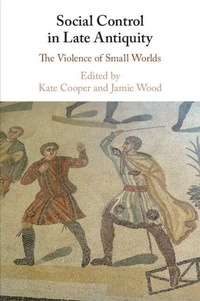
Social Control in Late Antiquity
The Violence of Small Worlds
Published on 10. March 2022
Book
Paperback/Softback
396 pages
978-1-108-74269-6 (ISBN)
Description
Social Control in Late Antiquity: The Violence of Small Worlds explores the small-scale communities of late antiquity - households, monasteries, and schools - where power was a question of personal relationships. When fathers, husbands, teachers, abbots, and slave-owners asserted their own will, they saw themselves as maintaining the social order, and expected law and government to reinforce their rule. Naturally, the members of these communities had their own ideas, and teaching them to 'obey their betters' was not always a straightforward business. Drawing on a wide variety of sources from across the late Roman Mediterranean, from law codes and inscriptions to monastic rules and hagiography, the book considers the sometimes conflicting identities of women, slaves, and children, and documents how they found opportunities for agency and recognition within a system built on the unremitting assertion of the rights of the powerful.
Reviews / Votes
'... scholars with a robust background in late antiquity, early Christian monasticism, Church fathers, inter alia, will find much to appreciate in its pages.' Sarah Rollens, Bryn Mawr Classical Review 'Social Control in Late Antiquity offers a number of truly excellent and thought-provoking contributions to the still highly relevant project of studying the role of power relations in the formation of early Christian identity and institutions.' Kristina Sessa, Journal of Early Christian Studies '[The book] is rich in content and covers an impressive variety of late antique authors and writings; the volume offers nuanced perspectives on violence and engages the modern sociological concepts of Pierre Bourdieu and Michel Foucault. Fascinating to read are not only the discussions of lesser-known late antique writings but also the alternative perspectives on well-known Christian authors and their texts. With its broad range of topics related to the 'violence of small worlds', this book is highly relevant and warmly recommended for anyone interested in historical, sociological, educational, Christian-theological, and literary studies of late antiquity.' Christina M. Kreinecke, AugustinianaMore details
Language
English
Place of publication
Cambridge
United Kingdom
Target group
Professional and scholarly
Edition type
New edition
Product notice
Paperback (trade)
Illustrations
Worked examples or Exercises
Dimensions
Height: 229 mm
Width: 152 mm
Thickness: 21 mm
Weight
526 gr
ISBN-13
978-1-108-74269-6 (9781108742696)
Copyright in bibliographic data and cover images is held by Nielsen Book Services Limited or by the publishers or by their respective licensors: all rights reserved.
Schweitzer Classification
Other editions
Additional editions
Book
10/2020
Cambridge University Press
€166.50
Shipment within 15-20 days
Persons
Content
Introduction. The violence of small worlds: re-thinking small-scale social control in late antiquity Kate Cooper and Jamie Wood; Part I. Women and Children First: Autonomy, Social Control, and Social Reproduction in the Late Ancient Household: 1. Female crime and female confinement in late antiquity Julia Hillner; 2. Holy beatings: Emmelia, her son Gregory of Nyssa, and the Forty Martyrs of Sebasteia Vasiliki Limberis; 3. Power, faith, and reciprocity in a slave society: domestic relationships in the preaching of John Chrysostom Jonathan Tallon; 4. A predator and a gentleman: Augustine, autobiography, and the ethics of Christian marriage Kate Cooper; Part II. 'Slaves, Be Subject to your Masters': Discipline, Reciprocity, and Moral Autonomy in a Slave Society: 5. Modelling msarrquta: humiliation, Christian monasticism, and the ascetic life of slavery in late antique Syria and Mesopotamia Chris L. de Wet; 6. Constructing complexity: slavery in the small worlds of early monasticism Lillian Larsen; 7. Disciplining the slaves of god: monastic children in Egypt at the end of antiquity Maria Chiara Giorda; Part III. Knowledge, Power, and Symbolic Violence: The Aesthetics of Control in Christian Pedagogy: 8. John Chrysostom and the strategic use of fear Blake Leyerle; 9. The fear of belonging: the violent training of elite males in the late fourth century Jamie Wood; 10. Words at war: textual violence in Eusebius of Caesarea Aaron Johnson; 11. Of sojourners and soldiers: demonic violence in the letters of Antony and the life of Antony Blossom Stefaniw; 12. Coercing the catechists: Augustine's De Catechizandis rudibus Melissa Markauskas; Part IV. Vulnerability and Power: Christian Heroines and the Small Worlds of Late Antiquity: 13. Reading Thecla in fourth-century Pontus: violence, virginity, and female autonomy in Gregory of Nyssa's Life of Macrina James Corke-Webster; 14. Family heroines: female vulnerability in the writings of Ambrose of Milan David Natal; 15. Women on the edge: violence, 'othering', and the limits of imperial power in Euphemia and the Goth Thomas Dimambro.