

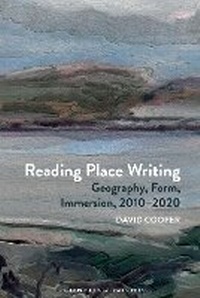
Reading Place Writing
Geography, Form, Immersion, 2010-2020
Will be published approx. on 11. September 2026
Book
Hardback
272 pages
978-1-80596-981-5 (ISBN)
Description
Ebook available to libraries exclusively as part of the JSTOR Path to Open intiative.
Creative nonfictional writing about place became increasingly prominent in British and Irish literary culture during the 2010s. More particularly, a wide range of writers, exploring a diverse range of landscapes, focused on the local and the everyday in examining 'the undiscovered country of the nearby' (Robert Macfarlane). This literary geographical monograph is the first book-length study of such works of place writing and offers detailed readings of key texts by, amongst others, Elizabeth-Jane Burnett, Rachel Lichtenstein, Amy Liptrot, Iain Sinclair, Richard Skelton, and Jean Sprackland. Many of these place writing books have been described as immersive works of literature; but, to date, the precise meaning of that term has remained unexamined. How, then, do a range of creative nonfictional texts from the 2010s function as works of immersive place writing? By extension, how do such creative nonfictional texts - rooted, as they are, in the articulation of actual geographical experience - complicate the understanding of what it means for a reader to be imaginatively immersed in a literary work? Reading Place Writing explores these critical questions through an interdisciplinary enlacing of geographical thought, cognitive linguistics, narrative theory, and a series of creative-critical interventions.
Creative nonfictional writing about place became increasingly prominent in British and Irish literary culture during the 2010s. More particularly, a wide range of writers, exploring a diverse range of landscapes, focused on the local and the everyday in examining 'the undiscovered country of the nearby' (Robert Macfarlane). This literary geographical monograph is the first book-length study of such works of place writing and offers detailed readings of key texts by, amongst others, Elizabeth-Jane Burnett, Rachel Lichtenstein, Amy Liptrot, Iain Sinclair, Richard Skelton, and Jean Sprackland. Many of these place writing books have been described as immersive works of literature; but, to date, the precise meaning of that term has remained unexamined. How, then, do a range of creative nonfictional texts from the 2010s function as works of immersive place writing? By extension, how do such creative nonfictional texts - rooted, as they are, in the articulation of actual geographical experience - complicate the understanding of what it means for a reader to be imaginatively immersed in a literary work? Reading Place Writing explores these critical questions through an interdisciplinary enlacing of geographical thought, cognitive linguistics, narrative theory, and a series of creative-critical interventions.
Reviews / Votes
'With its eclectic selection of primary texts, confident interdisciplinarity and innovative narrative scholarship, David Cooper's monograph contributes substantially to what is understood by the term "place writing". Cooper uncovers an almost alchemical interplay between the places of the text and the places of the reader, and in doing so brilliantly illuminates how rich, resonant and crucial to our time the experience of reading place writing can be.' Pippa Marland, University of Bristol 'David Cooper's monograph offers a theoretically rich and well-informed account of contemporary "place writing". He clearly designates its defining characteristics - localised, experiential, immersive - and surveys a wide array of material that testifies to its range and heterogeneity in the UK and Ireland today. The incisive conclusions offered will be of interest to literary critics and cultural geographers alike.' Daniel Weston, University of GreenwichMore details
Series
Language
English
Place of publication
Liverpool
United Kingdom
Target group
College/higher education
Professional and scholarly
Illustrations
4 Illustrations, black and white
Dimensions
Height: 239 mm
Width: 163 mm
ISBN-13
978-1-80596-981-5 (9781805969815)
Copyright in bibliographic data and cover images is held by Nielsen Book Services Limited or by the publishers or by their respective licensors: all rights reserved.
Schweitzer Classification
Person
David Cooper is Senior Lecturer in English at Manchester Metropolitan University where he is the founding co-director of the Centre for Place Writing.
Content
Prologue: Reading as a Spatial Event I: Silverdale, Morecambe Bay
Introduction
Reading as a Spatial Event II: Oxford Road, Manchester
Immersion: Reading, Writing, and Thinking
Reading as a Spatial Event III: Adlington-Blackrod-Horwich Parkway
Noticing: Diaries, Rhythms, and the Fieldwork of Everyday Life
Reading as a Spatial Event IV: Grasmere
Mapping: Practices, Bodies, and Depths
Reading as a Spatial Event V: Manchester-Munich-Tokyo
Researching: Histories, Archives, and Voices
Reading as a Spatial Event VI: University of East Anglia, Norwich
Connecting: Scepticism, Smartphones, and Digital Re-Enchantment
Reading as a Spatial Event VII: Putney Bridge, London
Remembering: Memory, Nostalgia, and the Ongoing Present
Reading as a Spatial Event VIII: Woolton, Liverpool
Coda
Epilogue: Reading as a Spatial Event IX: Silverdale, Morecambe Bay
Introduction
Reading as a Spatial Event II: Oxford Road, Manchester
Immersion: Reading, Writing, and Thinking
Reading as a Spatial Event III: Adlington-Blackrod-Horwich Parkway
Noticing: Diaries, Rhythms, and the Fieldwork of Everyday Life
Reading as a Spatial Event IV: Grasmere
Mapping: Practices, Bodies, and Depths
Reading as a Spatial Event V: Manchester-Munich-Tokyo
Researching: Histories, Archives, and Voices
Reading as a Spatial Event VI: University of East Anglia, Norwich
Connecting: Scepticism, Smartphones, and Digital Re-Enchantment
Reading as a Spatial Event VII: Putney Bridge, London
Remembering: Memory, Nostalgia, and the Ongoing Present
Reading as a Spatial Event VIII: Woolton, Liverpool
Coda
Epilogue: Reading as a Spatial Event IX: Silverdale, Morecambe Bay