

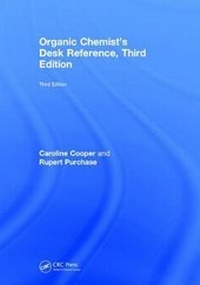
Organic Chemist's Desk Reference, Third Edition
3rd Edition
Published on 22. August 2017
Book
Hardback
296 pages
978-1-138-06795-0 (ISBN)
Description
Launched in 1995 as a companion to the Dictionary of Organic Compounds, the Organic Chemist's Desk Reference has been essential reading for laboratory chemists who need a succinct guide to the `nuts and bolts' of organic chemistry - the literature, nomenclature, stereochemistry, spectroscopy, hazard information, and laboratory data. This third edition reflects changes in the dissemination of chemical information, revisions to chemical nomenclature, and the adoption of new techniques in NMR spectroscopy, which have taken place since publication of the last edition in 2011. Organic chemistry embraces many other disciplines - from material sciences to molecular biology - whose practitioners will benefit from the comprehensive but concise information brought together in this book. Extensively revised and updated, this new edition contains the very latest data that chemists need access to for experimentation and research.
Reviews / Votes
Reviews of the Second Edition:"The Organic Chemist's Desk Reference, under the editorship of Caroline Cooper, is a resource that academics and researchers in organic chemistry will find extremely useful in their line of work, be it in class or laboratory."
- Tevita Voro, in The Higher Education Academy, UK Physical Sciences Centre, Reviews, July 2011, No. 22, Vol 12
"This book is a collection of very valuable information that is routinely used. ... this is an excellent collection of material that would be a worthy addition to any organic chemistry lab."
- Paul E. Floreancig, Journal of Medical Chemistry
"Summing Up: Highly recommended. Academic and professional audiences, all levels."
- G. A. Slough, Kalamazoo College, CHOICE, February 2012, Vol 9, No. 6
More details
Edition
3rd New edition
Language
English
Place of publication
London
United Kingdom
Publishing group
Taylor & Francis Ltd
Target group
Professional and scholarly
Edition type
New edition
Illustrations
96 s/w Tabellen
2 equations; 96 Tables, black and white
Dimensions
Height: 254 mm
Width: 178 mm
ISBN-13
978-1-138-06795-0 (9781138067950)
Copyright in bibliographic data and cover images is held by Nielsen Book Services Limited or by the publishers or by their respective licensors: all rights reserved.
Schweitzer Classification
Other editions
Additional editions
Caroline Cooper | Rupert Purchase
Organic Chemist's Desk Reference
Book
12/2018
3rd Edition
CRC Press
€275.29
Shipment within 10-20 days
Caroline Cooper | Rupert Purchase
Organic Chemist's Desk Reference
Book
08/2017
3rd Edition
CRC Press
€131.40
Shipment within 15-20 days
Caroline Cooper | Rupert Purchase
Organic Chemist's Desk Reference
E-Book
08/2017
3rd Edition
CRC Press
€125.99
Available for download
Persons
Content
The Organic Chemistry Literature
Abstracting and Other Current Awareness Services
Principal Electronic Dictionaries and Chemical Compound Databases
Reference Works and Review Series
Patent Literature on the Web
Primary Journals
Electronic Sources for Chemistry Journals
Leading Publishers of Chemistry Journals and Chemical Information
Nomenclature Fundamentals
Introduction
IUPAC Nomenclature
General Principles of Nomenclature
Chemical Abstracts (CAS) Nomenclature
Types of Name
Constructing a Systematic Name
Azo and Azoxy Compounds
Tautomeric Compounds
Nomenclature Algorithms
Nomenclature of Ring Systems
Ring Systems (General)
Bridged Ring Systems
Heterocyclic Ring Systems
Spiro Compounds
Ring Assemblies
Ring Fusion Names
Stereochemistry
The Sequence Rule: R and S
Graphical and Textual Representations of Stereochemistry
Chiral Molecules with No Centres of Chirality
E and Z
The d,l-System
Descriptors and Terms Used in Stereochemistry
Graphical Representation of Organic Compounds
Zigzag Natta Projection
Stereochemistry
Structure and Nomenclature of Some Individual Classes of Compounds
Carbohydrates
Alditols and Cyclitols
Amino Acids and Peptides
Nucleotides and Nucleosides
Steroids
Lipids
Organoboron Compounds
Organophosphorus (and Organoarsenic) Compounds
Labelled Compounds
Infrared and Ultraviolet Spectroscopy
Infrared Spectroscopy
Ultraviolet Spectroscopy
Nuclear Magnetic Resonance Spectroscopy
Common Nuclei Used in NMR
Chemical Shift Data
Coupling Constants
Modern NMR Techniques for Structural Elucidation of Small Molecules
Determination of Structure by a Combination of IR and NMR
Mass Spectrometry
Introduction
Ionisation Techniques and Mass Spectrometer Systems
Interpreting Mass Spectra and Molecular Mass
Sample Introduction and Solvent Systems for Electrospray Mass Spectrometry
Common Adducts and Contaminants in Mass Spectra
MALDI Matrices
Fragment Ions and Neutral Losses
Natural Abundance and Isotopic Masses of Selected Isotopes and Nuclear Particles
Glossary of Abbreviations and Terms Commonly Used in Mass Spectrometry
Crystallography
Introduction
Definitions
Crystallographic Point Groups
Space Groups
Reciprocal Lattice
Examples of Organic Crystals
CIF Data Format
Bragg's Law and the X-ray Spectrum
Crystal Specimen Preparation for X-ray Analysis
Chemical Hazard Information for the Laboratory
Hazard and Risk Assessment
Physical and Reactive Chemical Hazards
Health Hazards of Chemicals
Handling and Storage of Chemicals
Hazardous Reaction Mixtures
Disposal of Chemicals
Solvents
Peroxide-Forming Chemicals
Reactive Inorganic Reagents Including Strong Acids and Bases
COSHH Assessments for the Organic Chemistry Laboratory
Further Literature Sources of Hazard Information
Abbreviations and Acronyms for Reagents and Protecting Groups in Organic Chemistry
Glossary of Miscellaneous Terms and Techniques Used in Nomenclature, Including Colloquial Terms
Representation of Organic Compounds: Molecular Formulae, CAS Registry Numbers and Linear Notations
Molecular Formulae
CAS Registry Numbers
InChI (TM)
Simplified Molecular-Input Line-Entry System
Laboratory Data and SI Units
Solvents
Buffer Solutions
Acid and Base Dissociation Constants
Resolving Agents
Freezing Mixtures
Materials Used for Heating Baths
Drying Agents
Properties of Common Gases
Pressure-Temperature Nomograph
SI Units
Further Reading on SI Units
Websites
Languages
German-English Dictionary
Russian and Greek Alphabets
Index
Abstracting and Other Current Awareness Services
Principal Electronic Dictionaries and Chemical Compound Databases
Reference Works and Review Series
Patent Literature on the Web
Primary Journals
Electronic Sources for Chemistry Journals
Leading Publishers of Chemistry Journals and Chemical Information
Nomenclature Fundamentals
Introduction
IUPAC Nomenclature
General Principles of Nomenclature
Chemical Abstracts (CAS) Nomenclature
Types of Name
Constructing a Systematic Name
Azo and Azoxy Compounds
Tautomeric Compounds
Nomenclature Algorithms
Nomenclature of Ring Systems
Ring Systems (General)
Bridged Ring Systems
Heterocyclic Ring Systems
Spiro Compounds
Ring Assemblies
Ring Fusion Names
Stereochemistry
The Sequence Rule: R and S
Graphical and Textual Representations of Stereochemistry
Chiral Molecules with No Centres of Chirality
E and Z
The d,l-System
Descriptors and Terms Used in Stereochemistry
Graphical Representation of Organic Compounds
Zigzag Natta Projection
Stereochemistry
Structure and Nomenclature of Some Individual Classes of Compounds
Carbohydrates
Alditols and Cyclitols
Amino Acids and Peptides
Nucleotides and Nucleosides
Steroids
Lipids
Organoboron Compounds
Organophosphorus (and Organoarsenic) Compounds
Labelled Compounds
Infrared and Ultraviolet Spectroscopy
Infrared Spectroscopy
Ultraviolet Spectroscopy
Nuclear Magnetic Resonance Spectroscopy
Common Nuclei Used in NMR
Chemical Shift Data
Coupling Constants
Modern NMR Techniques for Structural Elucidation of Small Molecules
Determination of Structure by a Combination of IR and NMR
Mass Spectrometry
Introduction
Ionisation Techniques and Mass Spectrometer Systems
Interpreting Mass Spectra and Molecular Mass
Sample Introduction and Solvent Systems for Electrospray Mass Spectrometry
Common Adducts and Contaminants in Mass Spectra
MALDI Matrices
Fragment Ions and Neutral Losses
Natural Abundance and Isotopic Masses of Selected Isotopes and Nuclear Particles
Glossary of Abbreviations and Terms Commonly Used in Mass Spectrometry
Crystallography
Introduction
Definitions
Crystallographic Point Groups
Space Groups
Reciprocal Lattice
Examples of Organic Crystals
CIF Data Format
Bragg's Law and the X-ray Spectrum
Crystal Specimen Preparation for X-ray Analysis
Chemical Hazard Information for the Laboratory
Hazard and Risk Assessment
Physical and Reactive Chemical Hazards
Health Hazards of Chemicals
Handling and Storage of Chemicals
Hazardous Reaction Mixtures
Disposal of Chemicals
Solvents
Peroxide-Forming Chemicals
Reactive Inorganic Reagents Including Strong Acids and Bases
COSHH Assessments for the Organic Chemistry Laboratory
Further Literature Sources of Hazard Information
Abbreviations and Acronyms for Reagents and Protecting Groups in Organic Chemistry
Glossary of Miscellaneous Terms and Techniques Used in Nomenclature, Including Colloquial Terms
Representation of Organic Compounds: Molecular Formulae, CAS Registry Numbers and Linear Notations
Molecular Formulae
CAS Registry Numbers
InChI (TM)
Simplified Molecular-Input Line-Entry System
Laboratory Data and SI Units
Solvents
Buffer Solutions
Acid and Base Dissociation Constants
Resolving Agents
Freezing Mixtures
Materials Used for Heating Baths
Drying Agents
Properties of Common Gases
Pressure-Temperature Nomograph
SI Units
Further Reading on SI Units
Websites
Languages
German-English Dictionary
Russian and Greek Alphabets
Index