

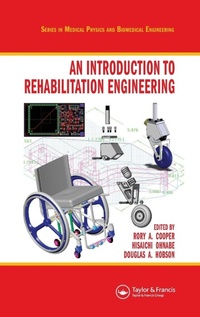
An Introduction to Rehabilitation Engineering
1st Edition
Published on 26. December 2006
Book
Hardback
470 pages
978-0-8493-7222-3 (ISBN)
Description
Answering the widespread demand for an introductory book on rehabilitation engineering (RE), Dr. Rory A. Cooper, a distinguished RE authority, and his esteemed colleagues present An Introduction to Rehabilitation Engineering. This resource introduces the fundamentals and applications of RE and assistive technologies (ATs).
After providing a brief introduction, the book describes the models for AT service delivery, the design tools and principles of universal design, and various technology-transfer mechanisms, models, and principles. The text then explains the process for creating assistive device standards, followed by a review of seating biomechanics and soft tissue biomechanics. Subsequent chapters examine design and service delivery principles of wheelchairs and scooters, functional electrical stimulation and its applications, wheelchair-accessible transportation legislation, and the applications of robotics in medical rehabilitation. The book proceeds to discuss prosthetic and orthotic design and usage, visual and hearing impairment, Web-related AT, and augmentative and alternative communication (AAC) technology. It concludes with an introduction to adaptive sports and recreation.
Incorporating the critical aspects of RE and AT, An Introduction to Rehabilitation Engineering focuses on the principles, modeling, standards, devices, and technologies of RE and AT. It presents a concise yet complete overview of RE to provide a solid foundation in the subject as well as to stimulate further study.
After providing a brief introduction, the book describes the models for AT service delivery, the design tools and principles of universal design, and various technology-transfer mechanisms, models, and principles. The text then explains the process for creating assistive device standards, followed by a review of seating biomechanics and soft tissue biomechanics. Subsequent chapters examine design and service delivery principles of wheelchairs and scooters, functional electrical stimulation and its applications, wheelchair-accessible transportation legislation, and the applications of robotics in medical rehabilitation. The book proceeds to discuss prosthetic and orthotic design and usage, visual and hearing impairment, Web-related AT, and augmentative and alternative communication (AAC) technology. It concludes with an introduction to adaptive sports and recreation.
Incorporating the critical aspects of RE and AT, An Introduction to Rehabilitation Engineering focuses on the principles, modeling, standards, devices, and technologies of RE and AT. It presents a concise yet complete overview of RE to provide a solid foundation in the subject as well as to stimulate further study.
Reviews / Votes
"Finally, a text that allows engineers and graduate students from other healthcare professions understand and appreciate just how vast and exciting the contributions of rehabilitation engineering and assistive technology can be for people with disabilities. This text is perfect not only for engineering students but also for physical therapists and other professionals who want to know the science behind assistive technology. Understanding the language of rehabilitation and engineering is critical for the engineering student's introduction to the field of assistive technology or the rehabilitation professor who wants to better appreciate the science of a device that improves their patients' lives everyday. This text offers wonderfully straightforward insights into the very complex world of rehabilitation engineering. Dr. Cooper and associates have successfully written a text that offers engineers and rehabilitation professionals alike the blueprints for understanding the language, process, and science behind the product development associated with assistive technology. The rapidly emerging field of rehabilitation engineering will grow even faster now that Dr. Cooper and associates have provided the first text to offer the blueprints to product development and the science of assistive technology."-Robert Gailey, University of Miami Miller School of Medicine, Florida, USA
More details
Series
Language
English
Place of publication
Bosa Roca
United States
Publishing group
Taylor & Francis Inc
Target group
College/higher education
Undergraduate
Product notice
sewn/stitched
Cloth over boards
Illustrations
102 s/w Abbildungen, 58 s/w Photographien bzw. Rasterbilder, 24 s/w Tabellen
24 Tables, black and white; 58 Halftones, black and white; 102 Illustrations, black and white
Dimensions
Height: 240 mm
Width: 161 mm
Thickness: 30 mm
Weight
869 gr
ISBN-13
978-0-8493-7222-3 (9780849372223)
Copyright in bibliographic data and cover images is held by Nielsen Book Services Limited or by the publishers or by their respective licensors: all rights reserved.
Schweitzer Classification
Other editions
New editions
Rory A. Cooper | Hisaichi Ohnabe | Rosemarie Cooper
An Introduction to Rehabilitation Engineering
Book
11/2025
2nd Edition
CRC Press
€131.20
Shipment within 10-20 days
Persons
Rory A Cooper, Hisaichi Ohnabe, Douglas A. Hobson
Content
Introduction. Clinical Practice of Rehabilitation Engineering. Universal Design. Technology Transfer. Standards for Assistive Technology. Seating Biomechanics and Systems. Tissue Integrity Management. Wheelchairs. Functional Electrical Stimulation. Wheelchair Transportation Safety. Rehabilitation Robotics. Major Limb Prosthetic Devices. Orthotic Devices. Aids for People with Low Vision and Blindness. Maximizing Participation for People with Hearing Loss. Telecommunications, Computers, and Web Accessibility. Augmentative and Alternative Communication Technology. Adaptive Sports and Recreation Technology. Selected Terms and Definitions. Abbreviations. Index.