

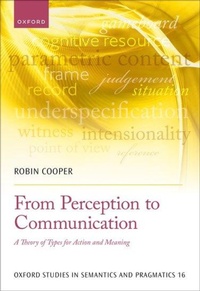
From Perception to Communication
A Theory of Types for Action and Meaning
Published on 16. March 2023
Book
Hardback
464 pages
978-0-19-287131-2 (ISBN)
Description
This is an open access title available under the terms of a CC BY-NC-ND 4.0 International licence. It is free to read at Oxford Scholarship Online and offered as a free PDF download from OUP and selected open access locations.
This book characterizes a notion of type that covers both linguistic and non-linguistic action, and lays the foundations for a theory of action based on a Theory of Types with Records (TTR). Robin Cooper argues that a theory of language based on action allows the adoption of a perspective on linguistic content that is centred on interaction in dialogue; this approach is crucially different to the traditional view of natural languages as essentially similar to formal languages such as logics developed by philosophers or mathematicians. At the same time, he claims that the substantial technical advantages made by the formal language view of semantics can be incorporated into the action-based view, and that this can lead to important improvements in both intuitive understanding and empirical coverage. This enterprise uses types rather than possible worlds as commonly employed in studies of the semantics of natural language. Types are more tractable than possible worlds and offer greater potential for understanding the implementation of semantics both on machines and in biological brains.
This book characterizes a notion of type that covers both linguistic and non-linguistic action, and lays the foundations for a theory of action based on a Theory of Types with Records (TTR). Robin Cooper argues that a theory of language based on action allows the adoption of a perspective on linguistic content that is centred on interaction in dialogue; this approach is crucially different to the traditional view of natural languages as essentially similar to formal languages such as logics developed by philosophers or mathematicians. At the same time, he claims that the substantial technical advantages made by the formal language view of semantics can be incorporated into the action-based view, and that this can lead to important improvements in both intuitive understanding and empirical coverage. This enterprise uses types rather than possible worlds as commonly employed in studies of the semantics of natural language. Types are more tractable than possible worlds and offer greater potential for understanding the implementation of semantics both on machines and in biological brains.
More details
Series
Language
English
Place of publication
Oxford
United Kingdom
Target group
Professional and scholarly
Product notice
sewn/stitched
Cloth over boards
Dimensions
Height: 252 mm
Width: 179 mm
Thickness: 31 mm
Weight
993 gr
ISBN-13
978-0-19-287131-2 (9780192871312)
Copyright in bibliographic data and cover images is held by Nielsen Book Services Limited or by the publishers or by their respective licensors: all rights reserved.
Schweitzer Classification
Other editions
Additional editions
E-Book
03/2023
1st Edition
OUP eBook
€110.99
Available for download
Person
Robin Cooper is Professor Emeritus and Senior Researcher at the University of Gothenburg, where he was previously Professor of Computational Linguistics. He is currently conducting research within the Centre for Linguistic Theory and Studies in Probability (CLASP) at Gothenburg. He is a Fellow of the British Academy and the Royal Society of Arts and Sciences in Gothenburg, and a member of the Academia Europaea.
Content
General preface
Acknowledgements
How to read this book
Introduction
Part I: From perception and action to grammar
1: From perception to intensionality
2: From event perception and action to information states and information exchange
3: Grammar in a theory of action
Part II: Towards a dialogical view of semantics
4: Reference and mental states
5: Frames and descriptions
6: Modality and intensionality without possible worlds
7: Witness-based quantification
8: Type-based underspecification
Conclusion
Appendix: TTR
References
Symbols and notations used
Named types
Name index
Subject index
Acknowledgements
How to read this book
Introduction
Part I: From perception and action to grammar
1: From perception to intensionality
2: From event perception and action to information states and information exchange
3: Grammar in a theory of action
Part II: Towards a dialogical view of semantics
4: Reference and mental states
5: Frames and descriptions
6: Modality and intensionality without possible worlds
7: Witness-based quantification
8: Type-based underspecification
Conclusion
Appendix: TTR
References
Symbols and notations used
Named types
Name index
Subject index