

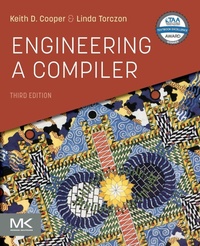
Engineering a Compiler
3rd Edition
Published on 21. November 2022
Book
Paperback/Softback
848 pages
978-0-12-815412-0 (ISBN)
Description
*Textbook and Academic Authors Association (TAA) Textbook Excellence Award Winner, 2024*
Engineering a Compiler, Third Edition covers the latest developments in compiler technology, with new chapters focusing on semantic elaboration (the problems that arise in generating code from the ad-hoc syntax-directed translation schemes in a generated parser), on runtime support for naming and addressability, and on code shape for expressions, assignments and control-structures. Leading educators and researchers, Keith Cooper and Linda Torczon, have revised this popular text with a fresh approach to learning important techniques for constructing a modern compiler, combining basic principles with pragmatic insights from their own experience building state-of-the-art compilers.
Engineering a Compiler, Third Edition covers the latest developments in compiler technology, with new chapters focusing on semantic elaboration (the problems that arise in generating code from the ad-hoc syntax-directed translation schemes in a generated parser), on runtime support for naming and addressability, and on code shape for expressions, assignments and control-structures. Leading educators and researchers, Keith Cooper and Linda Torczon, have revised this popular text with a fresh approach to learning important techniques for constructing a modern compiler, combining basic principles with pragmatic insights from their own experience building state-of-the-art compilers.
More details
Edition
3rd edition
Language
English
Place of publication
San Francisco
United States
Publishing group
Elsevier Science & Technology
Target group
College/higher education
Primarily graduate, some undergraduate students in computer science; professional compiler writers, system software developers, architects and computer system designers
Dimensions
Height: 233 mm
Width: 189 mm
Thickness: 31 mm
Weight
1308 gr
ISBN-13
978-0-12-815412-0 (9780128154120)
Copyright in bibliographic data and cover images is held by Nielsen Book Services Limited or by the publishers or by their respective licensors: all rights reserved.
Schweitzer Classification
Other editions
Additional editions
Keith D. Cooper | Linda Torczon
Engineering a Compiler
E-Book
08/2022
3rd Edition
Morgan Kaufmann
€62.99
Available for download
Previous edition
Keith D. Cooper | Linda Torczon
Engineering a Compiler
Book
03/2011
2nd Edition
Morgan Kaufmann
€87.89
Article exhausted; check for reprint
Persons
Dr. Cooper Ph.D., Professor, Dept. of Computer Science at Rice University, is the leader of the Massively Scalar Compiler Project at Rice, which investigates issues relating to optimization and code generation for modern machines. He is also a member of the Center for High Performance Software Research, the Computer and Information Technology Institute, and the Center for Multimedia Communication -- all at Rice. He teaches courses in Compiler Construction at the undergraduate and graduate level. Linda Torczon is a principal investigator on the Massively Scalar Compiler Project at Rice University, and the Grid Application Development Software Project sponsored by the next Generation Software program of the National Science Foundation. She also serves as the executive director of HiPerSoft and of the Los Alamos Computer Science Institute. Her research interests include code generation, interprocedural dataflow analysis and optimization, and programming environments.
Content
1. Overview of Compilation
2. Scanners
3. Parsers
4. Intermediate Representations
5. Syntax-Driven Translation
6. Implementing Procedures
7. Code Shape
8. Introduction to Optimization
9. Data-Flow Analysis
10. Scalar Optimization
11. Instruction Selection
12. Instruction Scheduling
13. Register Allocation
14. Runtime Optimization
2. Scanners
3. Parsers
4. Intermediate Representations
5. Syntax-Driven Translation
6. Implementing Procedures
7. Code Shape
8. Introduction to Optimization
9. Data-Flow Analysis
10. Scalar Optimization
11. Instruction Selection
12. Instruction Scheduling
13. Register Allocation
14. Runtime Optimization