

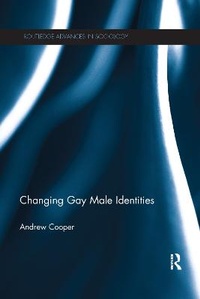
Changing Gay Male Identities
1st Edition
Published on 28. April 2017
Book
Paperback/Softback
186 pages
978-1-138-06923-7 (ISBN)
Description
As the world changes, so sexual identities are changing. In a context of globalisation, mass communication and technological advances, individuals find themselves able to make lifestyle choices in new and different ways. In this increasingly confusing world, sociologists have argued that identities are in flux, and that traditional patterns of identity and intimacy are being disrupted and reshaped, with all the implications for sexual identities that this suggests.
Changing Gay Male Identities draws on the powerful life stories of twenty-one gay men to explore how individuals construct and maintain their sense of self in contemporary society. The book draws upon theoretical debates on topics such as gender, performance, sex, class, camp, race and ethnicity, to explore four aspects of identity:
the role of the body in who we are
relationships and communities
performing in everyday life
reconciling different aspects of our selves (such as religion and sexuality).
In Changing Gay Male Identities Andrew Cooper assesses the magnitude of these social and sexual changes. He argues that although there are many opportunities for new forms of identity in a changing world, the possibilities can be significantly constrained, and that this has major implications for the freedoms and choices of individuals in contemporary societies. This book will be of interest to students and scholars of sociology, sexuality studies, gender studies, and GLBTQ studies.
Changing Gay Male Identities draws on the powerful life stories of twenty-one gay men to explore how individuals construct and maintain their sense of self in contemporary society. The book draws upon theoretical debates on topics such as gender, performance, sex, class, camp, race and ethnicity, to explore four aspects of identity:
the role of the body in who we are
relationships and communities
performing in everyday life
reconciling different aspects of our selves (such as religion and sexuality).
In Changing Gay Male Identities Andrew Cooper assesses the magnitude of these social and sexual changes. He argues that although there are many opportunities for new forms of identity in a changing world, the possibilities can be significantly constrained, and that this has major implications for the freedoms and choices of individuals in contemporary societies. This book will be of interest to students and scholars of sociology, sexuality studies, gender studies, and GLBTQ studies.
More details
Series
Language
English
Place of publication
London
United Kingdom
Publishing group
Taylor & Francis Ltd
Target group
College/higher education
Illustrations
1 s/w Tabelle
1 Tables, black and white
Dimensions
Height: 234 mm
Width: 156 mm
Weight
453 gr
ISBN-13
978-1-138-06923-7 (9781138069237)
Copyright in bibliographic data and cover images is held by Nielsen Book Services Limited or by the publishers or by their respective licensors: all rights reserved.
Schweitzer Classification
Other editions
Additional editions
Andrew Cooper
Changing Gay Male Identities
E-Book
04/2013
1st Edition
Routledge
€52.49
Available for download
Andrew Cooper
Changing Gay Male Identities
E-Book
04/2013
1st Edition
Routledge
€52.49
Available for download
Andrew Cooper
Changing Gay Male Identities
Book
04/2013
1st Edition
Routledge
€223.21
Shipment within 15-20 days
Person
Andrew Cooper was awarded a PhD from London South Bank University for detailed research into the identity work carried out by gay men. His current research interests include sexuality and gender, identity, race and ethnicity, and social disadvantage.
Content
Acknowledgments. 1. Fixing or Fracturing Identities 2. The Importance of Sexual Identities in a Changing World 3. Reconciling Identities 4. Performing Identities 5. Identities Embodied 6. Relational Identities 7. The Future of (Gay Male) Identities. Appendix 1: Methodology Used for the Research. Appendix 2: Profiles of the Men Interviewed. Bibliography