

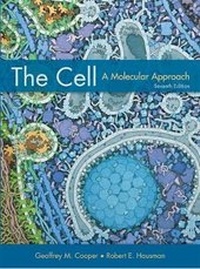
The Cell
A Molecular Approach
7th Edition
Published on 8. October 2015
Book
Hardback
832 pages
978-1-60535-290-9 (ISBN)
Description
Written by an active scientist and experienced educator, this textbook combines readability and cohesiveness with comprehensive and up-to-date science.Teaching cell biology can be a daunting task because the field is so vast and rapidly moving, characterised by a continual explosion of new information. Students need to understand the principles of cell biology and be able to appreciate new advances, rather than just memorising "the facts." At the same time, the material must be presented in sufficient depth to thoughtfully engage students and provide a sound basis for further studies. The Cell, Seventh Edition provides a balance of concepts and details that meets the needs of today's students and their teachers.New to This Edition Over 70 new Data Analysis Problems, with answers and explanations New online videos, referenced throughout the bookA new chapter-Genomics, Proteomics, and Systems Biology-focuses on these rapidly advancing areas and includes discussion of the growing field of synthetic biology.Other notable advances covered in the Seventh Edition include super-resolution microscopy, genome editing by the CRISPR/Cas system, epigenetics, the organisation of chromosome domains in the nucleus, and an updated discussion of prions and Alzheimer's disease.New Key Experiment boxes: HeLa cells; the ENCODE ProjectNew Molecular Medicine boxes: Malaria and Synthetic Biology; Alzheimer's Disease; Peroxisome Biogenesis Disorders
Reviews / Votes
"I enjoy the text and find its overall appearance pleasing. It is obvious that a lot of thought went into putting the material together and making it accessible to students." --Geoffrey Toner, Thomas Jefferson UniversityMore details
Edition
7th edition
Language
English
Place of publication
Sunderland
United States
Target group
College/higher education
Illustrations
Illustrations
Weight
2230 gr
ISBN-13
978-1-60535-290-9 (9781605352909)
Copyright in bibliographic data and cover images is held by Nielsen Book Services Limited or by the publishers or by their respective licensors: all rights reserved.
Schweitzer Classification
Other editions
Additional editions
Geoffrey M. Cooper | Robert E. Hausman
The Cell: A Molecular Approach
Book
11/2015
7th Edition
Sinauer Associates Inc.,U.S.
€78.10
Article exhausted; check different version
Persons
Geoffrey M. Cooper is Professor of Biology and Associate Dean of the Faculty for Natural Sciences at Boston University. Receiving a Ph.D. in Biochemistry from the University of Miami in 1973, he pursued postdoctoral work with Howard Temin at the University of Wisconsin, where he developed gene transfer assays to characterize the proviral DNAs of Rous sarcoma virus and related retroviruses. He then joined the faculty of Dana-Farber Cancer Institute
and Harvard Medical School in 1975, where he pioneered the discovery of oncogenes in human cancers. Since moving to Boston University as Chair of Biology in 1998, Dr. Cooper has used The Cell in teaching undergraduate
cell biology, as well as continuing his research on the roles of oncogene proteins in the signaling pathways that regulate cell proliferation and programmed cell death. He has authored two textbooks on cancer and published over 100 research papers in the field of cell signaling and cancer research.
Robert E. Hausman was a Professor in the Department of Biology at Boston University. Receiving a Ph.D. in Biological Science from Northwestern University in 1971, he pursued postdoctoral work with Aron Moscona at the University of Chicago, where he investigated cell-cell interactions during early embryonic development. Dr. Hausman joined the faculty of Boston University in 1978, extending his investigations of cell surface interactions to muscle and nervous system development.
He taught undergraduate cell biology with Dr. Cooper and contributed to several chapters of previous editions of The Cell.
and Harvard Medical School in 1975, where he pioneered the discovery of oncogenes in human cancers. Since moving to Boston University as Chair of Biology in 1998, Dr. Cooper has used The Cell in teaching undergraduate
cell biology, as well as continuing his research on the roles of oncogene proteins in the signaling pathways that regulate cell proliferation and programmed cell death. He has authored two textbooks on cancer and published over 100 research papers in the field of cell signaling and cancer research.
Robert E. Hausman was a Professor in the Department of Biology at Boston University. Receiving a Ph.D. in Biological Science from Northwestern University in 1971, he pursued postdoctoral work with Aron Moscona at the University of Chicago, where he investigated cell-cell interactions during early embryonic development. Dr. Hausman joined the faculty of Boston University in 1978, extending his investigations of cell surface interactions to muscle and nervous system development.
He taught undergraduate cell biology with Dr. Cooper and contributed to several chapters of previous editions of The Cell.
Content
Preface PART I. FUNDAMENTALS AND FOUNDATIONSChapter 1. An Overview of Cells and Cell ResearchChapter 2. Molecules and MembranesChapter 3. Bioenergetics and MetabolismChapter 4. Fundamentals of Molecular BiologyChapter 5. Genomics, Proteomics, and Systems BiologyPART II. THE FLOW OF GENETIC INFORMATIONChapter 6. Genes and GenomesChapter 7. Replication, Maintenance, and Rearrangements of Genomic DNAChapter 8. RNA Synthesis and ProcessingChapter 9. Protein Synthesis, Processing, and RegulationPART III. CELL STRUCTURE AND FUNCTIONChapter 10. The NucleusChapter 11. Protein Sorting and TransportChapter 12. Mitochondria, Chloroplasts, and PeroxisomesChapter 13. The Cytoskeleton and Cell MovementChapter 14. The Plasma MembraneChapter 15. Cell Walls, the Extracellular Matrix, and Cell InteractionsPART IV. CELL REGULATION Chapter 16. Cell SignalingChapter 17. The Cell CycleChapter 18. Cell Death and Cell RenewalChapter 19. CancerAnswers to QuestionsGlossaryIllustration CreditsIndex