

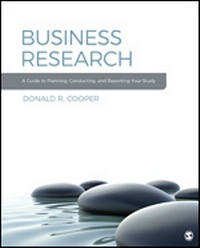
Business Research
A Guide to Planning, Conducting, and Reporting Your Study
1st Edition
Published on 8. February 2019
Book
Paperback/Softback
432 pages
978-1-5443-0782-4 (ISBN)
Description
Business Research: A Guide to Planning, Conducting and Reporting Your Study bridges the academic foundation and the practical application of research methodology through an in-depth and insightful tour of the research process-exploring, planning, creating, conducting, collecting, analyzing, and reporting. The text weaves together timeless principles, emerging ideas, contemporary examples and modern tools in a narrative that is both authoritative and supportive. Integrating a unique Roadmap framework throughout, Business Research navigates students from the start of their initial inquiry to their final stop in reporting their findings, building their confidence as they move point-to-point in their journey. Written with exceptional clarity and focus, Donald Cooper has created a guide to research that will be valuable to students in their academic pursuits as well as their professional careers.
Give your students the SAGE edge!
SAGE edge offers a robust online environment featuring an impressive array of free tools and resources for review, study, and further exploration, keeping both instructors and students.
Give your students the SAGE edge!
SAGE edge offers a robust online environment featuring an impressive array of free tools and resources for review, study, and further exploration, keeping both instructors and students.
Reviews / Votes
"Business Research: A Guide to Planning, Conducting, and Reporting Your Study is a worthy entry into this field of research texts. It provides a carefully thought out and tightly organized plan for conducting research across a variety of business and non-business fields. Rather than a cook book, it presents a sound theoretical approach to doing research firmly grounded in an understanding of the scientific method. It carries the student from problem inception to finished report in a highly readable and entertaining way. It can be recommended to any instructor who wants a text for a research methods course that is flexible and easy to use." -- Ronald Goldsmith * Reviewer * "Donald Cooper provides a roadmap for success by supplying his readers with the essential tools needed to succeed in conducting and reporting research in the ever changing business environment we live in today." -- Elizabeth Robinson "This book provides clear, concise and practical guides to the whole research process from beginning to end. It is an effective reference for students and anyone learning how to do research. It covers each and every step of the research process thoroughly from exploring research question and problem all the way to writing the results." -- Zara Ambadar "An excellent guide for the novice or experienced researcher. This book is written with scholarship, integrity, and intelligence. The author has provided an excellent writing style and examples. The material is easy to understand and presented in a fashion that students will enjoy." -- Joe Adamo "I believe this to be a vast improvement over traditional research texts. The language is easy to understand making the work more accessible to students." -- Mary Goebel-Lundholm "[Cooper] provides the step-by-step research process and explains the relevance and importance of each step. Additionally, the use and write-up of the data to inform readers of research is critical." -- Marcel Robles "This text provides a comprehensive coverage on business research." -- Haibo Wang "The textbook helps the serious researcher think better about research design." -- Jun YuMore details
Edition
First Edition
Language
English
Place of publication
Thousand Oaks
United States
Target group
College/higher education
Dimensions
Height: 232 mm
Width: 187 mm
Weight
713 gr
ISBN-13
978-1-5443-0782-4 (9781544307824)
Copyright in bibliographic data and cover images is held by Nielsen Book Services Limited or by the publishers or by their respective licensors: all rights reserved.
Schweitzer Classification
Content
List of Exhibits
Preface
Acknowledgments
About the Author
Chapter 1. From the Research Jitters to Employers' Most-Wanted Skills
Learning Objectives
Reasons to Study Business
What Recruiters Say About Research Skills
Research Fast-tracks Your Career
Business Research Defined
The Scope of Business Research
The Continuum of Basic, Practical, and Applied Research
Good Research Is . . .
Which Research Orientation Is Right for You?
The Road Map
Chapter Summary
Key Terms
Discussion Questions
Chapter 2. Self-Defense Tools for Research: Preparation, Reasoning, and Terminology
Learning Objectives
Scientific Inquiry
Reasoning to Sound Conclusions
Deciphering the Research Lingo
Case Study: The Toulmin Model of Argumentation and Reasoning-"Women Make Superior Managers"
Chapter Summary
Key Terms
Discussion Questions
Chapter 3. The Process Road Map: Exploring and Planning
Learning Objectives
Phases of the Research Process
Process Phase 1: Exploring
Process Phase 2: Planning
Chapter Summary
Key Terms
Discussion Questions
Chapter 4. The Process Road Map: Creating and Conducting
Learning Objectives
Process Phase 3: Creating
Process Phase 4: Conducting
Chapter Summary
Key Terms
Discussion Questions
Chapter 5. The Process Road Map: Collecting, Analyzing, and Writing
Learning Objectives
Process Phase 5: Collecting and Analyzing
Process Phase 6: Writing
Chapter Summary
Key Terms
Discussion Questions
Chapter 6. Nonexperimental Quantitative Designs
Learning Objectives
Design and the Research Question
What Is Research Design?
Nonexperimental Design
Nonexperimental Designs in Business
Design Is Not Method
Design Typologies
Business Research Design
Chapter Summary
Key Terms
Discussion Questions
Chapter 7. Qualitative Designs and Mixed Designs
Learning Objectives
Qualitative and Quantitative Design: A Synergistic Relationship
An Introduction to Qualitative Design
Mixed Design
Chapter Summary
Key Terms
Discussion Questions
Chapter 8. Experimental Designs
Learning Objectives
Optimizing Business Experiments
Experimental Classifications
Characteristics of Experimental Design
Pre-Experiments
True Experiments
Other Randomized Designs
Quasi-Experiments
Chapter Summary
Key Terms
Discussion Questions
Chapter 9. Writing the Report
Learning Objectives
Overview
Title
Abstract
Introduction
Method
Results
Discussion
References
Appendices
Chapter Summary
Key Terms
Discussion Questions
Appendices
Appendix A: Questionnaire Design Using Google Forms
Appendix B: Exemption Request (Institutional Review Board)
Appendix C: Sample Business Proposal
Appendix D: Statistical Decision Trees
Appendix E: Results of the Quantitative Design Textbook Survey
Appendix F: Brief Tutorial: Three Longitudinal Studies in One
Appendix G: Tutorial: Organize Your Report With Timesaving Applications
Glossary
References
Index
Preface
Acknowledgments
About the Author
Chapter 1. From the Research Jitters to Employers' Most-Wanted Skills
Learning Objectives
Reasons to Study Business
What Recruiters Say About Research Skills
Research Fast-tracks Your Career
Business Research Defined
The Scope of Business Research
The Continuum of Basic, Practical, and Applied Research
Good Research Is . . .
Which Research Orientation Is Right for You?
The Road Map
Chapter Summary
Key Terms
Discussion Questions
Chapter 2. Self-Defense Tools for Research: Preparation, Reasoning, and Terminology
Learning Objectives
Scientific Inquiry
Reasoning to Sound Conclusions
Deciphering the Research Lingo
Case Study: The Toulmin Model of Argumentation and Reasoning-"Women Make Superior Managers"
Chapter Summary
Key Terms
Discussion Questions
Chapter 3. The Process Road Map: Exploring and Planning
Learning Objectives
Phases of the Research Process
Process Phase 1: Exploring
Process Phase 2: Planning
Chapter Summary
Key Terms
Discussion Questions
Chapter 4. The Process Road Map: Creating and Conducting
Learning Objectives
Process Phase 3: Creating
Process Phase 4: Conducting
Chapter Summary
Key Terms
Discussion Questions
Chapter 5. The Process Road Map: Collecting, Analyzing, and Writing
Learning Objectives
Process Phase 5: Collecting and Analyzing
Process Phase 6: Writing
Chapter Summary
Key Terms
Discussion Questions
Chapter 6. Nonexperimental Quantitative Designs
Learning Objectives
Design and the Research Question
What Is Research Design?
Nonexperimental Design
Nonexperimental Designs in Business
Design Is Not Method
Design Typologies
Business Research Design
Chapter Summary
Key Terms
Discussion Questions
Chapter 7. Qualitative Designs and Mixed Designs
Learning Objectives
Qualitative and Quantitative Design: A Synergistic Relationship
An Introduction to Qualitative Design
Mixed Design
Chapter Summary
Key Terms
Discussion Questions
Chapter 8. Experimental Designs
Learning Objectives
Optimizing Business Experiments
Experimental Classifications
Characteristics of Experimental Design
Pre-Experiments
True Experiments
Other Randomized Designs
Quasi-Experiments
Chapter Summary
Key Terms
Discussion Questions
Chapter 9. Writing the Report
Learning Objectives
Overview
Title
Abstract
Introduction
Method
Results
Discussion
References
Appendices
Chapter Summary
Key Terms
Discussion Questions
Appendices
Appendix A: Questionnaire Design Using Google Forms
Appendix B: Exemption Request (Institutional Review Board)
Appendix C: Sample Business Proposal
Appendix D: Statistical Decision Trees
Appendix E: Results of the Quantitative Design Textbook Survey
Appendix F: Brief Tutorial: Three Longitudinal Studies in One
Appendix G: Tutorial: Organize Your Report With Timesaving Applications
Glossary
References
Index