

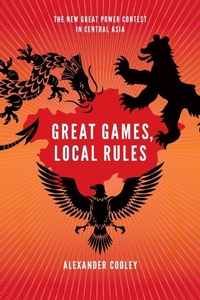
Great Games, Local Rules
The New Great Power Contest in Central Asia
Published on 20. February 2014
Book
Paperback/Softback
272 pages
978-0-19-933143-7 (ISBN)
Description
The struggle between Russia and Great Britain over Central Asia in the nineteenth century was the original "great game." But in the past quarter century, a new "great game" has emerged, pitting America against a newly aggressive Russia and a resource-hungry China, all struggling for influence over the same region, now one of the most volatile areas in the world: the long border region stretching from Iran through Pakistan to Kashmir.
In Great Games, Local Rules, Alexander Cooley, one of America's most respected international relations scholars, explores the dynamics of the new competition for control of the region since 9/11. All three great powers have crafted strategies to increase their power in the area, which includes Afghanistan and the former Soviet republics of Turkmenistan, Uzbekistan, Kyrgyzstan, and Kazakhstan. Each nation is pursuing important goals: basing rights for the US, access to natural resources for the Chinese, and increased political influence for the Russians.
However, overlooked in all of the talk about this new great game is fact that the Central Asian governments have proven themselves critical agents in their own right, establishing local rules for external power involvement that serve to fend off foreign interest. As a result, despite a decade of intense interest from the United States, Russia, and China, Central Asia remains a collection of segmented states, and the external competition has merely reinforced the sovereign authority of the individual Central Asian governments. A careful and surprising analysis of how small states interact with great powers in a vital region, Great Games, Local Rules greatly advances our understanding of how global politics actually works in the contemporary era.
In Great Games, Local Rules, Alexander Cooley, one of America's most respected international relations scholars, explores the dynamics of the new competition for control of the region since 9/11. All three great powers have crafted strategies to increase their power in the area, which includes Afghanistan and the former Soviet republics of Turkmenistan, Uzbekistan, Kyrgyzstan, and Kazakhstan. Each nation is pursuing important goals: basing rights for the US, access to natural resources for the Chinese, and increased political influence for the Russians.
However, overlooked in all of the talk about this new great game is fact that the Central Asian governments have proven themselves critical agents in their own right, establishing local rules for external power involvement that serve to fend off foreign interest. As a result, despite a decade of intense interest from the United States, Russia, and China, Central Asia remains a collection of segmented states, and the external competition has merely reinforced the sovereign authority of the individual Central Asian governments. A careful and surprising analysis of how small states interact with great powers in a vital region, Great Games, Local Rules greatly advances our understanding of how global politics actually works in the contemporary era.
Reviews / Votes
Great Games, Local Rules is a timely contribution ... this concise book (under 200 pages) with handy subheadings every two pages or so is recommended reading for journalists and students who want to brush up on the developments of the last ten years. In turn, Cooley has brought Central Asia to a wider academic audience. * Annabelle Chapman, LSE Review of Books * a highly readable, richly researched and insightful book that explores the increasingly intensifying interaction between China, Russia and the USA. ...Cooley has produced an excellent study of the region that should be required reading for scholars, policy makers, and interested students. * Johannes Olschner, The Royal Society for Asian Affairs *More details
Language
English
Place of publication
New York
United States
Target group
College/higher education
Professional and scholarly
Illustrations
16 illustrations
Dimensions
Height: 234 mm
Width: 156 mm
Thickness: 16 mm
Weight
468 gr
ISBN-13
978-0-19-933143-7 (9780199331437)
Copyright in bibliographic data and cover images is held by Nielsen Book Services Limited or by the publishers or by their respective licensors: all rights reserved.
Schweitzer Classification
Other editions
Additional editions

E-Book
07/2012
1st Edition
OUP eBook
€21.99
Available for download
Person
Alexander Cooley is the Tow Professor for Distinguished Scholars and Practitioners in the Department of Political Science at Barnard College, Columbia University. His books include Contracting States, Logics of Hierarchy, and Base Politics.
Content
Chapter 1: The New Multipolar Politics of Influence in Central Asia ; Chapter 2: Local Rules: The Origins and Politics of Central Asian Regime Survival ; Chapter 3: Washington's Strategy: Juggling Interests and Values on the Road to Afghanistan ; Chapter 4: Moscow's Strategy: The Quest for a Privileged Role ; Chapter 5: Beijing's Strategy: The SCO, Xinjiang and China's Great Leap Westward ; Chapter 6: Anti-Terrorism, Democratization and Human Rights ; Chapter 7: Geopolitical Competition and Political Stability: The Case of Kyrgyzstan ; Chapter 8: Corruption and Governance: Competition and Collusion in Contracting ; Chapter 9: Regional Integration: So Many Proposals, So Little Cooperation ; Chapter 10: Conclusion: Central Asia's Multipolar Politics in Comparative Perspective ; Appendix 1: Laws Passed after Color Revolutions that Introduced New Restrictions on NGOs ; and the Media ; Appendix 2: Election Monitor Assessments, ODIHR/SCO/CIS