

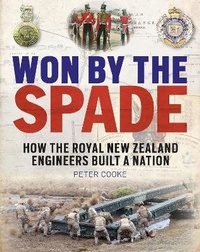
Won by the Spade
How the Royal New Zealand Engineers Built a Nation
Published on 1. April 2019
Book
Hardback
688 pages
978-1-77559-364-5 (ISBN)
Description
This authoritative history of the Royal New Zealand Engineers offers a comprehensive account of the corps' actions, events and personnel from the New Zealand Wars of the 19th century to the present. It examines military engineering in New Zealand, the corps' role in overseas wars and home defences, and provides a contemporary record of New Zealand's contribution to military engineering, including demining operations, peacekeeping and civil aid missions.
Won by the Spade carries underlying themes of military innovation and engineering's contribution to national development. In New Zealand's context military engineering played a key role in building infrastructure in an otherwise undeveloped country. The warfare in the North Island saw military engineers do this utility work until the 1870s, when peace prevailed. Military roads and communication corridors aided military success and opened up the country. Similarly, the electric telegraph hemmed in rebellious tribes as effectively as weapons. Thereafter a tradition developed of citizen sappers taking their civil experience into the military and, after several overseas wars, bring the experience back to developmental roles in civic, transport, utility and industrial sectors. With about 40 per cent of early European settlers in technological occupations, theirs was going to be a society which took to military engineering well. And it did.
Won by the Spade carries underlying themes of military innovation and engineering's contribution to national development. In New Zealand's context military engineering played a key role in building infrastructure in an otherwise undeveloped country. The warfare in the North Island saw military engineers do this utility work until the 1870s, when peace prevailed. Military roads and communication corridors aided military success and opened up the country. Similarly, the electric telegraph hemmed in rebellious tribes as effectively as weapons. Thereafter a tradition developed of citizen sappers taking their civil experience into the military and, after several overseas wars, bring the experience back to developmental roles in civic, transport, utility and industrial sectors. With about 40 per cent of early European settlers in technological occupations, theirs was going to be a society which took to military engineering well. And it did.
More details
Language
English
Place of publication
Auckland
New Zealand
Illustrations
50 color & 230 b-w photos
Dimensions
Height: 240 mm
Width: 190 mm
ISBN-13
978-1-77559-364-5 (9781775593645)
Copyright in bibliographic data and cover images is held by Nielsen Book Services Limited or by the publishers or by their respective licensors: all rights reserved.
Schweitzer Classification
Person
Peter Cooke specializes in New Zealand military history and industrial heritage, having written a dozen books to date. He has also written on such diverse topics as Shell Oil NZ Ltd, Wellington Returned and Services Association, water supply, rugby in war, and mine-proof vehicles. As a product of the British diaspora, he brings an internationalist perspective to works on New Zealand history, showing the country as part of a global whole. Peter edits two New Zealand military history periodicals, lobbies for defense heritage sites under threat, and runs field trips to local battle sites. Married with children, he lives in central Wellington and is actively involved with his community.
Content
Forewords
Acknowledgements:
Royal New Zealand Engineers Charitable Trust
Author
Notes on usage
1 1500-1860s: Maori Military Engineering
2 1840s-1870s: Royal Engineers in New Zealand
3 1870s-1900s: Rise of the New Zealand Engineer
4 First World War-1930s: Territorial Engineers and the Great War Sapper
5 Second World War: Mobilized Works in New Zealand and Pacific Defence
6 Second World War: Combat Engineering
7 1950s-1960s: Desert to Jungle
8 1970s-1980s: Inward Looking
9 1990s-2000s: Peace and Terror
10 2010s: Ubiquitous in Afghanistan and Iraq
Conclusion
Appendices:
1. Died in Service
2. Senior Appointments
3. Awards and Honours
4. NZ Engineer Units and Formations
5. New Zealanders in other Military Engineer Forces
6. The Corps of Royal New Zealand Engineers
Glossary
Notes
Bibliography
Index
Acknowledgements:
Royal New Zealand Engineers Charitable Trust
Author
Notes on usage
1 1500-1860s: Maori Military Engineering
2 1840s-1870s: Royal Engineers in New Zealand
3 1870s-1900s: Rise of the New Zealand Engineer
4 First World War-1930s: Territorial Engineers and the Great War Sapper
5 Second World War: Mobilized Works in New Zealand and Pacific Defence
6 Second World War: Combat Engineering
7 1950s-1960s: Desert to Jungle
8 1970s-1980s: Inward Looking
9 1990s-2000s: Peace and Terror
10 2010s: Ubiquitous in Afghanistan and Iraq
Conclusion
Appendices:
1. Died in Service
2. Senior Appointments
3. Awards and Honours
4. NZ Engineer Units and Formations
5. New Zealanders in other Military Engineer Forces
6. The Corps of Royal New Zealand Engineers
Glossary
Notes
Bibliography
Index