

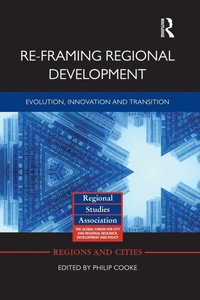
Re-framing Regional Development
Evolution, Innovation and Transition
1st Edition
Published on 17. July 2014
Book
Paperback/Softback
392 pages
978-1-138-79227-2 (ISBN)
Description
Turbulence characterises the current global scene. This book uses complementary theoretical approaches to understand and help prescribe policies to 're-frame' the regional development problem in turbulent times. These approaches are: evolutionary complexity; evolutionary economic geography; emergence theory; and resilience theory. From below, they address the four major crises creating a 'perfect storm' for societies and economics involving: the climate change crisis; the energy crisis; the banking and financial crisis; and the global economic crisis.
This book analyses and proposes ways in which regional economies, in particular, are having to be 'reframed' to address these crises. First, many must evolve in new ways, possibly moving back from the 'service economy' towards a new, greener form of manufacturing of goods as well as services. Accordingly, regional economies are innovating in new ways. Amongst these are the quest for 'relatedness' within their own regional orbits, and promoting 'modularity' as a mode of analysis and a policy stance to stimulate innovation across industry and geographical borders.
Finally, regional economies and societies are discovering that, from a 'resilience' perspective, they must find answers to the higher levels of governance with which they increasingly struggle. In this respect regional economies are in 'transition' and regional processes are 'emergent'. The transition seeks to address the four crises, involving re-balancing, re-directing and re-framing future policy and practice. This book describes many of the novel 'framings' involved in understanding the new ways in which this major task is being addressed in theory, policy and everyday practice.
This book analyses and proposes ways in which regional economies, in particular, are having to be 'reframed' to address these crises. First, many must evolve in new ways, possibly moving back from the 'service economy' towards a new, greener form of manufacturing of goods as well as services. Accordingly, regional economies are innovating in new ways. Amongst these are the quest for 'relatedness' within their own regional orbits, and promoting 'modularity' as a mode of analysis and a policy stance to stimulate innovation across industry and geographical borders.
Finally, regional economies and societies are discovering that, from a 'resilience' perspective, they must find answers to the higher levels of governance with which they increasingly struggle. In this respect regional economies are in 'transition' and regional processes are 'emergent'. The transition seeks to address the four crises, involving re-balancing, re-directing and re-framing future policy and practice. This book describes many of the novel 'framings' involved in understanding the new ways in which this major task is being addressed in theory, policy and everyday practice.
More details
Series
Language
English
Place of publication
London
United Kingdom
Publishing group
Taylor & Francis Ltd
Target group
College/higher education
Illustrations
36 s/w Zeichnungen, 16 s/w Tabellen
16 Tables, black and white; 36 Line drawings, black and white
Dimensions
Height: 234 mm
Width: 156 mm
Thickness: 21 mm
Weight
594 gr
ISBN-13
978-1-138-79227-2 (9781138792272)
Copyright in bibliographic data and cover images is held by Nielsen Book Services Limited or by the publishers or by their respective licensors: all rights reserved.
Schweitzer Classification
Other editions
Additional editions
E-Book
01/2013
Routledge
€77.99
Available for download
E-Book
01/2013
Routledge
€77.99
Available for download
Book
10/2012
1st Edition
Routledge
€232.70
Shipment within 15-20 days
Person
Philip Cooke is Director and Research Professor in Regional Development at the Centre for Advanced Studies, Cardiff University, UK.
Content
1. Reframing Regional Development: Complex systems integration, 'emergence', and policy modularisation Philip Cooke Part I: Evolutionary Transition Space 2. A World in Emergence: Notes toward a resynthesis of Urban-Economic Geography for the 21st Century Allen J. Scott 3. Regional Resilience, Cross-sectoral Knowledge Platforms and the Prospects for Growth in Canadian City-Regions David A. Wolfe 4. Forms of Emergence and the Evolution of Economic Landscapes Ron Martin and Peter Sunley 5. Strange Attractors and Policy Emergence: Complex adaptive innovation Philip Cooke Part II: Innovation and Diversity 6. The Health Technologies Sector in Oxfordshire: Evolution or optimism in regional development? Helen Lawton-Smith 7. Reframing Regional Innovation Systems: Evolution, complexity and public policy Elvira Uyarra and Kieron Flanagan 8. Path Dependence and New Technological Path Creation in the Economic Landscape James Simmie 9. Proximity and Innovation Networks: An evolutionary approach Pierre-Alexandre Balland, Ron Boschma and Koen Frenken Part III: Cluster Emergence and Destabilisation 10. Foresight and Innovation: Emergence and resilience of the cleantech cluster at Lahti, Finland Helinae Melkas and Tuomo Uotila 11. 'Twilight of the Gods': The rise of Asia Pacific and Californian convergent media and the demise of Nordic mobile telephony in the ICT global innovation network Philip Cooke 12. The Remarkable Resilience of Cities of Art: The challenge of a new Renaissance in Florence Luciana Lazzeretti 13. Socio-cultural Dynamics in Spatial Policy: Explaining the on-going success of cluster politics Dieter Rehfeld and Judith Terstriep Part IV: Evolutionary Spatial Policy 14. Transformation of Regional Innovation Systems: From old legacies to new development paths Franz Toedtling and Michaela Trippl 15. Path Dependence and the State: The politics of novelty in old industrial regions Kevin Morgan 16. City-regions, Innovation and Universities: The evolution and transition of UK urban governance institutions Fumi Kitagawa