

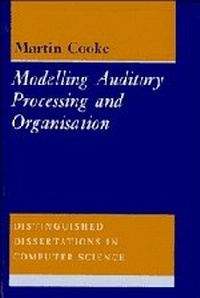
Modelling Auditory Processing and Organisation
Published on 19. August 1993
Book
Hardback
134 pages
978-0-521-45094-2 (ISBN)
Description
We are surrounded by noise; we must be able to separate the signals we want to hear from those we do not. To overcome this 'cocktail party effect' we have developed various strategies; endowing computers with similar abilities would enable the development of devices such as intelligent hearing aids and robust speech recognition systems. This book describes a system which attempts to separate multiple, simultaneous acoustic sources using strategies based on those used by humans. It is both a review of recent work on the modelling of auditory processes, and a presentation of a new model in which acoustic signals are decomposed into elements. These structures are then re-assembled in accordance with rules of auditory organisation which operate to bind together elements that are likely to have arisen from the same source. The model is evaluated by measuring its ability to separate speech from a wide variety of other sounds, including music, phones and other speech.
More details
Series
Language
English
Place of publication
Cambridge
United Kingdom
Target group
Professional and scholarly
Dimensions
Height: 255 mm
Width: 180 mm
Thickness: 13 mm
Weight
432 gr
ISBN-13
978-0-521-45094-2 (9780521450942)
Copyright in bibliographic data and cover images is held by Nielsen Book Services Limited or by the publishers or by their respective licensors: all rights reserved.
Schweitzer Classification
Other editions
New editions
Martin Cooke
Modelling Auditory Processing and Organisation
Book
02/2005
Cambridge University Press
€53.80
Shipment within 15-20 days
Additional editions
Martin Cooke
Modelling Auditory Processing and Organisation
Book
02/2005
Cambridge University Press
€53.80
Shipment within 15-20 days
Person
Content
Acknowledgments; 1. Introduction; 2. The auditory periphery: physiology, function and a computer model; 3. Auditory representations; 4. Modelling auditory scene exploration; 5. Implementation of auditory grouping principles; 6. An evaluation of sound source separation in the model; 7. Conclusions and further development; Appendices; Bibliography; Index.