

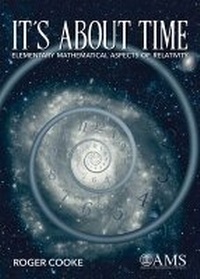
It's About Time
Elementary Mathematical Aspects of Relativity
Published on 30. April 2017
Book
Hardback
403 pages
978-1-4704-3483-0 (ISBN)
Description
This book has three main goals. First, it explores a selection of topics from the early period of the theory of relativity, focusing on particular aspects that are interesting or unusual. These include the twin paradox; relativistic mechanics and its interaction with Maxwell's laws; the earliest triumphs of general relativity relating to the orbit of Mercury and the deflection of light passing near the sun; and the surprising bizarre metric of Kurt Goedel, in which time travel is possible. Second, it provides an exposition of the differential geometry needed to understand these topics on a level that is intended to be accessible to those with just two years of university-level mathematics as background. Third, it reflects on the historical development of the subject and its significance for our understanding of what reality is and how we can know about the physical universe. The book also takes note of historical prefigurations of relativity, such as Euler's 1744 result that a particle moving on a surface and subject to no tangential acceleration will move along a geodesic, and the work of Lorentz and Poincare on space-time coordinate transformations between two observers in motion at constant relative velocity.
The book is aimed at advanced undergraduate mathematics, science, and engineering majors (and, of course, at any interested person who knows a little university-level mathematics). The reader is assumed to know the rudiments of advanced calculus, a few techniques for solving differential equations, some linear algebra, and basics of set theory and groups.
The book is aimed at advanced undergraduate mathematics, science, and engineering majors (and, of course, at any interested person who knows a little university-level mathematics). The reader is assumed to know the rudiments of advanced calculus, a few techniques for solving differential equations, some linear algebra, and basics of set theory and groups.
Reviews / Votes
This book is both pedagogical and humanistic in nature...in a historical setting, he gives a wealth of mathematical tools and many applications to astronomy, physics, and cosmology." - Alan S. McRae, Mathematical Reviews"Roger Cooke has successfully presented a wealth of fascinating ideas from the realm of physics, astronomy and cosmology while developing a range of powerful mathematical tools...This is an encyclopaedic discourse on relativity in a mathematical, philosophical and 'humanistic' setting...Being inexpert in this field myself, I was captivated by Roger Cooke's introduction to relativity. His book will appeal to a wide readership and it should provide the basis for a taught course at some suitable stage at the undergraduate level and beyond." - Peter Ruane, MAA Reviews
More details
Language
English
Place of publication
Providence
United States
Target group
Professional and scholarly
Dimensions
Height: 254 mm
Width: 178 mm
Weight
893 gr
ISBN-13
978-1-4704-3483-0 (9781470434830)
Copyright in bibliographic data and cover images is held by Nielsen Book Services Limited or by the publishers or by their respective licensors: all rights reserved.
Schweitzer Classification
Person
Roger Cooke, University of Vermont, Burlington, VT.
Content
The special theory: Time, space, and space-time
Relativistic mechanics
Electromagnetic theory
The general theory: Precession and deflection
Concepts of curvature, 1700-1850
Concepts of curvature, 1850-1950
The geometrization fo gravity
Historical and philosophical context: Experiments, chronology, metaphysics
Bibliography
Subject index
Name index
Relativistic mechanics
Electromagnetic theory
The general theory: Precession and deflection
Concepts of curvature, 1700-1850
Concepts of curvature, 1850-1950
The geometrization fo gravity
Historical and philosophical context: Experiments, chronology, metaphysics
Bibliography
Subject index
Name index