

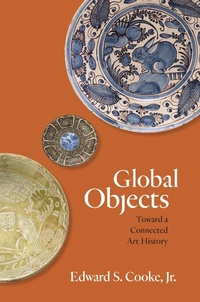
Global Objects
Toward a Connected Art History
Published on 4. October 2022
Book
Paperback/Softback
336 pages
978-0-691-18473-9 (ISBN)
Description
A bold reorientation of art history that bridges the divide between fine art and material culture through an examination of objects and their uses
Art history is often viewed through cultural or national lenses that define some works as fine art while relegating others to the category of craft. Global Objects points the way to an interconnected history of art, examining a broad array of functional aesthetic objects that transcend geographic and temporal boundaries and challenging preconceived ideas about what is and is not art.
Avoiding traditional binaries such as East versus West and fine art versus decorative art, Edward Cooke looks at the production, consumption, and circulation of objects made from clay, fiber, wood, and nonferrous base metals. Carefully considering the materials and process of making, and connecting process to product and people, he demonstrates how objects act on those who look at, use, and acquire them. He reveals how objects retain aspects of their local fabrication while absorbing additional meanings in subtle and unexpected ways as they move through space and time. In emphasizing multiple centers of art production amid constantly changing contexts, Cooke moves beyond regional histories driven by geography, nation-state, time period, or medium.
Beautifully illustrated, Global Objects traces the social lives of objects from creation to purchase, and from use to experienced meaning, charting exciting new directions in art history.
Art history is often viewed through cultural or national lenses that define some works as fine art while relegating others to the category of craft. Global Objects points the way to an interconnected history of art, examining a broad array of functional aesthetic objects that transcend geographic and temporal boundaries and challenging preconceived ideas about what is and is not art.
Avoiding traditional binaries such as East versus West and fine art versus decorative art, Edward Cooke looks at the production, consumption, and circulation of objects made from clay, fiber, wood, and nonferrous base metals. Carefully considering the materials and process of making, and connecting process to product and people, he demonstrates how objects act on those who look at, use, and acquire them. He reveals how objects retain aspects of their local fabrication while absorbing additional meanings in subtle and unexpected ways as they move through space and time. In emphasizing multiple centers of art production amid constantly changing contexts, Cooke moves beyond regional histories driven by geography, nation-state, time period, or medium.
Beautifully illustrated, Global Objects traces the social lives of objects from creation to purchase, and from use to experienced meaning, charting exciting new directions in art history.
Reviews / Votes
"[A] remarkably insightful book. . . . [Global Objects] illustrates how the hegemony of power attributed to 'fine art,' as distinguished from objects that have a utility in our daily lives, has resulted in a poverty of taste as well as the perpetuation of self-fulfilling prophecies about the importance of the so called 'sublime' in the construction of civilizations."---Donald Brackett, Critics at Large "A fascinating Tintin-esque history of many human artifacts that have truly global pedigrees. . . . An interesting read."---Jesse Russell, University Bookman "Challenging the binaries of Western versus Other and 'high' versus 'low' art in this book, Cooke presents a revisionist approach to global material culture that frames art objects as embodiments of social interactions across space and time. Global Objects. . . makes mate-rial culture studies digestible to individuals who seek to understand objects beyond the traditional fields of Western art history . . . [and] presents a necessary methodological revision to material culture studies in the post-colonial era."---Yasmine Yakupper, 21: Inquiries into Art, History, and the Visual - Beitraege zur Kunstgeschichte und visuellen Kultur "One of the great successes of Cooke's Global Objects is it is an analysis based on a significant number of case studies, a corpus of considerable scale. The attention paid to the objects themselves and the important place they occupy in the whole of Cooke's study, both visually and in terms of the narrative, make Global Objects a solid and handsome contribution to the history of art."---Noemie Etienne, Art Bulletin "As an introduction to material literacy, as a manifesto for a more inclusive art historical methodology, and above all, as a moving investigation of the power of objects to teach us, Global Objects succeeds beautifully in its aims."---Dawn Odell, Sehepunkte "Global Objects functions as a guide to how materials, making, movement, and meaning form the salient coordinates for the study of art, broadly defined and deeply informed by material culture. These four elements serve as categories of analysis for understanding artworks on their own terms and for narrating the history of art. They can also be usefully employed in teaching art history courses-indeed, it is from such a course that this book emerged. . . . [Cooke] provides a nuanced and inspiring approach to conceptualizing and narrating art history."---Pamela H. Smith, West 86thMore details
Language
English
Place of publication
New Jersey
United States
Product notice
Paperback (trade)
Illustrations
215 color illus.
Dimensions
Height: 234 mm
Width: 153 mm
Thickness: 19 mm
Weight
658 gr
ISBN-13
978-0-691-18473-9 (9780691184739)
Copyright in bibliographic data and cover images is held by Nielsen Book Services Limited or by the publishers or by their respective licensors: all rights reserved.
Schweitzer Classification
Other editions
Additional editions
E-Book
09/2022
1st Edition
Princeton University Press
€37.99
Available for download
Person
Edward S. Cooke, Jr. is the Charles F. Montgomery Professor of American Decorative Arts at Yale University. His books include Inventing Boston: Design, Production, and Consumption, 1680-1720 and Making Furniture in Preindustrial America: The Social Economy of Newtown and Woodbury, Connecticut. He lives in New Haven, Connecticut.