

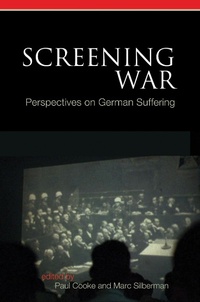
Screening War
Perspectives on German Suffering
Published on 30. July 2010
Book
Hardback
312 pages
978-1-57113-437-0 (ISBN)
Description
Re-examines German cinema's representation of the Germans as victims during the Second World War and its aftermath.
The recent "discovery" of German wartime suffering has had a particularly profound impact in German visual culture. Films from Margarethe von Trotta's Rosenstrasse (2003) to Oliver Hirschbiegel's Oscar-nominated Downfall (2004) and the two-part television mini-series Dresden (2006) have shown how ordinary Germans suffered during and after the war. Such films have been presented by critics as treating a topic that had been taboo for German filmmakers. However, the representation of wartime suffering has a long tradition on the German screen. For decades, filmmakers have recontextualized images of Germans as victims to engage shifting social and ideological discourses. By focusing on this process, the present volume explores how the changing representation of Germans as victims has shaped the ways in which both of the postwar German states and the now-unified nation have attempted to facethe trauma of the past and to construct a contemporary place for themselves in the world.
Contributors: Sean Allan, Tim Bergfelder, Daniela Berghahn, Erica Carter, David Clarke, John E. Davidson, Sabine Hake, JenniferKapczynski, Manuel Koeppen, Rachel Palfreyman, Brad Prager, Johannes von Moltke.
Paul Cooke is Professor of German Cultural Studies at the University of Leeds and Marc Silberman is Professor of German at the University of Wisconsin.
The recent "discovery" of German wartime suffering has had a particularly profound impact in German visual culture. Films from Margarethe von Trotta's Rosenstrasse (2003) to Oliver Hirschbiegel's Oscar-nominated Downfall (2004) and the two-part television mini-series Dresden (2006) have shown how ordinary Germans suffered during and after the war. Such films have been presented by critics as treating a topic that had been taboo for German filmmakers. However, the representation of wartime suffering has a long tradition on the German screen. For decades, filmmakers have recontextualized images of Germans as victims to engage shifting social and ideological discourses. By focusing on this process, the present volume explores how the changing representation of Germans as victims has shaped the ways in which both of the postwar German states and the now-unified nation have attempted to facethe trauma of the past and to construct a contemporary place for themselves in the world.
Contributors: Sean Allan, Tim Bergfelder, Daniela Berghahn, Erica Carter, David Clarke, John E. Davidson, Sabine Hake, JenniferKapczynski, Manuel Koeppen, Rachel Palfreyman, Brad Prager, Johannes von Moltke.
Paul Cooke is Professor of German Cultural Studies at the University of Leeds and Marc Silberman is Professor of German at the University of Wisconsin.
Reviews / Votes
[A] highly successful undertaking that should find a wide readership including advanced undergraduate and graduate seminars . . . . Unlike so many collections, where one cherry-picks interesting articles, it is clearly rewarding to read Screening War as a whole. . . . [A] rich and comprehensive picture about how film and the German cultural memory of World War II have developed over the last 65 years. * SEMINAR * Screening War is one of several recently published titles to focus on the representation of German victimhood in its various forms. [.] the volume's strength lies in the originality of some of the discussions. Several chapters offer intriguing accounts of little-known themes [.] or film-makers whose work has received only uneven scholarly attention [.]. Other contributors provide alternative and much-needed readings of better-known films and genres. [.]Screening War is a useful and welcome contribution to a fascinating topic. * MODERN LANGUAGE REVIEW * [I]nvaluable . . . . [O]f interest not only to anyone concerned with the cultural history of twentieth-century Germany or with the relations between film and totalitarianism, but also to anyone grappling with the methodological issues involved in not judging film as a more or less unsuccessful copy of a higher art form. * NEW CINEMAS * Through a careful scrutiny of a wide array of filmmakers and their work, Screening War offers a vivid glimpse of the cultural history of German visual media throughout the post-WWII period. . . . [A] formidable contribution . . . . * H-GERMAN, H-NET REVIEWS * The collection presents the theme complex of 'victim discourse' very broadly. What is stimulating about it . . . is therefore not so much the connections it provides to the examples already intensively discussed in research . . . but instead above all the references to works that have not been looked at so extensively in the light of victimization. * FILMBLATT * Provides a history of cultural and political discourses on German 'victimhood,' which counters the commonly-held belief that recent depictions of German suffering break a longstanding taboo. * THIS YEAR'S WORK IN MODERN LANGUAGE STUDIES *More details
Series
Language
English
Place of publication
Columbia, MD
United States
Publishing group
Boydell & Brewer Ltd
Target group
Professional and scholarly
Product notice
Cloth over boards
Illustrations
49 s/w Abbildungen
49 b/w illus.
Dimensions
Height: 257 mm
Width: 157 mm
Thickness: 23 mm
Weight
635 gr
ISBN-13
978-1-57113-437-0 (9781571134370)
Copyright in bibliographic data and cover images is held by Nielsen Book Services Limited or by the publishers or by their respective licensors: all rights reserved.
Schweitzer Classification
Other editions
Additional editions
E-Book
07/2010
1st Edition
De Gruyter
€48.99
Available for download
Persons
Paul Cooke is Senior Lecturer in German at the University of Leeds. BRAD PRAGER is Associate Professor of German at the University of Missouri, Columbia. DAVID CLARKE is Professor of Modern German Studies at Cardiff University, UK. Paul Cooke is Senior Lecturer in German at the University of Leeds. SEAN ALLAN is Professor of German at the University of St Andrews. He studied at Emmanuel College, Cambridge and at the Humboldt Universitaet in what was then East Berlin. From 2001-2016 he worked at the University of Warwick before moving to St Andrews in 2016 as Professor of German. His main research areas regard the culture of the European Enlightenment, interdisciplinary approaches to the mediation of music and the visual arts, as well as translation and translation studies. He is the author of The Plays of Heinrich von Kleist: Ideals and Illusions (1996) and The Stories of Heinrich von Kleist: Fictions of Security (Camden House, 2001). He is the co-editor of a special edition of German Life and Letters, entitled Heinrich von Kleist: Performance and Performativity (2011); the co-editor of the volumes Kleist, Education and Violence: The Transformation of Ethics and Aesthetics and Konstruktive und destruktive Funktionen von Gewalt im Werk Heinrich von Kleists (2012), and Re-Imagining DEFA: East German Cinema in its National and Transnational Contexts (2016); and the co-author of the monograph Unverhoffte Wirkungen: Erziehung und Gewalt im Werk Heinrich von Kleists (2014). His most recent book, Screening Art: Modernism and the Socialist Imaginary in East German Cinema (2019), investigates questions of intermediality and spans not only film, but also literature, music, and the visual arts in post-war cinema.
Content
Introduction: German Suffering? - Paul Cooke and Marc Silberman
Armchair Warriors: Heroic Postures in the West German War Film - Jennifer M. Kapczynski
German Martyrs: Images of Christianity and Resistance to National Socialism in German Cinema - David Clarke
The Rhetoric of Victim Narratives in West German Films of the 1950s - Manuel Koeppen
Sissi the Terrible: Melodrama, Victimhood, and Imperial Nostalgia in the Sissi Trilogy - Erica Carter
Political Affects: Antifascism and the Second World War in Frank Beyer and Konrad Wolf - Sabine Hake
Shadowlands: The Memory of the Ostgebiete in Contemporary German Film and Television - Tim Bergfelder
Links and Chains: Trauma between the Generations in the Heimat Mode - Rachel Palfreyman
Resistance of the Heart: Female Suffering and Victimhood in DEFA's Antifascist Films - Daniela Berghahn
Suffering and Sympathy in Volker Schloendorff's Der neunte Tag and Dennis Gansel's NaPolA - Brad Prager
Eberhard Fechner's History of Suffering: TV Talk, Temporal Distance, Spatial Displacement - John Davidson
The Politics of Feeling: Alexander Kluge on War, Film, and Emotion - Johannes von Moltke
Post-unification German-Jewish Relations and the Discourse of Victimhood in Dani Levy's Films - Sean Allan
Armchair Warriors: Heroic Postures in the West German War Film - Jennifer M. Kapczynski
German Martyrs: Images of Christianity and Resistance to National Socialism in German Cinema - David Clarke
The Rhetoric of Victim Narratives in West German Films of the 1950s - Manuel Koeppen
Sissi the Terrible: Melodrama, Victimhood, and Imperial Nostalgia in the Sissi Trilogy - Erica Carter
Political Affects: Antifascism and the Second World War in Frank Beyer and Konrad Wolf - Sabine Hake
Shadowlands: The Memory of the Ostgebiete in Contemporary German Film and Television - Tim Bergfelder
Links and Chains: Trauma between the Generations in the Heimat Mode - Rachel Palfreyman
Resistance of the Heart: Female Suffering and Victimhood in DEFA's Antifascist Films - Daniela Berghahn
Suffering and Sympathy in Volker Schloendorff's Der neunte Tag and Dennis Gansel's NaPolA - Brad Prager
Eberhard Fechner's History of Suffering: TV Talk, Temporal Distance, Spatial Displacement - John Davidson
The Politics of Feeling: Alexander Kluge on War, Film, and Emotion - Johannes von Moltke
Post-unification German-Jewish Relations and the Discourse of Victimhood in Dani Levy's Films - Sean Allan