

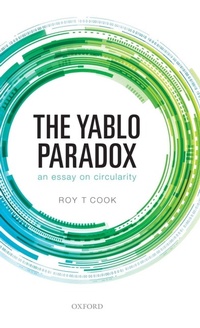
The Yablo Paradox
An Essay on Circularity
Published on 29. May 2014
Book
Hardback
204 pages
978-0-19-966960-8 (ISBN)
Description
Roy T Cook examines the Yablo paradox--a paradoxical, infinite sequence of sentences, each of which entails the falsity of all others later than it in the sequence--with special attention paid to the idea that this paradox provides us with a semantic paradox that involves no circularity.
The three main chapters of the book focus, respectively, on three questions that can be (and have been) asked about the Yablo construction. First we have the Characterization Problem, which asks what patterns of sentential reference (circular or not) generate semantic paradoxes. Addressing this problem requires an interesting and fruitful detour through the theory of directed graphs, allowing us to draw interesting connections between philosophical problems and purely mathematical ones. Next is the Circularity Question, which addresses whether or not the Yablo paradox is genuinely non-circular. Answering this question is complicated: although the original formulation of the Yablo paradox is circular, it turns out that it is not circular in any sense that can bear the blame for the paradox. Further, formulations of the paradox using infinitary conjunction provide genuinely non-circular constructions. Finally, Cook turns his attention to the Generalizability Question: can the Yabloesque pattern be used to generate genuinely non-circular variants of other paradoxes, such as epistemic and set-theoretic paradoxes? Cook argues that although there are general constructions-unwindings--that transform circular constructions into Yablo-like sequences, it turns out that these sorts of constructions are not 'well-behaved' when transferred from semantic puzzles to puzzles of other sorts. He concludes with a short discussion of the connections between the Yablo paradox and the Curry paradox.
The three main chapters of the book focus, respectively, on three questions that can be (and have been) asked about the Yablo construction. First we have the Characterization Problem, which asks what patterns of sentential reference (circular or not) generate semantic paradoxes. Addressing this problem requires an interesting and fruitful detour through the theory of directed graphs, allowing us to draw interesting connections between philosophical problems and purely mathematical ones. Next is the Circularity Question, which addresses whether or not the Yablo paradox is genuinely non-circular. Answering this question is complicated: although the original formulation of the Yablo paradox is circular, it turns out that it is not circular in any sense that can bear the blame for the paradox. Further, formulations of the paradox using infinitary conjunction provide genuinely non-circular constructions. Finally, Cook turns his attention to the Generalizability Question: can the Yabloesque pattern be used to generate genuinely non-circular variants of other paradoxes, such as epistemic and set-theoretic paradoxes? Cook argues that although there are general constructions-unwindings--that transform circular constructions into Yablo-like sequences, it turns out that these sorts of constructions are not 'well-behaved' when transferred from semantic puzzles to puzzles of other sorts. He concludes with a short discussion of the connections between the Yablo paradox and the Curry paradox.
Reviews / Votes
The Yablo Paradox is a fun read. Those familiar with this literature will find new things here that are worth the time. (A number of them, however, are more deeply discussed in Cook (2012) and other papers in that special issue, some of which Iave cited above ... Those not familiar with this literature will be well served by taking this book as an initial foray. * David Ripley, Analysis * Cook provides a systematic and comprehensive study about the most important semantic puzzles such as the Liar, the Curry and -- of course -- the infinitary paradoxes such as Yablo's sequences. * Notre Dame Philosophical Reviews Online * The Yablo Paradox is an important contribution to the literature on paradoxes. Everyone who is interested in such issues should read it. * J. Payne, History and Philosophy of Logic *More details
Language
English
Place of publication
Oxford
United Kingdom
Target group
College/higher education
Dimensions
Height: 222 mm
Width: 145 mm
Thickness: 15 mm
Weight
394 gr
ISBN-13
978-0-19-966960-8 (9780199669608)
Copyright in bibliographic data and cover images is held by Nielsen Book Services Limited or by the publishers or by their respective licensors: all rights reserved.
Schweitzer Classification
Other editions
Additional editions
E-Book
05/2014
1st Edition
OUP Oxford
€80.99
Available for download
E-Book
05/2014
1st Edition
OUP eBook
€40.49
Available for download
Person
Roy T Cook is professor in the department of philosophy at the University of Minnesota, Twin Cities. He is also an associate fellow at the Northern Institute of Philosophy at the University of Aberdeen and a research fellow of the Minnesota Center for Philosophy of Science. He is the author of Key Concepts in Philosophy: Paradox (Polity, 2013) and The Dictionary of Philosophical Logic (Edinburgh University Press, 2009), editor of The Arche Papers on the Mathematics of Abstraction (Springer, 2007), and co-editor of The Art of Comics: A Philosophical Approach (with Aaron Meskin; Wiley-Blackwell, 2012). He has also published numerous articles on the philosophy of logic, the philosophy of mathematics, the history of analytic philosophy, the aesthetics of popular art, and other topics.
Content
Acknowledgements ; Introduction: Why Should We Care? ; 1. Origins and Mathematics ; 2. The Yablo Paradox and Circularity ; 3. Generalizing the Yablo Paradox ; 4. The Curry Generalization ; Bibliography ; Index