

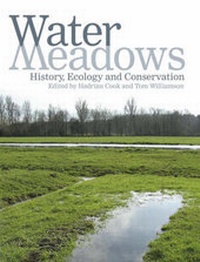
Water Meadows
History, Ecology and Conservation
Published on 1. December 2007
Book
Paperback/Softback
978-1-905119-12-7 (ISBN)
Description
This book brings to public attention some of the most evocative and threatened features of the landscape of southern England. Water meadows work with nature to improve agricultural productivity, whilst providing rich habitats for wildlife such as water voles, waders and grass snakes. They are areas of low-lying grassland which are regularly 'drowned' - artificially irrigated - at certain times of the year, to stimulate the early growth of grass in the spring. Only a few remain in operation today, though they played a crucial role in Britains past farming economy. Their archaeological remains can be found all over southern England, with Hampshire and Wiltshire having perhaps the best surviving examples. In this book leading archaeologists and scientists - together with one of the last practising 'drowners' - explore the ecology and history of water meadows. They ask when and where the art of floating originated, and explain its hydrology. They also investigate water meadows conservation status and potential for the future.
Reviews / Votes
extremely readable' -- Southern History Southern History A fascinating and informative book for those interested in their local history as well as those with a particular interest in the water meadow itself.' -- The Wiltshire Archaeological and Natural History Magazine The Wiltshire Archaeological and Natural History Magazine An excellent book which should be of interest, not only to landscape historians and archaeologists, but to a much wider audience.' -- Landscape History Landscape History Essential reading for anyone with an interest in river habitats... an invaluable contribution.' -- Wild Trout Trust News Wild Trout Trust NewsMore details
Language
English
Place of publication
Macclesfield
United Kingdom
Illustrations
149 b/w illus
ISBN-13
978-1-905119-12-7 (9781905119127)
Copyright in bibliographic data and cover images is held by Nielsen Book Services Limited or by the publishers or by their respective licensors: all rights reserved.
Schweitzer Classification
Persons
Hadrian Cook teaches and writes on environmental science, environmental policy and landscape history. He was educated in the universities of Sheffield, London and East Anglia and taught in schools before taking up a teaching appointment at Wye College and Imperial College within the University of London. He presently teaches at Kingston University and in adult education. Tom Williamson was born in Hemel Hemstead in Hertfordshire, and was brought up in Bushey, before reading history and archaeology at Jesus College, Cambridge. Since 1984 he has taught at the University of East Anglia. He is now Professor of Landscape History there, and has written widely on landscape archaeology, agricultural history and the history of landscape design. He has a particular interest in the landscape history of Hertfordshire.
Content
Introducing Water Meadows - Tom Williamson and Hadrian Cook; The Floated Water Meadows of Wessex: A Triumph of English Agriculture - Joe Bettey; The Archaeology of Water Meadows - Christopher Taylor; Floating in Context: Meadows in the Long Term - Tom Williamson; The Later History of Water Meadows - Hadrian Cook and Tom Williamson; Drowning by Numbers: The Functioning of Bedwork Water Meadows - Roger L. Cutting and Ian Cummings; The Effects of Floating on Plant Communities - Ian Cummings and Roger L. Cutting; The Hydrology, Soils and Geology of the Wessex Water Meadows - Hadrian F. Cook; The Management of Water Meadows: Four Hundred Years of Intensive Integrated Agriculture - Kathy Stearne; Water Meadow Management Today: The Practitioner's View - Peter Martin and Kathy Stearne;Agri-Environment Schemes and Water Meadow Conservation - Kathy Stearne and Andrew Fielder; Conclusion - Tom Williamson and Hadrian Cook; Bibliography; Index