

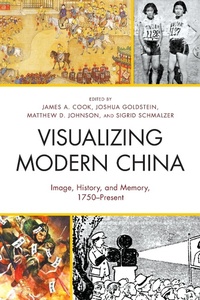
Visualizing Modern China
Image, History, and Memory, 1750-Present
Published on 14. December 2015
Book
Paperback/Softback
306 pages
978-1-4985-0143-9 (ISBN)
Description
Visualizing Modern China: Image, History, and Memory, 1750-Present offers a sophisticated yet accessible interpretation of modern Chinese history through visual imagery. With rich illustrations and a companion website, it is an ideal textbook for college-level courses on modern Chinese history and on modern visual culture. The introduction provides a methodological framework and historical overview, while the chronologically arranged chapters use engaging case studies to explore important themes. Topics include: Qing court ritual, rebellion and war, urban/rural relations, art and architecture, sports, the Chinese diaspora, state politics, film propaganda and censorship, youth in the Cultural Revolution, environmentalism, and Internet culture.
Companion website: http://visualizingmodernchina.org
Companion website: http://visualizingmodernchina.org
Reviews / Votes
This exceptional book provides a fresh history of modern China, showing how it was shaped by visual experiences. Leading scholars trace the strong connection between image-making and state power from the eighteenth to the twenty-first centuries. The essays examine not only artifacts, from folk art to propagandistic cinema, but also how the gaze has been manipulated to create new perceptions of the nation. The book should be read by all who are interested in the relation between vision and power. -- Yomi Braester, University of WashingtonMore details
Series
Language
English
Place of publication
United States
Publishing group
Bloomsbury Publishing Plc
Target group
College/higher education
Product notice
Paperback (trade)
Illustrations
Illustrations; Halftones, Black & White including Black & White Photographs
Dimensions
Height: 229 mm
Width: 152 mm
Thickness: 17 mm
Weight
469 gr
ISBN-13
978-1-4985-0143-9 (9781498501439)
Copyright in bibliographic data and cover images is held by Nielsen Book Services Limited or by the publishers or by their respective licensors: all rights reserved.
Schweitzer Classification
Persons
James A. Cook is associate director of the Asian Studies Center at the University of Pittsburgh.
Joshua Goldstein is associate professor of history at University of Southern California.
Matthew D. Johnson is assistant professor of East Asian history at Grinnell College.
Sigrid Schmalzer is associate professor of history at UMass Amherst.
Joshua Goldstein is associate professor of history at University of Southern California.
Matthew D. Johnson is assistant professor of East Asian history at Grinnell College.
Sigrid Schmalzer is associate professor of history at UMass Amherst.
Content
Chapter 1: Introduction
James Cook, Joshua Goldstein, Matthew Johnson, Sigrid Schmalzer
Chapter 2: Envisioning the Spectacles of Emperor Qianlong's Tours of Southern China
Michael G. Chang
Chapter 3: In the Eyes of the Beholder: Rebellion as Visual Experience
Cecily McCaffrey
Chapter 4: Yangliuqing New Year's Pictures: The Fortune of a Folk Tradition
Madeleine Yue Dong
Chapter 5: Monumentality in Nationalist Nanjing: Purple Mountain's Changing Views
Charles D. Musgrove
Chapter 6: "The Me in the Mirror": Voyeurism and Discipline in Women's Physical Culture, 1921-1937
Andrew D. Morris
Chapter 7: Rethinking "China": Overseas Chinese and China's Modernity
Jame A. Cook
Chapter 8: The Myth about Chinese Leftist Cinema
Zhiwei Xiao
Chapter 9: Imagining the Refugee: The Emergence of a State Welfare System in the War of Resistance
Lu Liu
Chapter 10: Revolutionary Real Estate: Envisioning Space in Communist Dalian
Christian Hess
Chapter 11: Spatial Profiling: Seeing Rural and Urban in Mao's China
Jeremy Brown
Chapter 12: Cinema and Propaganda during the Great Leap Forward
Matthew Johnson
Chapter 13: Images, Memories and Lives, of Sent-down Youth in Yunnan
Zheng Xiaowei
Chapter 14: Wild Pandas, Wild People: Two Views of Wilderness in Deng-Era China
Elena Songster, Sigrid Schmalzer
Chapter 15: Contextualizing the Visual (and Virtual) Realities of Expo 2010
Susan Fernsebner
James Cook, Joshua Goldstein, Matthew Johnson, Sigrid Schmalzer
Chapter 2: Envisioning the Spectacles of Emperor Qianlong's Tours of Southern China
Michael G. Chang
Chapter 3: In the Eyes of the Beholder: Rebellion as Visual Experience
Cecily McCaffrey
Chapter 4: Yangliuqing New Year's Pictures: The Fortune of a Folk Tradition
Madeleine Yue Dong
Chapter 5: Monumentality in Nationalist Nanjing: Purple Mountain's Changing Views
Charles D. Musgrove
Chapter 6: "The Me in the Mirror": Voyeurism and Discipline in Women's Physical Culture, 1921-1937
Andrew D. Morris
Chapter 7: Rethinking "China": Overseas Chinese and China's Modernity
Jame A. Cook
Chapter 8: The Myth about Chinese Leftist Cinema
Zhiwei Xiao
Chapter 9: Imagining the Refugee: The Emergence of a State Welfare System in the War of Resistance
Lu Liu
Chapter 10: Revolutionary Real Estate: Envisioning Space in Communist Dalian
Christian Hess
Chapter 11: Spatial Profiling: Seeing Rural and Urban in Mao's China
Jeremy Brown
Chapter 12: Cinema and Propaganda during the Great Leap Forward
Matthew Johnson
Chapter 13: Images, Memories and Lives, of Sent-down Youth in Yunnan
Zheng Xiaowei
Chapter 14: Wild Pandas, Wild People: Two Views of Wilderness in Deng-Era China
Elena Songster, Sigrid Schmalzer
Chapter 15: Contextualizing the Visual (and Virtual) Realities of Expo 2010
Susan Fernsebner