

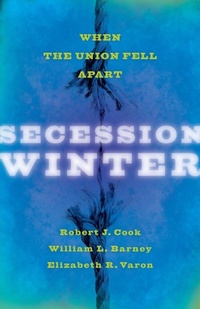
Secession Winter
When the Union Fell Apart
Published on 26. June 2013
Book
Paperback/Softback
136 pages
978-1-4214-0896-5 (ISBN)
Description
Politicians and opinion leaders on both sides of the Mason-Dixon line struggled to formulate coherent responses to the secession of the deep South states. The Confederate attack on Fort Sumter in mid-April 1861 triggered civil war and the loss of four upper South states from the Union. The essays by three senior historians in "Secession Winter" explore the robust debates that preceded these events. For five months in the winter of 1860-1861, Americans did not know for certain that civil war was upon them. Some hoped for a compromise; others wanted a fight. Many struggled to understand what was happening to their country. Robert J. Cook, William L. Barney, and Elizabeth R. Varon take approaches to this period that combine political, economic, and social-cultural lines of analysis. Rather than focus on whether civil war was inevitable, they look at the political process of secession and find multiple internal divisions-political parties, whites and nonwhites, elites and masses, men and women. Even individual northerners and southerners suffered inner conflicts.
The authors include the voices of Unionists and Whig party moderates who had much to lose and upcountry folk who owned no slaves and did not particularly like those who did. Barney contends that white southerners were driven to secede by anxiety and guilt over slavery. Varon takes a new look at Robert E. Lee's decision to join the Confederacy. Cook argues that both northern and southern politicians claimed the rightness of their cause by constructing selective narratives of historical grievances. "Secession Winter" explores the fact of contingency and reminds readers and students that nothing was foreordained.
The authors include the voices of Unionists and Whig party moderates who had much to lose and upcountry folk who owned no slaves and did not particularly like those who did. Barney contends that white southerners were driven to secede by anxiety and guilt over slavery. Varon takes a new look at Robert E. Lee's decision to join the Confederacy. Cook argues that both northern and southern politicians claimed the rightness of their cause by constructing selective narratives of historical grievances. "Secession Winter" explores the fact of contingency and reminds readers and students that nothing was foreordained.
Reviews / Votes
This slim but stimulating collection... deserves a wide audience. -- Jeremy Neely Journal of Southern History [ Secession Winter] should be attractive for use in undergraduate courses on the Civil War era. -- Stanley Harrold The HistorianMore details
Series
Language
English
Place of publication
Baltimore, MD
United States
Target group
College/higher education
Product notice
Paperback (trade)
Dimensions
Height: 216 mm
Width: 140 mm
Thickness: 8 mm
Weight
184 gr
ISBN-13
978-1-4214-0896-5 (9781421408965)
DOI
10.1353/book.49261
Copyright in bibliographic data and cover images is held by Nielsen Book Services Limited or by the publishers or by their respective licensors: all rights reserved.
Schweitzer Classification
Other editions
Additional editions
E-Book
06/2013
Johns Hopkins University Press
€17.49
Available for download
Book
06/2013
Johns Hopkins University Press
€46.50
Article not available at the moment
Persons
Robert J. Cook is a professor of American history at the University of Sussex and author of Civil War Senator: William Pitt Fessenden and the Fight to Save the American Republic. William L. Barney is a professor of history at the University of North Carolina at Chapel Hill and author of The Civil War and Reconstruction: A Student Companion. Elizabeth R. Varon is a professor of history at the University of Virginia and author of Disunion! The Coming of the American Civil War, 1789-1859.
Content
Foreword by Jarod Roll
Introduction: The Secession Crisis as a Study in Conflict Resolution
Rush to Disaster: Secession and the Slaves' Revenge
"Save in Defense of My Native State": A New Look at Robert E. Lee's Decision to Join the Confederacy
The Shadow of the Past: Collective Memory and the Coming of the American Civil War
Conclusion: Conflicted Minds andCivil War Causation
Notes
Guide to Further Reading
Index
Introduction: The Secession Crisis as a Study in Conflict Resolution
Rush to Disaster: Secession and the Slaves' Revenge
"Save in Defense of My Native State": A New Look at Robert E. Lee's Decision to Join the Confederacy
The Shadow of the Past: Collective Memory and the Coming of the American Civil War
Conclusion: Conflicted Minds andCivil War Causation
Notes
Guide to Further Reading
Index