

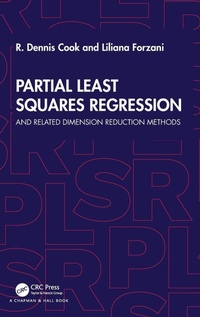
Partial Least Squares Regression
and Related Dimension Reduction Methods
1st Edition
Published on 17. July 2024
Book
Hardback
412 pages
978-1-032-77318-6 (ISBN)
Description
Partial least squares (PLS) regression is, at its historical core, a black-box algorithmic method for dimension reduction and prediction based on an underlying linear relationship between a possibly vector-valued response and a number of predictors.
Through envelopes, much more has been learned about PLS regression, resulting in a mass of information that allows an envelope bridge that takes PLS regression from a black-box algorithm to a core statistical paradigm based on objective function optimization and, more generally, connects the applied sciences and statistics in the context of PLS. This book focuses on developing this bridge. It also covers uses of PLS outside of linear regression, including discriminant analysis, non-linear regression, generalized linear models and dimension reduction generally.
Key Features:
* Showcases the first serviceable method for studying high-dimensional regressions.
* Provides necessary background on PLS and its origin.
* R and Python programs are available for nearly all methods discussed in the book.
This book can be used as a reference and as a course supplement at the Master's level in Statistics and beyond. It will be of interest to both statisticians and applied scientists.
Through envelopes, much more has been learned about PLS regression, resulting in a mass of information that allows an envelope bridge that takes PLS regression from a black-box algorithm to a core statistical paradigm based on objective function optimization and, more generally, connects the applied sciences and statistics in the context of PLS. This book focuses on developing this bridge. It also covers uses of PLS outside of linear regression, including discriminant analysis, non-linear regression, generalized linear models and dimension reduction generally.
Key Features:
* Showcases the first serviceable method for studying high-dimensional regressions.
* Provides necessary background on PLS and its origin.
* R and Python programs are available for nearly all methods discussed in the book.
This book can be used as a reference and as a course supplement at the Master's level in Statistics and beyond. It will be of interest to both statisticians and applied scientists.
More details
Language
English
Place of publication
Boca Raton
United Kingdom
Publishing group
Taylor & Francis Ltd
Target group
College/higher education
Professional and scholarly
Postgraduate and Professional Reference
Illustrations
32 s/w Abbildungen, 32 s/w Zeichnungen, 35 s/w Tabellen
35 Tables, black and white; 32 Line drawings, black and white; 32 Illustrations, black and white
Dimensions
Height: 240 mm
Width: 161 mm
Thickness: 29 mm
Weight
834 gr
ISBN-13
978-1-032-77318-6 (9781032773186)
Copyright in bibliographic data and cover images is held by Nielsen Book Services Limited or by the publishers or by their respective licensors: all rights reserved.
Schweitzer Classification
Other editions
Additional editions
R. Dennis Cook | Liliana Forzani
Partial Least Squares Regression
and Related Dimension Reduction Methods
E-Book
07/2024
1st Edition
Chapman and Hall
€73.99
Available for download
R. Dennis Cook | Liliana Forzani
Partial Least Squares Regression
and Related Dimension Reduction Methods
E-Book
07/2024
1st Edition
Chapman and Hall
€73.99
Available for download
Persons
R. Dennis Cook is Professor Emeritus, School of Statistics, University of Minnesota. His research areas include dimension reduction, linear and nonlinear regression, experimental design, statistical diagnostics, statistical graphics, and population genetics. Perhaps best known for "Cook's Distance," a now ubiquitous statistical method, he has authored over 250 research articles, two textbooks and three research monographs. He is a five-time recipient of the Jack Youden Prize for Best Expository Paper in Technometrics as well as the Frank Wilcoxon Award for Best Technical Paper. He received the 2005 COPSS Fisher Lecture and Award, and is a Fellow of ASA and IMS.
Liliana Forzani is Full Professor, School of Chemical Engineering, National University of Litoral and principal researcher of CONICET (National Scientific and Technical Research Council), Argentina. Her contributions are in mathematical statistics, especially sufficient dimension reduction, abundance in regression and statistics for chemometrics. She established the first research group in statistics at her university after receiving her Ph.D in Statistics at the University of Minnesota. She has authored over 75 research articles in mathematics and statistics, and was recipient of the L'Oreal-Unesco-Conicet prize for Women in science.
Liliana Forzani is Full Professor, School of Chemical Engineering, National University of Litoral and principal researcher of CONICET (National Scientific and Technical Research Council), Argentina. Her contributions are in mathematical statistics, especially sufficient dimension reduction, abundance in regression and statistics for chemometrics. She established the first research group in statistics at her university after receiving her Ph.D in Statistics at the University of Minnesota. She has authored over 75 research articles in mathematics and statistics, and was recipient of the L'Oreal-Unesco-Conicet prize for Women in science.
Content
Preface
1. Introduction
2. Envelopes for Regression
3. PLS Algorithms for Predictor Reduction
4. Asymptotic Properties of PLS
5. Simultaneous Reduction
6. Partial PLS and Partial Envelopes
7. Linear Discriminant Analysis
8. Quadratic Discriminant Analysis
9. Nonlinear PLS
10. The Role of PLS in Social Science Path Analyses
11. Ancillary Topics
A. Proofs of Selected Results
Bibliography
1. Introduction
2. Envelopes for Regression
3. PLS Algorithms for Predictor Reduction
4. Asymptotic Properties of PLS
5. Simultaneous Reduction
6. Partial PLS and Partial Envelopes
7. Linear Discriminant Analysis
8. Quadratic Discriminant Analysis
9. Nonlinear PLS
10. The Role of PLS in Social Science Path Analyses
11. Ancillary Topics
A. Proofs of Selected Results
Bibliography