

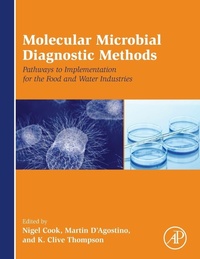
Molecular Microbial Diagnostic Methods
Pathways to Implementation for the Food and Water Industries
Published on 1. October 2015
Book
Hardback
262 pages
978-0-12-416999-9 (ISBN)
Description
Molecular Microbial Diagnostic Methods: Pathways to Implementation for the Food and Water Industry was developed by recognized and experienced highlevel scientists. It's a comprehensive and detailed reference that uncovers industry needs for the use of molecular methods by providing a brief history of water and food analysis for the pathogens of concern. It also describes the potential impact of current and cutting-edge molecular methods. This book discusses the advantages of the implementation of molecular methods, describes information on when and how to use specific methods, and presents why one should utilize them for pathogen detection in the routine laboratory. The content is also pertinent for anyone carrying out microbiological analysis at the research level, and for scientists developing methods, as it focuses on the requirements of end-users.
More details
Language
English
Place of publication
San Diego
United States
Publishing group
Elsevier Science Publishing Co Inc
Target group
Professional and scholarly
Researchers and research analysts in microbiological laboratories
Product notice
Laminated cover
Dimensions
Height: 235 mm
Width: 191 mm
Thickness: 16 mm
Weight
674 gr
ISBN-13
978-0-12-416999-9 (9780124169999)
Copyright in bibliographic data and cover images is held by Nielsen Book Services Limited or by the publishers or by their respective licensors: all rights reserved.
Schweitzer Classification
Other editions
Additional editions
Nigel Cook | Martin D'Agostino | K. Clive Thompson
Molecular Microbial Diagnostic Methods
Pathways to Implementation for the Food and Water Industries
E-Book
10/2015
Academic Press
€108.00
Available for download
Persons
Dr. Nigel Cook is Senior microbiologist at The Food and Environment Research Agency (FERA) in the UK. He specializes in integrated monitoring and control of foodborne viruses in European Food Supply Chains. Martin D'Agostino has worked for Fera Science Ltd, formerly the Food and Environment Research Agency (Fera) since 1994. His microbiological career began with Kennerty Farm Dairies in Aberdeen (now Robert Wisemans) as a laboratory assistant, until he joined what was the Torry Food Science Laboratory (Central Science Laboratory, MAFF) in 1994, now named the Food and Environment Research Agency as part of Defra. He has been involved in EU Framework 5, 6 and 7 projects dealing with such areas as Food PCR, Surveillance of Adenovirus and Norovirus in European Bathing waters and more recently has assisted in the coordination of the FP7 project entitled "Integrated monitoring and Control of Foodborne Viruses in European Food Supply Chains? (www.eurovital.org). This has resulted in the accumulation of many European and worldwide contacts from both Academia and Industry related to both food and environmental microbiology. Martin has experience of chairing and presenting scientific talks at international scientific meetings and has been an author in at least 25 peer reviewed articles including journal manuscripts, several reviews and book chapters and is an editor of a book, related to the detection and implementation of rapid methods for foodborne and environmental human pathogens. Dr. K. Clive Thompson is Fellow of the Royal Society of Chemistry; Fellow of the Institute of Food Science & Technology; Fellow of the Royal Society of Public Health; Member of the Water Management Society; Member of the American Chemical Society; Member of the American Society for Microbiology; Fellow of the Chartered Institute of Water and Environmental Management; Member of Board of Trustees of Society of Chemical Industry; Society of Chemical Industry (SCI) Environmental Medal (2003); Member of AOAC; Member of the Society of Environmental Toxicology and Chemistry; Distinguished Service Certificate, British Standards in appreciation of long and valued contributions to the development of British, European and International Standards; and Visiting Professor at Brunel University.He is currently Chief Scientist at ALcontrol Laboratories UK, which analyses a very wide range of samples including food, drinking water, process waters, and effluents for both chemical and microbiological parameters. It has eight laboratories in the UK and is one of the largest contract contaminated land analysis / water analysis / food analysis laboratory organisations in Europe. Dr Thompson previously worked for Yorkshire water and Severn Trent Water. He is a member of many national and international standardisation committees and has published more than 40 peer-reviewed papers and co-edited a significant number of books.
Content
1. Food industry current status
2. Future directions for molecular microbial diagnostic methods for the food industry
3. Current status of molecular microbiological techniques for the analysis of drinking water
4. Future directions for molecular microbial diagnostic methods for the water industry
5. EN ISO Standards for both culture and molecular methods
6. Laboratory validation, verification and accreditation of molecular methods
7. DNA extraction: finding the most suitable method
8. Assessing organism viability and interpreting genomic unit vs. colony forming unit data for water and food borne microorganisms such as Legionella, Campylobacter, Salmonella and Listeria
9. MALDI-TOF: A rapid microbiological confirmation technique for food and water analysis
10. Chapter highlights, future requirements and conclusions
2. Future directions for molecular microbial diagnostic methods for the food industry
3. Current status of molecular microbiological techniques for the analysis of drinking water
4. Future directions for molecular microbial diagnostic methods for the water industry
5. EN ISO Standards for both culture and molecular methods
6. Laboratory validation, verification and accreditation of molecular methods
7. DNA extraction: finding the most suitable method
8. Assessing organism viability and interpreting genomic unit vs. colony forming unit data for water and food borne microorganisms such as Legionella, Campylobacter, Salmonella and Listeria
9. MALDI-TOF: A rapid microbiological confirmation technique for food and water analysis
10. Chapter highlights, future requirements and conclusions