

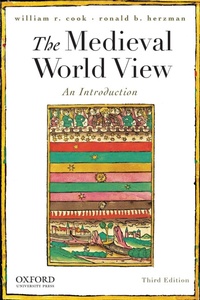
The Medieval World View
An Introduction
3rd Edition
Published on 12. January 2012
Book
Paperback/Softback
432 pages
978-0-19-537368-4 (ISBN)
Description
The Medieval World View, Third Edition, presents the presuppositions of medieval society in a systematic fashion by integrating brief, self-contained selections from primary texts and carefully captioned photographs into a narrative of the medieval world and its foundations.
The text is divided into three parts. Treating both the classical and biblical antecedents of the Middle Ages and ending in Late Antiquity, Part One includes a thorough discussion of the monumental figure of St. Augustine. Part Two deals with the early Middle Ages, beginning with the disintegration of the Roman Empire and continuing through the German invasions and the renaissance associated with the reign of Charlemagne. Part Three examines the High Middle Ages and beyond, following developments in the Church, in politics, and in arts and culture from the twelfth century through the end of the fifteenth century. The third edition features two entirely new chapters, Chapter 5 on Byzantium and Chapter 6 on Islam. Handling sophisticated issues with great clarity and ease, The Medieval World View is ideal for courses in Medieval history, literature, or art history.
The text is divided into three parts. Treating both the classical and biblical antecedents of the Middle Ages and ending in Late Antiquity, Part One includes a thorough discussion of the monumental figure of St. Augustine. Part Two deals with the early Middle Ages, beginning with the disintegration of the Roman Empire and continuing through the German invasions and the renaissance associated with the reign of Charlemagne. Part Three examines the High Middle Ages and beyond, following developments in the Church, in politics, and in arts and culture from the twelfth century through the end of the fifteenth century. The third edition features two entirely new chapters, Chapter 5 on Byzantium and Chapter 6 on Islam. Handling sophisticated issues with great clarity and ease, The Medieval World View is ideal for courses in Medieval history, literature, or art history.
Reviews / Votes
"Cook and Herzman is my favorite textbook for use in the classroom. . . . I can think of no better text to assign to my students for an overview of Christian thought from Paul up through the mendicant movement. I use the book in almost every course I teach."--Valerie Ramseyer, Wellesley College"The Medieval World View's great strength is its streamlined focus on the intellectual legacies of the Middle Ages."--Curtis Gruenler, Hope College
More details
Edition
3rd Revised edition
Language
English
Place of publication
New York
United States
Edition type
Revised edition
Dimensions
Height: 234 mm
Width: 156 mm
Thickness: 23 mm
Weight
646 gr
ISBN-13
978-0-19-537368-4 (9780195373684)
Copyright in bibliographic data and cover images is held by Nielsen Book Services Limited or by the publishers or by their respective licensors: all rights reserved.
Schweitzer Classification
Other editions
Previous edition
William R. Cook
The Medieval World View
Book
07/2003
2nd Edition
Oxford University Press Inc
€54.47
Article exhausted; check for reprint
Persons
William R. Cook is Distinguished Teaching Professor of History at the State University of New York at Geneseo.
Ronald B. Herzman is Distinguished Teaching Professor of English at the State University of New York at Geneseo.
Ronald B. Herzman is Distinguished Teaching Professor of English at the State University of New York at Geneseo.
Content
Acknowledgements ; Preface ; Introduction ; Time Line ; PART 1: FOUNDATIONS OF THE MIDDLE AGES ; 1. The Bible ; 2. The Classical Heritage ; 3. Early Christianity ; 4. Saint Augustine ; PART 2: THE MEDITERRANEAN WORLD ; 5. Byzantium ; 6. Islam ; 7. The West After the Collapse of Roman Authority ; PART 3: THE EARLY MIDDLE AGES ; 8. Western Monasticism ; 9. The First Medieval Synthesis: The Carolingian World and Its Dissolution ; PART 4: THE HIGH MIDDLE AGES ; 10. Church, State, and Society ; 11. The Renaissance of the Twelfth Century ; 12. Francis of Assisi and the Mendicants ; PART 5: EPILOGUE ; 13. From Medieval to Renaissance ; Notes ; Bibliography ; Index