

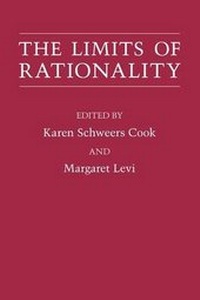
The Limits of Rationality
Published on 15. November 1990
Book
Paperback/Softback
272 pages
978-0-226-74239-7 (ISBN)
Description
Prevailing economic theory presumes that agents act rationally when they make decisions, striving to maximize the efficient use of their resources. Psychology has repeatedly challenged the rational choice paradigm with persuasive evidence that people do not always make the optimal choice. Yet the paradigm has proven so successful a predictor that its use continues to flourish, fueled by debate across the social sciences over why it works so well.
Intended to introduce novices to rational choice theory, this accessible, interdisciplinary book collects writings by leading researchers. The Limits of Rationality illuminates the rational choice paradigm of social and political behavior itself, identifies its limitations, clarifies the nature of current controversies, and offers suggestions for improving current models.
In the first section of the book, contributors consider the theoretical foundations of rational choice. Models of rational choice play an important role in providing a standard of human action and the bases for constitutional design, but do they also succeed as explanatory models of behavior? Do empirical failures of these explanatory models constitute a telling condemnation of rational choice theory or do they open new avenues of investigation and theorizing?
Emphasizing analyses of norms and institutions, the second and third sections of the book investigate areas in which rational choice theory might be extended in order to provide better models. The contributors evaluate the adequacy of analyses based on neoclassical economics, the potential contributions of game theory and cognitive science, and the consequences for the basic framework when unequal bargaining power and hierarchy are introduced.
Intended to introduce novices to rational choice theory, this accessible, interdisciplinary book collects writings by leading researchers. The Limits of Rationality illuminates the rational choice paradigm of social and political behavior itself, identifies its limitations, clarifies the nature of current controversies, and offers suggestions for improving current models.
In the first section of the book, contributors consider the theoretical foundations of rational choice. Models of rational choice play an important role in providing a standard of human action and the bases for constitutional design, but do they also succeed as explanatory models of behavior? Do empirical failures of these explanatory models constitute a telling condemnation of rational choice theory or do they open new avenues of investigation and theorizing?
Emphasizing analyses of norms and institutions, the second and third sections of the book investigate areas in which rational choice theory might be extended in order to provide better models. The contributors evaluate the adequacy of analyses based on neoclassical economics, the potential contributions of game theory and cognitive science, and the consequences for the basic framework when unequal bargaining power and hierarchy are introduced.
More details
Language
English
Place of publication
Chicago
United States
Publishing group
The University of Chicago Press
Target group
College/higher education
Professional and scholarly
Dimensions
Height: 23 mm
Width: 15 mm
Thickness: 3 mm
Weight
652 gr
ISBN-13
978-0-226-74239-7 (9780226742397)
Copyright in bibliographic data and cover images is held by Nielsen Book Services Limited or by the publishers or by their respective licensors: all rights reserved.
Schweitzer Classification
Other editions
Additional editions
Karen Schweers Cook | Margaret Levi
Limits of Rationality
E-Book
10/2008
1st Edition
University of Chicago Press
€73.69
Available for download