

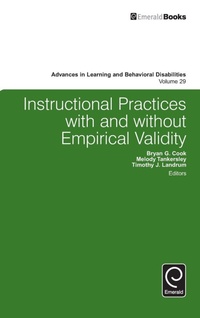
Instructional Practices with and without Empirical Validity
Published on 6. July 2016
Book
Hardback
350 pages
978-1-78635-126-5 (ISBN)
Description
It is important that stakeholders are aware of practices supported as effective for students with learning and behavioral disabilities in order to provide instruction that results in improved learner outcomes. Perhaps equally important, stakeholders should also know which practices have been shown by research to be ineffective (e.g., have no, small, or inconsistent effects on learner outcomes). Special education has a long history of using practices that, though appealing in some ways, have little or no positive impact on learner outcomes. In order to bridge the gap between research and practice, educators must be aware of which practices work (and prioritize their use) and which do not (and avoid their use). In this volume, each chapter describes two practices one supported as effective by research and one shown by research to be ineffective in critical areas of education for students with learning and behavioral disabilities. Chapter authors will provide readers guidance in how to do this for each effective practices and provide concrete reasons to not do this for each ineffective practice.
Reviews / Votes
American educators provide information on theory, critical elements, and research for instructional practices that are and are not supported by bodies of scientific research as effective in critical outcome areas, particularly regarding students with learning and behavioral disabilities. Their topics include two approaches for improving reading fluency: research supports repeated reading but not colored filters, developing mathematical problem solving through strategic instruction: much more than key word, what the research says about movement as behavioral moderator, the appropriate and inappropriate use of praise and feedback for students with learning and behavioral disabilities, and deep pressure therapy does not reduce stereotypical behavior but function-based interventions do. -- Annotation * (protoview.com) *More details
Series
Language
English
Place of publication
Bingley
United Kingdom
Publishing group
Emerald Publishing Limited
Target group
Professional and scholarly
College/higher education
Dimensions
Height: 235 mm
Width: 157 mm
Thickness: 17 mm
Weight
493 gr
ISBN-13
978-1-78635-126-5 (9781786351265)
Copyright in bibliographic data and cover images is held by Nielsen Book Services Limited or by the publishers or by their respective licensors: all rights reserved.
Schweitzer Classification
Other editions
Additional editions
Bryan G. Cook | Melody Tankersley | Timothy J. Landrum
Instructional Practices with and without Empirical Validity
E-Book
07/2016
Emerald Publishing Limited
€113.99
Available for download
Persons
Edited by Bryan G. Cook, University of Hawaii at Manoa, Honolulu, HI, USA
Melody Tankersley, Kent State University, Kent, OH, USA
Timothy J. Landrum, University of Louisville, Louisville, KY, USA
Melody Tankersley, Kent State University, Kent, OH, USA
Timothy J. Landrum, University of Louisville, Louisville, KY, USA
Content
1. Instructional Practices with and Without Empirical Validity: An Introduction - Bryan G. Cook, Melody Tankersley and Timothy J. Landrum
2. Two Approaches for Improving Reading Fluency: Research Supports Repeated Reading But Not Colored Filters - Bryan G. Cook and Christina Keaulana
3. Developing Mathematical Problem Solving Through Strategic Instruction: Much More Than a Keyword - Paul J. Riccomini, Jiwon Hwang and Stephanie Morano
4. Effective and Ineffective Writing Practices for Students with Disabilities - Amy Gillespie Rouse and Alyson A. Collins
5. Picture Exchange Communication System and Facilitated Communication: Contrasting an Evidence-Based Practice with a Discredited Method - Jason C. Travers, Matt Tincani, Julie L. Thompson and Richard L. Simpson
6. Movement as Behavioral Moderator: What Does the Research Say? - Amy E. Ruhaak and Bryan G. Cook
7. Learning Styles, Learning Preferences, and Student Choice: Implications for Teaching - Timothy J. Landrum and Kimberly M. Landrum
8. Never Say Never: The Appropriate and Inappropriate Use of Praise and Feedback for Students with Learning and Behavioral Disabilities - Lauren W. Collins and Lysandra Cook
9. Do School-Wide Positive Behavioral Interventions and Supports, Not Exclusionary Discipline Practices - Rhonda N. T. Nese and Kent McIntosh
10. Deep Pressure Therapy Doesn't Reduce Stereotypical Behavior, Function-Based Interventions Do Mickey Losinski and Robin Parks Ennis
2. Two Approaches for Improving Reading Fluency: Research Supports Repeated Reading But Not Colored Filters - Bryan G. Cook and Christina Keaulana
3. Developing Mathematical Problem Solving Through Strategic Instruction: Much More Than a Keyword - Paul J. Riccomini, Jiwon Hwang and Stephanie Morano
4. Effective and Ineffective Writing Practices for Students with Disabilities - Amy Gillespie Rouse and Alyson A. Collins
5. Picture Exchange Communication System and Facilitated Communication: Contrasting an Evidence-Based Practice with a Discredited Method - Jason C. Travers, Matt Tincani, Julie L. Thompson and Richard L. Simpson
6. Movement as Behavioral Moderator: What Does the Research Say? - Amy E. Ruhaak and Bryan G. Cook
7. Learning Styles, Learning Preferences, and Student Choice: Implications for Teaching - Timothy J. Landrum and Kimberly M. Landrum
8. Never Say Never: The Appropriate and Inappropriate Use of Praise and Feedback for Students with Learning and Behavioral Disabilities - Lauren W. Collins and Lysandra Cook
9. Do School-Wide Positive Behavioral Interventions and Supports, Not Exclusionary Discipline Practices - Rhonda N. T. Nese and Kent McIntosh
10. Deep Pressure Therapy Doesn't Reduce Stereotypical Behavior, Function-Based Interventions Do Mickey Losinski and Robin Parks Ennis