

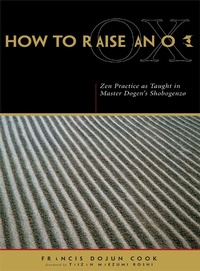
How to Raise an Ox
ZEN Practice as Taught in Master Dogen's "Shobogenzo"
Will be published approx. on 1. May 1999
Book
Paperback/Softback
208 pages
978-0-86171-317-2 (ISBN)
Description
Thirteenth-century Zen Master Eihei Dogen has been unanimously acknowledged by Japanese and Western scholars alike as Japan's foremost philosopher. Now Francis Dojun Cook, a Dogen scholar for many years, has translated ten practice-oriented chapters of Master Dogen's masterwork, the Shobogenzo ("Treasury of the True Dharma Eye"), in which he discusses what is involved in the wholehearted, moment-to-moment practice of Zen, with numerous examples from the lives of past masters.
More details
Edition
New edition
Language
English
Place of publication
Somerville
United States
Edition type
New edition
Product notice
Paperback (trade)
Unsewn / adhesive bound
Dimensions
Height: 230 mm
Width: 151 mm
Thickness: 14 mm
Weight
272 gr
ISBN-13
978-0-86171-317-2 (9780861713172)
Copyright in bibliographic data and cover images is held by Nielsen Book Services Limited or by the publishers or by their respective licensors: all rights reserved.
Schweitzer Classification
Other editions
Additional editions
Eihei Dogen | Francis Dojun Cook
How to Raise an Ox
Zen Practice as Taught in Master Dogen's Shobogenzo
E-Book
08/2011
Wisdom Publications
€12.85
Available for download
Person
Eihei Dogen founded the Japanese Soto School of Zen, and is renowned as one of the world’s most remarkable religious thinkers. As Shakespeare does with English, Dogen utterly transforms the language of Zen, using it in novel and extraordinarily beautiful ways in his voluminous writings. Born in 1200 to an aristocratic background, he was ordained a monk in the Japanese Tendai School in his early teens, but became dissatisfied with Japanese Buddhism. After traveling in China from 1223 to 1227, he returned to introduce to Japan the Soto lineage and the large body of Chan teaching stories, or koans, which he had thoroughly mastered. From 1233 to 1243 he taught near the cultural capital of Kyoto, then in 1243 moved to the remote northern mountains and founded the temple Eiheiji, still one of the headquarter temples of Soto Zen. There, until his illness and death in 1253, he trained a core group of monks who spread Soto Zen throughout the Japanese countryside. Dogen’s writings are noted for their poetic and philosophic depth, though aimed at spiritual practitioners. His two major, massive works are Shobogenzo (True Dharma Eye Treasury) and Eihei Koroku (Dogen’s Extensive Record). Although not studied for many centuries aside from Soto scholars, in modern times Dogen’s writings, through translation, have become an important part of the spread of Buddhism in the West.