

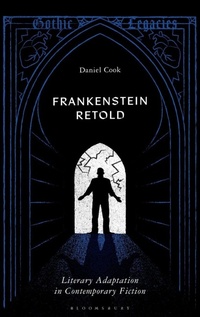
Frankenstein Retold
Literary Adaptation in Contemporary Fiction
Will be published approx. on 16. April 2026
Book
Hardback
240 pages
978-1-350-50195-9 (ISBN)
Description
Placing Frankenstein in the critical frameworks of book history and secondary authorship, this book explores the increasing array of book-based reworkings of, and sequels to, the novel that up to this point, have been largely ignored. Covering novels, novellas and short stories across a range of genres from romance to YA fiction, Frankenstein Retold examines a broad range of these texts in different purviews and demonstrates their own critical value as well and pertinence for understanding new approaches to literary adaptation in theory and practice more broadly. Organised thematically, the book cover topics including: filial characterisation; continuations and sequels explicitly tied to Shelley's narrative; epistolary, journal-based, found-text and other storytelling forms; coquels set against the original material; fiction in which Shelley's materials have been transplanted to entirely new settings, periods or genres; cameos; and the ghostly presence of the original author. A testament to the vitality of the original story more than two centuries after it first appeared, Daniel Cook explores works from a huge range of writers such as Peter Ackroyd, Jeanette Winterson, Ahmed Saadawi, Suzanne Weyne, Jon Skovron, William A. Chandler, Susan Heyboer Okeefe, Hailey Bailey, Laurie Sheck, Edward M. Erdelac, Fred Saberhagen and Kate Horsley among many others. With a large body of scholarship already exploring the rich cinematic, transmedial and cultural afterlife of Shelley's novel, Frankenstein Retold offers a bridge between literary studies notions of book history and authorship, and media studies approaches to transmedia storytelling, between fan writing and media production histories.
Reviews / Votes
Set against a marching hoard of Frankenstein scholarship that tends to focus disproportionately on Shelley's cinematic afterlives, this book makes a fresh intervention by considering the literary, book-based adaptations that animate the enduring myth of Frankenstein. Treating Frankenstein as a "foundational allegory of Gothic authorship," this book provides a formal analysis and taxonomy of the exciting and at times monstrous literary experiments that unfold and feed into one another as contemporary authors rewrite and reassemble Shelley's "hideous progeny." Original and compelling, this is a must-read for scholars interested in Shelley or the Gothic, or in how literature continues to reinvent itself. * Kirstin Mills, Senior Lecturer, Macquarie University, Australia *More details
Series
Language
English
Place of publication
London
United Kingdom
Publishing group
Bloomsbury Publishing PLC
Target group
Professional and scholarly
College/higher education
Dimensions
Height: 240 mm
Width: 161 mm
Thickness: 17 mm
Weight
517 gr
ISBN-13
978-1-350-50195-9 (9781350501959)
Copyright in bibliographic data and cover images is held by Nielsen Book Services Limited or by the publishers or by their respective licensors: all rights reserved.
Schweitzer Classification
Other editions
Additional editions
E-Book
03/2026
1st Edition
Bloomsbury Academic
€94.49
Available for download
E-Book
03/2026
1st Edition
Bloomsbury Academic
€94.49
Available for download
Person
Daniel Cook is Associate Dean and Reader in English Literature at the University of Dundee, UK. He is the author of Walter Scott and Short Fiction (2021), Reading Swift's Poetry (2020), and Thomas Chatterton and Neglected Genius, 1760-1830 (2013). His most recent books include The Cambridge Companion to Gulliver's Travels, with Nicholas Seager (2023), Gulliver's Travels: The Norton Library (2023), Scottish Poetry, 1730-1830 (2023), and Austen After 200: New Reading Spaces, with Annika Bautz and Kerry Sinanan (2022).
Content
Preface
Introduction
New and Hybrid Species
Retelling Tales in Theory and Practice Frankensteinian Retellings Frankenstein Retold: A User's Guide
Chapter 1. New Beginnings
The Answering Novel: Frankenstein Unbound
The Teller and the Tale: Frankissstein
Chapter 2. The Literary Redo
The Strange Casebook
The Turning Pages: A Monster's Notes
When a Monster Calls: Monster and The Frankenstein Papers
Chapter 3. Sequels and Prequels
The Frankenstein Sequel Becoming Victor
Chapter 4. Brides Revisited
Half-Finished Brides
Survivors: Pandora's Bride and Born of the Sea
Chapter 5. Orcadian Coquels
The Bride-to-be: The Monster's Wife
The Restless Bride of Eynhallow
Chapter 6. Patchwork Things
The Twice-Told Tale: Poor Things
M/S: Patchwork Girl
Chapter 7. Old Endings
The Under-Story of Elizabeth Frankenstein Unnatural Women
Frankenstein's Daughters
Afterword: The Modern Deucalion
Bibliography
Index
Introduction
New and Hybrid Species
Retelling Tales in Theory and Practice Frankensteinian Retellings Frankenstein Retold: A User's Guide
Chapter 1. New Beginnings
The Answering Novel: Frankenstein Unbound
The Teller and the Tale: Frankissstein
Chapter 2. The Literary Redo
The Strange Casebook
The Turning Pages: A Monster's Notes
When a Monster Calls: Monster and The Frankenstein Papers
Chapter 3. Sequels and Prequels
The Frankenstein Sequel Becoming Victor
Chapter 4. Brides Revisited
Half-Finished Brides
Survivors: Pandora's Bride and Born of the Sea
Chapter 5. Orcadian Coquels
The Bride-to-be: The Monster's Wife
The Restless Bride of Eynhallow
Chapter 6. Patchwork Things
The Twice-Told Tale: Poor Things
M/S: Patchwork Girl
Chapter 7. Old Endings
The Under-Story of Elizabeth Frankenstein Unnatural Women
Frankenstein's Daughters
Afterword: The Modern Deucalion
Bibliography
Index