

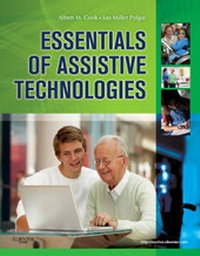
Essentials of Assistive Technologies
Published on 27. January 2012
Book
Paperback/Softback
360 pages
978-0-323-07536-7 (ISBN)
Description
Master the assistive strategies you need to make confident clinical decisions and help improve the quality of life for people with disabilities with this new essentials text. Based on the Human Activity Assistive Technology (HAAT) model developed by Dr. Cook, the book provides the most important coverage of the devices, services, and practices that comprise assistive technology and focuses on the relationship between the human user and the assisted activity within specific contexts. Case studies, illustrations of assistive devices, review questions, and well-developed learning objectives help you focus on the most important areas of assistive technology application.
UNIQUE! OTA focus provides you with the specific information occupational therapy assistants need to know to implement and utilize assistive technologies.
Comprehensive coverage includes all areas of assistive technologies.
The AT industry
A historical perspective on the industry
Relevant legislation
Issues of professional practice
Service delivery in assistive technologies
General purpose assistive technologies
Specific areas of application for assistive technologies
And more
Content derived from market leader gives you similar chapters and organization to the Principles text, but has more of a focus on the practical skills and knowledge needed for the implementation of AT.
UNIQUE! OTA focus provides you with the specific information occupational therapy assistants need to know to implement and utilize assistive technologies.
Comprehensive coverage includes all areas of assistive technologies.
The AT industry
A historical perspective on the industry
Relevant legislation
Issues of professional practice
Service delivery in assistive technologies
General purpose assistive technologies
Specific areas of application for assistive technologies
And more
Content derived from market leader gives you similar chapters and organization to the Principles text, but has more of a focus on the practical skills and knowledge needed for the implementation of AT.
Reviews / Votes
"This book strive to support rehabilitation staff who need practical information about AT, with emphasis on implementing effective systems for consumers in clinical and community settings to facilitate increased independence in activities of daily living...There is a good balance of theory and practice, and for those who wish to focus on theory, the theory has been separated in the text to make it easier to focus on...It is well referenced, with links to aid further research, if required. The reader can also register on-line to the 'Evolve' website to add to the learning experience, with free study tools."Irish Journal of Occupational Therapy, April 2012
More details
Language
English
Place of publication
St Louis
United States
Publishing group
Elsevier - Health Sciences Division
Target group
Professional and scholarly
Illustrations
Approx. 250 illustrations
Dimensions
Height: 276 mm
Width: 216 mm
Weight
710 gr
ISBN-13
978-0-323-07536-7 (9780323075367)
Copyright in bibliographic data and cover images is held by Nielsen Book Services Limited or by the publishers or by their respective licensors: all rights reserved.
Schweitzer Classification
Other editions
Additional editions
Pe Cook | BScOT Polgar
Essentials of Assistive Technologies
E-Book
12/2011
Mosby
€58.99
Available for download
Persons
Professor Emeritus Albert M. Cook, Communication Sciences and Disorders, University of Alberta, Edmonton, Alberta, Canada. Professor Emerita Janice Miller Polgar works at the School of Occupational Therapy, Faculty of Health Sciences, Western University, London, Ontario, Canada.
Content
1. Introduction and Overview
2. A Framework for Assistive Technologies
3. Disabled Human User of Assistive Technologies
4. Seating Systems as Extrinsic Enablers for Assistive Technologies
5. Making the Connection: User Inputs for Assistive Technologies
6. Control Interfaces for Assistive Technologies
7. Computer Access ? Augmenting the Keyboard and Mouse
8. Sensory Aids for Persons with Visual Impairments
9. Sensory Aids for Persons with Auditory Impairments
10. Assistive Technologies to Aid Cognitive Function
11. Augmentative and Alternative Communication
12. Technologies That Enable Mobility
13. Technologies for Transportation and Driving
14. Technologies That Aid Manipulation and Control of the Environment
2. A Framework for Assistive Technologies
3. Disabled Human User of Assistive Technologies
4. Seating Systems as Extrinsic Enablers for Assistive Technologies
5. Making the Connection: User Inputs for Assistive Technologies
6. Control Interfaces for Assistive Technologies
7. Computer Access ? Augmenting the Keyboard and Mouse
8. Sensory Aids for Persons with Visual Impairments
9. Sensory Aids for Persons with Auditory Impairments
10. Assistive Technologies to Aid Cognitive Function
11. Augmentative and Alternative Communication
12. Technologies That Enable Mobility
13. Technologies for Transportation and Driving
14. Technologies That Aid Manipulation and Control of the Environment