

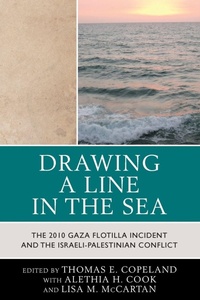
Drawing a Line in the Sea
The Gaza Flotilla Incident and the Israeli-Palestinian Conflict
Published on 18. October 2013
Book
Paperback/Softback
200 pages
978-0-7391-8807-1 (ISBN)
Description
The deadly May 31, 2010 Gaza flotilla incident has been misunderstood. This book explores the incident in more detail than mainstream media coverage has allowed-explaining the background, key players, and the incident itself-enriched by the authors having had unique access to senior Israeli officials in the immediate aftermath of the event. The incident is a microcosm of the struggle between terrorism and democratic societies, and raises a number of legal, ethical, and strategic political issues in the contemporary Middle East. Chapters address the political and military scenario preceding the incident, key state and non-state actors involved, military and ethical dimensions of the operation, and the aftermath in the media and politics. The book provides thoughtful and readable analysis that is useful to policy makers and to the general public, and draws some important conclusions for the continuing conflict between democratic states and terrorists and their sponsors.
Reviews / Votes
The Gaza Flotilla Incident of 2010 marked a dramatic shift in Turkey's relations with Israel and with the Middle East region in general. Drawing a Line in the Sea, an excellent collection of 14 essays by academics familiar with the region, goes a long way toward helping readers understand what led up to the Gaza Flotilla Incident and its significance to the Middle East and beyond. Drawing a Line is effectively organized in three parts: The Scenario, The Players, and The Incident and its Aftermath. Each has its own story to tell and each essay is well worth the read. -- Fred M. Gottheil, University of Illinois at Urbana-ChampaignMore details
Language
English
Place of publication
United States
Publishing group
Bloomsbury Publishing Plc
Target group
Professional and scholarly
Dimensions
Height: 229 mm
Width: 152 mm
Thickness: 11 mm
Weight
307 gr
ISBN-13
978-0-7391-8807-1 (9780739188071)
Copyright in bibliographic data and cover images is held by Nielsen Book Services Limited or by the publishers or by their respective licensors: all rights reserved.
Schweitzer Classification
Other editions
Additional editions
Alethia H. Cook | Lisa M. McCartan
Drawing a Line in the Sea
The Gaza Flotilla Incident and the Israeli-Palestinian Conflict
E-Book
09/2011
1st Edition
Lexington Books
from
€65.09
Available for download
Alethia H. Cook | Lisa M. McCartan
Drawing a Line in the Sea
The Gaza Flotilla Incident and the Israeli-Palestinian Conflict
E-Book
09/2011
1st Edition
Lexington Books
€48.49
Available for download
Persons
Thomas E. Copeland is associate professor of political science and humanities at Geneva College.
Alethia H. Cook is assistant director of the Security Studies Program at East Carolina University.
Lisa M. McCartan is associate professor in the department of anthropology, criminology, and sociology at Le Moyne College.
Alethia H. Cook is assistant director of the Security Studies Program at East Carolina University.
Lisa M. McCartan is associate professor in the department of anthropology, criminology, and sociology at Le Moyne College.
Content
Chapter 1. Introduction: Understanding the Gaza Flotilla Incident
Part 2 Part 1: The Scenario
Chapter 3 Chapter 2. Ethnic and Religious Dimensions of the Israeli-Palestinian Struggle
Chapter 4 Chapter 3. Why There? The Origin, Evolution, and Historical Significanceof the Gaza Strip
Chapter 5 Chapter 4. Iran and Weapons Proliferation in Lebanon and Gaza
Chapter 6 Chapter 5. Ethical Considerations and Israeli Policy towards the Palestinians
Part 7 Part 2: The Players
Chapter 8 Chapter 6. Islamic Resurgence in Turkey: The Mavi Marmara Incident as its Statement
Chapter 9 Chapter 7. Hamas - Ideology, Elections, and Governance in Gaza
Chapter 10 Chapter 8. Charity Begins (and Ends?) at Home: The Nexus between Islamic Social Welfare and the Funding of Terrorism
Chapter 11 Chapter 9. RMA's, Hybrid Wars, and the Gaza Flotilla Incident
Part 12 Part 3: The Incident and Its Aftermath
Chapter 13 Chapter 10. Tactical Ethics: An Evaluation of the Israeli Naval Commando Assault on the MV Mavi Marmara
Chapter 14 Chapter 11. Playing Offense and Defense: Examining the Effectiveness of Israel's Counterterrorism Strategies
Chapter 15 Chapter 12. Understanding American Media Reaction to the Gaza Flotilla Incident
Chapter 16 Chapter 13. US-Israeli Relations in the Wake of the Flotilla Incident
Chapter 17 Chapter 14. Drawing a Line in the Sea: What the Gaza Flotilla Incident Means
Part 2 Part 1: The Scenario
Chapter 3 Chapter 2. Ethnic and Religious Dimensions of the Israeli-Palestinian Struggle
Chapter 4 Chapter 3. Why There? The Origin, Evolution, and Historical Significanceof the Gaza Strip
Chapter 5 Chapter 4. Iran and Weapons Proliferation in Lebanon and Gaza
Chapter 6 Chapter 5. Ethical Considerations and Israeli Policy towards the Palestinians
Part 7 Part 2: The Players
Chapter 8 Chapter 6. Islamic Resurgence in Turkey: The Mavi Marmara Incident as its Statement
Chapter 9 Chapter 7. Hamas - Ideology, Elections, and Governance in Gaza
Chapter 10 Chapter 8. Charity Begins (and Ends?) at Home: The Nexus between Islamic Social Welfare and the Funding of Terrorism
Chapter 11 Chapter 9. RMA's, Hybrid Wars, and the Gaza Flotilla Incident
Part 12 Part 3: The Incident and Its Aftermath
Chapter 13 Chapter 10. Tactical Ethics: An Evaluation of the Israeli Naval Commando Assault on the MV Mavi Marmara
Chapter 14 Chapter 11. Playing Offense and Defense: Examining the Effectiveness of Israel's Counterterrorism Strategies
Chapter 15 Chapter 12. Understanding American Media Reaction to the Gaza Flotilla Incident
Chapter 16 Chapter 13. US-Israeli Relations in the Wake of the Flotilla Incident
Chapter 17 Chapter 14. Drawing a Line in the Sea: What the Gaza Flotilla Incident Means