

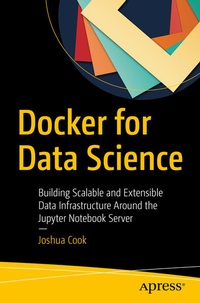
Docker for Data Science
Building Scalable and Extensible Data Infrastructure Around the Jupyter Notebook Server
Published on 25. August 2017
Book
Paperback/Softback
XXI, 257 pages
978-1-4842-3011-4 (ISBN)
Description
Learn Docker "infrastructure as code" technology to define a system for performing standard but non-trivial data tasks on medium- to large-scale data sets, using Jupyter as the master controller.
It is not uncommon for a real-world data set to fail to be easily managed. The set may not fit well into access memory or may require prohibitively long processing. These are significant challenges to skilled software engineers and they can render the standard Jupyter system unusable.
As a solution to this problem, Docker for Data Science proposes using Docker. You will learn how to use existing pre-compiled public images created by the major open-source technologies-Python, Jupyter, Postgres-as well as using the Dockerfile to extend these images to suit your specific purposes. The Docker-Compose technology is examined and you will learn how it can be used to build a linked system with Python churning data behind the scenesand Jupyter managing these background tasks. Best practices in using existing images are explored as well as developing your own images to deploy state-of-the-art machine learning and optimization algorithms.
What You'll Learn
Who This Book Is For
Data scientists, machine learning engineers, artificial intelligence researchers, Kagglers, and software developers
It is not uncommon for a real-world data set to fail to be easily managed. The set may not fit well into access memory or may require prohibitively long processing. These are significant challenges to skilled software engineers and they can render the standard Jupyter system unusable.
As a solution to this problem, Docker for Data Science proposes using Docker. You will learn how to use existing pre-compiled public images created by the major open-source technologies-Python, Jupyter, Postgres-as well as using the Dockerfile to extend these images to suit your specific purposes. The Docker-Compose technology is examined and you will learn how it can be used to build a linked system with Python churning data behind the scenesand Jupyter managing these background tasks. Best practices in using existing images are explored as well as developing your own images to deploy state-of-the-art machine learning and optimization algorithms.
What You'll Learn
-
Master interactive development using the Jupyter platform
-
Run and build Docker containers from scratch and from publicly available open-source images
-
Write infrastructure as code using the docker-compose tool and its docker-compose.yml file type
-
Deploy a multi-service data science application across a cloud-based system
Who This Book Is For
Data scientists, machine learning engineers, artificial intelligence researchers, Kagglers, and software developers
More details
Edition
1st ed.
Language
English
Place of publication
Berkeley
United States
Target group
Professional and scholarly
Illustrations
76 farbige Abbildungen, 21 s/w Abbildungen
XXI, 257 p. 97 illus., 76 illus. in color.
Dimensions
Height: 235 mm
Width: 155 mm
Thickness: 16 mm
Weight
435 gr
ISBN-13
978-1-4842-3011-4 (9781484230114)
DOI
10.1007/978-1-4842-3012-1
Schweitzer Classification
Other editions
Additional editions
Joshua Cook
Docker for Data Science
Building Scalable and Extensible Data Infrastructure Around the Jupyter Notebook Server
E-Book
08/2017
APress
€62.99
Available for download
Person
Joshua Cook
is a mathematician. He writes code in Bash, C, and Python and has done pure and applied computational work in geo-spatial predictive modeling, quantum mechanics, semantic search, and artificial intelligence. He also has 10 years experience teaching mathematics at the secondary and post-secondary level. His research interests lie in high-performance computing, interactive computing, feature extraction, and reinforcement learning. He is always willing to discuss orthogonality or to explain why Fortran is the language of the future over a warm or cold beverage.
Content
Chapter 1: Introduction.- Chapter 2: Docker.- Chapter 3: Interactive Programming.- Chapter 4: Docker Engine.- Chapter 5: The Dockerfile.- Chapter 6: Docker Hub.- Chapter 7: The Opinionated Jupyter Stacks.- Chapter 8: The Data Stores.- Chapter 9: Docker Compose.- Chapter 10: Interactive Development.