

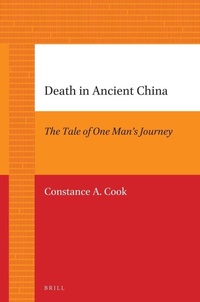
Death in Ancient China
The Tale of One Man's Journey
Published on 10. March 2011
Book
Paperback/Softback
300 pages
978-90-04-20570-3 (ISBN)
Description
This richly illustrated book provides a glimpse into the belief system and the material wealth of the social elite in pre-Imperial China through a close analysis of tomb contents and excavated bamboo texts.
The point of departure is the textual and material evidence found in one tomb of an elite man buried in 316 BCE near a once wealthy middle Yangzi River valley metropolis. Particular emphasis is placed on the role of cosmological symbolism and the nature of the spirit world. The author shows how illness and death were perceived as steps in a spiritual journey from one realm into another. Transmitted textual records are compared with excavated texts. The layout and contents of this multi-chambered tomb are analyzed as are the contents of two texts, a record of divination and sacrifices performed during the last three years of the occupant's life and a tomb inventory record of mortuary gifts. The texts are fully translated and annotated in the appendices.
A first-time close-up view of a set of local beliefs which not only reflect the larger ancient Chinese religious system but also underlay the rich intellectual and artistic life of pre-Imperial China.
With first full translations of texts previously unknown to all except a small handful of sinologists.
Originally published in hardcover
The point of departure is the textual and material evidence found in one tomb of an elite man buried in 316 BCE near a once wealthy middle Yangzi River valley metropolis. Particular emphasis is placed on the role of cosmological symbolism and the nature of the spirit world. The author shows how illness and death were perceived as steps in a spiritual journey from one realm into another. Transmitted textual records are compared with excavated texts. The layout and contents of this multi-chambered tomb are analyzed as are the contents of two texts, a record of divination and sacrifices performed during the last three years of the occupant's life and a tomb inventory record of mortuary gifts. The texts are fully translated and annotated in the appendices.
A first-time close-up view of a set of local beliefs which not only reflect the larger ancient Chinese religious system but also underlay the rich intellectual and artistic life of pre-Imperial China.
With first full translations of texts previously unknown to all except a small handful of sinologists.
Originally published in hardcover
More details
Series
Language
English
Place of publication
Leiden
Netherlands
Target group
Professional and scholarly
All those interested in ancient Chinese religion, cosmology, Chu culture, burial traditions, ancient rituals concerning illness and death, divination, art, excavated manuscripts, food culture, and philology.
Product notice
Paperback (trade)
Unsewn / adhesive bound
Dimensions
Height: 239 mm
Width: 156 mm
Thickness: 20 mm
Weight
465 gr
ISBN-13
978-90-04-20570-3 (9789004205703)
Copyright in bibliographic data and cover images is held by Nielsen Book Services Limited or by the publishers or by their respective licensors: all rights reserved.
Schweitzer Classification
Other editions
Additional editions

Software
07/2006
Brill
Unfortunately, price unknown
Available (delivery time upon request)
Book
06/2006
Brill
€186.50
Shipment within 10-20 days
Person
Constance A Cook, Ph.D. (1990) in Oriental Languages, University of California, Berkeley, is Associate Professor of Chinese at Lehigh University. Her publications, including her edited volume Defining Chu: Image and Reality in Ancient China (Univ. of Hawaii, 1999), focus on the cultural analysis of excavated texts.