

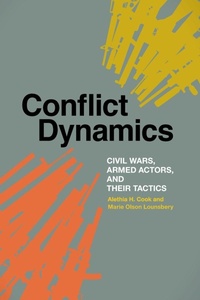
Conflict Dynamics
Civil Wars, Armed Actors, and Their Tactics
Published on 15. November 2020
Book
Paperback/Softback
232 pages
978-0-8203-5883-3 (ISBN)
Description
Conflict Dynamics presents case studies of six nation-states: Sierra Leone, the Republic of Congo, Sri Lanka, Myanmar, Indonesia, and Peru. In the book, Alethia H. Cook and Marie Olson Lounsbery examine the evolving nature of violence in intrastate conflicts, as well as the governments and groups involved, by focusing on the context of the relationships involved, the capacities of the conflict's participants, and the actors' goals. The authors first present a theoretical framework through which the changeable mix of relative group capacities and the resulting tactical decisions can be examined systematically and as conflicts evolve over time. They then apply that framework to the six case studies to show its usefulness in better understand-ing conflicts individually and in comparison.
While previous research on civil wars has tended to focus on causes and outcomes, Conflict Dynamics takes a more comprehensive approach to understanding conflict behavior. The shifting nature of relative group capacity (measured in many different ways), coupled with dynamic group goals, determines the tactical decisions of civil war actors and the paths a rebellion will take. The case studies illustrate the relevance of third parties to this process and how their interventions can influence tactics.
The progression of violence in conflicts is inextricably linked to the decisions made in their midst. These influence future iterations of the conflictual relationship. Complex groups on both sides both drive and are driven by the decisions made. Understanding conflicts requires that these reciprocal impacts be considered. The comparative frame-work demonstrated in this book allows one to flesh out this complexity.
While previous research on civil wars has tended to focus on causes and outcomes, Conflict Dynamics takes a more comprehensive approach to understanding conflict behavior. The shifting nature of relative group capacity (measured in many different ways), coupled with dynamic group goals, determines the tactical decisions of civil war actors and the paths a rebellion will take. The case studies illustrate the relevance of third parties to this process and how their interventions can influence tactics.
The progression of violence in conflicts is inextricably linked to the decisions made in their midst. These influence future iterations of the conflictual relationship. Complex groups on both sides both drive and are driven by the decisions made. Understanding conflicts requires that these reciprocal impacts be considered. The comparative frame-work demonstrated in this book allows one to flesh out this complexity.
More details
Series
Language
English
Place of publication
Georgia
United States
Target group
Professional and scholarly
Product notice
Paperback (trade)
Illustrations
6 Maps; 6 Maps; 6 Maps; 6 Maps; 6 Maps; 6 Maps; 6 Maps
Dimensions
Height: 229 mm
Width: 152 mm
Thickness: 14 mm
Weight
383 gr
ISBN-13
978-0-8203-5883-3 (9780820358833)
Copyright in bibliographic data and cover images is held by Nielsen Book Services Limited or by the publishers or by their respective licensors: all rights reserved.
Schweitzer Classification
Other editions
Additional editions
Alethia H. Cook | Marie Olson Lounsbery
Conflict Dynamics
Civil Wars, Armed Actors, and Their Tactics
E-Book
05/2017
Cokesbury
€64.49
Available for download
Persons
ALETHIA H. COOK is an associate professor of political science at East Carolina University. She is author of Emergency Response to Domestic Terrorism: How Bureaucracies Reacted to the 1995 Oklahoma City Bombing and coauthor, with Jalil Roshandel, of The United States and Iran: Policy Challenges and Opportunities. MARIE OLSON LOUNSBERY is a professor of political science at East Carolina University. She is coauthor, with Frederic Pearson, of Civil Wars: Internal Struggles, Global Consequences.