

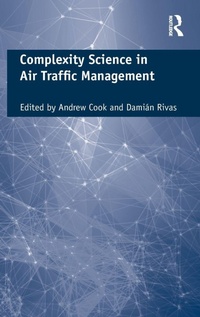
Complexity Science in Air Traffic Management
1st Edition
Published on 27. June 2016
Book
Hardback
188 pages
978-1-4724-6037-0 (ISBN)
Description
Air traffic management (ATM) comprises a highly complex socio-technical system that keeps air traffic flowing safely and efficiently, worldwide, every minute of the year. Over the last few decades, several ambitious ATM performance improvement programmes have been undertaken. Such programmes have mostly delivered local technological solutions, whilst corresponding ATM performance improvements have fallen short of stakeholder expectations. In hindsight, this can be substantially explained from a complexity science perspective: ATM is simply too complex to address through classical approaches such as system engineering and human factors. In order to change this, complexity science has to be embraced as ATM's 'best friend'. The applicability of complexity science paradigms to the analysis and modelling of future operations is driven by the need to accommodate long-term air traffic growth within an already-saturated ATM infrastructure.
Complexity Science in Air Traffic Management is written particularly, but not exclusively, for transport researchers, though it also has a complementary appeal to practitioners, supported through the frequent references made to practical examples and operational themes such as performance, airline strategy, passenger mobility, delay propagation and free-flight safety. The book should also have significant appeal beyond the transport domain, due to its intrinsic value as an exposition of applied complexity science and applied research, drawing on examples of simulations and modelling throughout, with corresponding insights into the design of new concepts and policies, and the understanding of complex phenomena that are invisible to classical techniques.
Complexity Science in Air Traffic Management is written particularly, but not exclusively, for transport researchers, though it also has a complementary appeal to practitioners, supported through the frequent references made to practical examples and operational themes such as performance, airline strategy, passenger mobility, delay propagation and free-flight safety. The book should also have significant appeal beyond the transport domain, due to its intrinsic value as an exposition of applied complexity science and applied research, drawing on examples of simulations and modelling throughout, with corresponding insights into the design of new concepts and policies, and the understanding of complex phenomena that are invisible to classical techniques.
More details
Language
English
Place of publication
London
United Kingdom
Publishing group
Taylor & Francis Ltd
Target group
Professional and scholarly
Dimensions
Height: 240 mm
Width: 161 mm
Thickness: 15 mm
Weight
452 gr
ISBN-13
978-1-4724-6037-0 (9781472460370)
Copyright in bibliographic data and cover images is held by Nielsen Book Services Limited or by the publishers or by their respective licensors: all rights reserved.
Schweitzer Classification
Other editions
Additional editions
Andrew Cook | Damian Rivas
Complexity Science in Air Traffic Management
E-Book
06/2016
Routledge
€231.99
Available for download
Andrew Cook | Damian Rivas
Complexity Science in Air Traffic Management
E-Book
06/2016
Routledge
€231.99
Available for download
Persons
Andrew Cook is a Principal Research Fellow at the University of Westminster, where he manages the Department's ATM research. He has been a research fellow of the University for over 20 years. Leader of ten projects for EUROCONTROL, Andrew is currently engaged in several projects in SESAR's Workpackage E (long-term and innovative research), in addition to air transport industry and EU framework research coordination. Other responsibilities include serving on the programme committee for the annual SESAR innovation conferences and on the Editorial Board of the Journal of Aerospace Operations. Andrew has published widely in ATM, across a number of domains, and frequently reviews journal submissions for Elsevier. He was editor of the first book on European ATM, published by Ashgate. Andrew holds a BA (Hons) Natural Sciences, with supplementary Distinction, and a DPhil Physiological Sciences, both from the University of Oxford.
Damian Rivas received his first degree in Aeronautical Engineering from the Polytechnic University of Madrid and has a PhD from Case Western Reserve University (Cleveland, Ohio). He is currently Professor in the Department of Aerospace Engineering of the Universidad de Sevilla, teaching flight mechanics and air navigation; Director of the Group of Aerospace Engineering of the University of Seville; scientific coordinator of the SESAR WP-E ComplexWorld Network; and a member of the programme committee of the annual SESAR Innovation Days conferences. His main research interests are aircraft trajectory optimisation, aircraft conflict detection and resolution, and uncertainty propagation in air traffic management.
Damian Rivas received his first degree in Aeronautical Engineering from the Polytechnic University of Madrid and has a PhD from Case Western Reserve University (Cleveland, Ohio). He is currently Professor in the Department of Aerospace Engineering of the Universidad de Sevilla, teaching flight mechanics and air navigation; Director of the Group of Aerospace Engineering of the University of Seville; scientific coordinator of the SESAR WP-E ComplexWorld Network; and a member of the programme committee of the annual SESAR Innovation Days conferences. His main research interests are aircraft trajectory optimisation, aircraft conflict detection and resolution, and uncertainty propagation in air traffic management.
Content
Glossary of Common Terms; Chapter 1 Introduction, Marc Bourgois; Chapter 2 Complex Network Theory, Andrew Cook Dr, Massimiliano Zanin Dr; Chapter 3 Complex Networks in Air Transport, Fabrizio Lillo, Rosario N. Mantegna, Salvatore Micciche; Chapter 4 Uncertainty, Damian Rivas, Rafael Vazquez; Chapter 5 Resilience, Henk A.P. Blom Dr, Soufiane Bouarfa; Chapter 6 Emergent Behaviour, Henk A.P. Blom Dr, Mariken H.C. Everdij Dr, Soufiane Bouarfa; Chapter 7 Data Science, Massimiliano Zanin Dr, Andrew Cook Dr, Seddik Belkoura; Chapter 8 Conclusions and a Look Ahead, David Perez;