

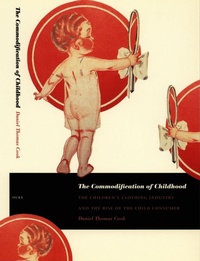
The Commodification of Childhood
The Children's Clothing Industry and the Rise of the Child Consumer
Will be published approx. on 20. April 2004
Book
Hardback
224 pages
978-0-8223-3279-4 (ISBN)
Description
In this revealing social history, Daniel Thomas Cook explores the roots of children's consumer culture-and the commodification of childhood itself-by looking at the rise, growth, and segmentation of the children's clothing industry. Cook describes how in the early twentieth century merchants, manufacturers, and advertisers of children's clothing began to aim commercial messages at the child rather than the mother. Cook situates this fundamental shift in perspective within the broader transformation of the child into a legitimate, individualized, self-contained consumer.The Commodification of Childhood begins with the publication of the children's wear industry's first trade journal, The Infants' Department, in 1917 and extends into the early 1960s, by which time the changes Cook chronicles were largely complete. Analyzing trade journals and other documentary sources, Cook shows how the industry created a market by developing and promulgating new understandings of the "nature," needs, and motivations of the child consumer. He discusses various ways that discursive constructions of the consuming child were made material: in the creation of separate children's clothing departments, in their segmentation and layout by age and gender gradations (such as infant, toddler, boys, girls, tweens, and teens), in merchants' treatment of children as individuals on the retail floor, and in displays designed to appeal directly to children. Ultimately, The Commodification of Childhood provides a compelling argument that any consideration of "the child" must necessarily take into account how childhood came to be understood through, and structured by, a market idiom.
Reviews / Votes
"Blending the sociologist's theoretical rigor with the historian's attention to detail and change, Daniel Thomas Cook offers us a striking and original explanation of how twentieth-century notions of childhood together with new marketing practices led to the modern autonomous child."-Gary Cross, author of The Cute and the Cool: Wondrous Innocence and Modern American Children's Culture "Daniel Thomas Cook's The Commodification of Childhood is a pioneering and major contribution to our understanding of consumer culture. On the basis of his detailed and fascinating examination of children's clothing marketing through the twentieth century, Cook constructs a larger template for understanding the complex and evolving relations between consumers and marketers. The theoretical discussions are a tour de force. A must-read for all scholars of consumer society."-Juliet B. Schor, author of The Overspent American: Why We Want What We Don't NeedMore details
Language
English
Place of publication
North Carolina
United States
Target group
Professional and scholarly
Product notice
Cloth over boards
Illustrations
9 illus., 2 tables
Dimensions
Height: 218 mm
Width: 142 mm
Thickness: 20 mm
Weight
408 gr
ISBN-13
978-0-8223-3279-4 (9780822332794)
Copyright in bibliographic data and cover images is held by Nielsen Book Services Limited or by the publishers or by their respective licensors: all rights reserved.
Schweitzer Classification
Other editions
Additional editions

Daniel Thomas Cook
The Commodification of Childhood
The Children's Clothing Industry and the Rise of the Child Consumer
E-Book
04/2004
1st Edition
De Gruyter
€198.99
Available for download
Person
Daniel Thomas Cook is a sociologist in the Department of Advertising at University of Illinois, Champaign-Urbana. He is the editor of Symbolic Childhood.
Content
Acknowledgments ix
1 Introduction
1
2 A Brief History of Childhood and Motherhood into the Twentieth Century
22
3 Merchandising, Motherhood, and Morality: Industry Origins and Child Welfare, 1917-1929 41
4 Pediocularity: From the Child's Point of View 66
5 Reconfiguring Girlhood: Age Grading, Size Ranges, and Aspirational Merchandising in the 1930s
96
6 Baby Booms and Market Booms: Teen and Subteen Girls in the Postwar Marketplace 122
7 Concluding Remarks 144
Appendix: Figures and Tables 153
Notes 157
Bibliography 181
Index 201
1 Introduction
1
2 A Brief History of Childhood and Motherhood into the Twentieth Century
22
3 Merchandising, Motherhood, and Morality: Industry Origins and Child Welfare, 1917-1929 41
4 Pediocularity: From the Child's Point of View 66
5 Reconfiguring Girlhood: Age Grading, Size Ranges, and Aspirational Merchandising in the 1930s
96
6 Baby Booms and Market Booms: Teen and Subteen Girls in the Postwar Marketplace 122
7 Concluding Remarks 144
Appendix: Figures and Tables 153
Notes 157
Bibliography 181
Index 201