

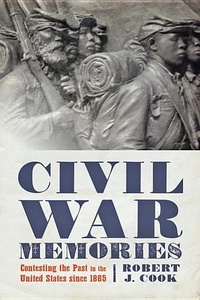
Civil War Memories
Contesting the Past in the United States since 1865
Published on 10. January 2018
Book
Paperback/Softback
288 pages
978-1-4214-2349-4 (ISBN)
Description
At a cost of at least 800,000 lives, the Civil War preserved the Union, aborted the breakaway Confederacy, and liberated a race of slaves. Civil War Memories is the first comprehensive account of how and why Americans have selectively remembered, and forgotten, this watershed conflict since its conclusion in 1865. Drawing on an array of textual and visual sources as well as a wide range of modern scholarship on Civil War memory, Robert J. Cook charts the construction of four dominant narratives by the ordinary men and women, as well as the statesmen and generals, who lived through the struggle and its tumultuous aftermath. Part One explains why the Yankee victors' memory of the "War of the Rebellion" drove political conflict into the 1890s, then waned with the passing of the soldiers who had saved the republic.
It also touches on the leading role southern white women played in the development of the racially segregated South's "Lost Cause"; explores why, by the beginning of the twentieth century, the majority of Americans had embraced a powerful reconciliatory memory of the Civil War; and details the failed efforts to connect an emancipationist reading of the conflict to the fading cause of civil rights. Part Two demonstrates the Civil War's capacity to thrill twentieth-century Americans in movies such as The Birth of a Nation and Gone with the Wind. It also reveals the war's vital connection to the black freedom struggle in the modern era. Finally, Cook argues that the massacre of African American parishioners in Charleston in June 2015 highlighted the continuing relevance of the Civil War by triggering intense nationwide controversy over the place of Confederate symbols in the United States. Written in vigorous prose for a wide audience and designed to inform popular debate on the relevance of the Civil War to the racial politics of modern America, Civil War Memories is required reading for informed Americans today.
It also touches on the leading role southern white women played in the development of the racially segregated South's "Lost Cause"; explores why, by the beginning of the twentieth century, the majority of Americans had embraced a powerful reconciliatory memory of the Civil War; and details the failed efforts to connect an emancipationist reading of the conflict to the fading cause of civil rights. Part Two demonstrates the Civil War's capacity to thrill twentieth-century Americans in movies such as The Birth of a Nation and Gone with the Wind. It also reveals the war's vital connection to the black freedom struggle in the modern era. Finally, Cook argues that the massacre of African American parishioners in Charleston in June 2015 highlighted the continuing relevance of the Civil War by triggering intense nationwide controversy over the place of Confederate symbols in the United States. Written in vigorous prose for a wide audience and designed to inform popular debate on the relevance of the Civil War to the racial politics of modern America, Civil War Memories is required reading for informed Americans today.
Reviews / Votes
The book is full of interesting anecdotes that illustrate the many skirmishes between the competing narratives-History News Network Cook's work has the advantage of covering the entirety of post-Civil War history, making his the most comprehensive entry in this scholarly debate . . . His consistent attention to electoral politics across time sets his work apart from that of many other authors and makes the book well worth reading.
-Annals of Iowa Civil War Memories offers a comprehensive treatment of the memory of the nation's most enduring and contested event. In offering a study of Civil War memory since 1865, Cook underscores that memories of the war have never been monolithic. They have always been debated, politicized, and maligned. His attention to the war's differing memories in the modern era reminds us how the Civil War continues to resonate within our own "mystic chords of memory."
-Jennifer M. Murray, University of Virginia's College at Wise, Journal of Southern History In Civil War Memories: Contesting the Past in the United States since 1865, Robert J. Cook outlines the fight over the memory of the Civil War since Appomattox. It is a tightly argued work that blends adept synthesis with primary source research, and Cook offers an absorbing study of the Civil War's long memory and, implicitly, a meditation on the ways in which various entities "marshal the past so powerfully in the service of the present."
-Bonnie Laughlin-Schultz, Eastern Illinois University, American Historical Review
More details
Language
English
Place of publication
Baltimore, MD
United States
Target group
College/higher education
Product notice
Paperback (trade)
Dimensions
Height: 228 mm
Width: 153 mm
Thickness: 20 mm
Weight
403 gr
ISBN-13
978-1-4214-2349-4 (9781421423494)
DOI
10.56021/9781421423494
Copyright in bibliographic data and cover images is held by Nielsen Book Services Limited or by the publishers or by their respective licensors: all rights reserved.
Schweitzer Classification
Other editions
Additional editions
E-Book
01/2018
Johns Hopkins University Press
€18.99
Available for download
Person
Robert J. Cook is a professor of American history at the University of Sussex. He is the author of Civil War Senator: William Pitt Fessenden and the Fight to Save the American Republic and a coauthor of Secession Winter: When the Union Fell Apart.
Content
Acknowledgments
Introduction
Part I
1. A Fractured Country and Its Fractured Memories
2. The Resurgent South and Its Lost Cause
3. Remembering the Victors' War in the Gilded Age
4. The Rocky Road to Sectional Reconciliation
Part II
5. Distant Drums in an Age of Global Warfare
6. Centennial Blues
7. Afterlife
Conclusion
Notes
Bibliography
Index
Introduction
Part I
1. A Fractured Country and Its Fractured Memories
2. The Resurgent South and Its Lost Cause
3. Remembering the Victors' War in the Gilded Age
4. The Rocky Road to Sectional Reconciliation
Part II
5. Distant Drums in an Age of Global Warfare
6. Centennial Blues
7. Afterlife
Conclusion
Notes
Bibliography
Index