

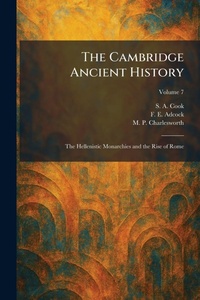
The Cambridge Ancient History
Description
"The Cambridge Ancient History: Volume VII the Hellenistice Monarchies and the Rise of Rome" is a seminal scholarly work that explores the transformative period of the Mediterranean world following the death of Alexander the Great. This volume meticulously documents the fragmentation of the Macedonian Empire and the subsequent emergence of the Hellenistic monarchies, alongside the steady and inexorable ascent of the Roman Republic as a dominant Mediterranean power.
Expertly edited by S. A. Cook, F. E. Adcock, and M. P. Charlesworth, the text provides a comprehensive analysis of the political, social, and military shifts that defined the third century BC. From the internal struggles of the Diadochi to the early Punic Wars and Rome's expanding influence in Italy and beyond, this work offers a detailed synthesis of ancient historical developments. Readers will find deep insights into the cultural synthesis of the Hellenistic age and the institutional foundations that allowed Rome to transition from a regional player to a burgeoning empire.
As part of a landmark series in classical studies, this volume remains an essential resource for understanding the complex interplay between the Greek East and the Roman West. Its rigorous scholarship and narrative depth make it a cornerstone for any serious study of ancient history and the geopolitical evolution of the classical world.
This work has been selected by scholars as being culturally important, and is part of the knowledge base of civilization as we know it. This work was reproduced from the original artifact, and remains as true to the original work as possible. Therefore, you may see the original copyright references, library stamps (as most of these works have been housed in our most important libraries around the world), and other notations in the work.
This work is in the public domain in the United States of America, and possibly other nations. Within the United States, you may freely copy and distribute this work, as no entity (individual or corporate) has a copyright on the body of the work.
As a reproduction of a historical artifact, this work may contain missing or blurred pages, poor pictures, errant marks, etc. Scholars believe, and we concur, that this work is important enough to be preserved, reproduced, and made generally available to the public. We appreciate your support of the preservation process, and thank you for being an important part of keeping this knowledge alive and relevant.