

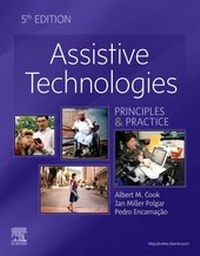
Assistive Technologies
Principles and Practice
5th Edition
Published on 17. January 2020
Book
Hardback
978-0-323-52338-7 (ISBN)
Description
Master the assistive strategies you need to make confident clinical decisions and help improve the quality of life for people with disabilities. Based on the Human Activity Assistive Technology (HAAT) model developed by Al Cook, Sue Hussey and Jan Polgar, Assistive Technologies: Principles & Practice, 5th Edition, provides detailed coverage of the broad range of devices, services, and practices that comprise assistive technology. This new text offers a systematic process for ensuring the effective application of assistive technologies - and focuses on the relationship between the human user and the assisted activity within specific contexts. It features over 30 new photos and illustrations, as well as, updated chapters and case studies that reflect current technology.
Human Activity Assistive Technology (HAAT) framework locates assistive technology within common, everyday contexts for more relevant application.
Focus on clinical application guides application of concepts to real-world situations.
Study questions and chapter summaries in each chapter help assessment of understanding and identification of areas where more study is needed.
Coverage of changing AT needs throughout the lifespan emphasizes how AT fits into people's lives and contributes to their full participation in society.
Principles and practice of assistive technology provide the foundation for effective reasoning.
Ethical issues content provides vital information to guide AT service delivery.
Explicit applications of the HAAT model in each of the chapters on specific technologies and more emphasis on the interactions among the elements make content even easier to understand.
New! Thoroughly updated chapters to reflect current technology and practice.
New! Expanded discussion on assistive robotics and smart technologies.
New! Review of global initiatives on Assistive Technology.
New! Updated art program with 30+ new photos and illustrations.
New! Updated case studies to reflect changes in technology and practice since last edition.
Human Activity Assistive Technology (HAAT) framework locates assistive technology within common, everyday contexts for more relevant application.
Focus on clinical application guides application of concepts to real-world situations.
Study questions and chapter summaries in each chapter help assessment of understanding and identification of areas where more study is needed.
Coverage of changing AT needs throughout the lifespan emphasizes how AT fits into people's lives and contributes to their full participation in society.
Principles and practice of assistive technology provide the foundation for effective reasoning.
Ethical issues content provides vital information to guide AT service delivery.
Explicit applications of the HAAT model in each of the chapters on specific technologies and more emphasis on the interactions among the elements make content even easier to understand.
New! Thoroughly updated chapters to reflect current technology and practice.
New! Expanded discussion on assistive robotics and smart technologies.
New! Review of global initiatives on Assistive Technology.
New! Updated art program with 30+ new photos and illustrations.
New! Updated case studies to reflect changes in technology and practice since last edition.
More details
Edition
5th edition
Language
English
Place of publication
St Louis
United States
Publishing group
Elsevier - Health Sciences Division
Target group
College/higher education
Illustrations
200 illustrations (200 in full color); Illustrations
Dimensions
Height: 276 mm
Width: 216 mm
Weight
1270 gr
ISBN-13
978-0-323-52338-7 (9780323523387)
Copyright in bibliographic data and cover images is held by Nielsen Book Services Limited or by the publishers or by their respective licensors: all rights reserved.
Schweitzer Classification
Other editions
New editions
Book
01/2025
6th Edition
Churchill Livingstone
€116.50
Shipment within 15-20 days
Additional editions
Albert M. Cook | Janice Miller Polgar | Pedro Encarnação
Assistive Technologies- E-Book
Assistive Technologies- E-Book
E-Book
11/2019
5th Edition
Mosby
€76.99
Available for download
Previous edition
Book
12/2014
4th Edition
Mosby
€92.84
Article exhausted; check for reprint
Persons
Professor Emeritus Albert M. Cook, Communication Sciences and Disorders, University of Alberta, Edmonton, Alberta, Canada. Professor Emerita Janice Miller Polgar works at the School of Occupational Therapy, Faculty of Health Sciences, Western University, London, Ontario, Canada. Senior Affiliate Professor Pedro Encarnacao works at Catolica Lisbon School of Business and Economics, Universidade Catolica Portuguesa, Lisboa, Portugal.
Author
Professor Emeritus, Communication Sciences and Disorders, University of Alberta, Edmonton, Alberta, Canada
Professor Emerita, School of Occupational Therapy, Faculty of Health Sciences, Western University, London, Ontario, Canada
Senior Affiliate Professor, Catolica Lisbon School of Business & Economics, Universidade Catolica Portuguesa, Lisboa, Portugal
Content
1. Principles of Assistive Technology
2. Technologies that Assist People Who Have Disabilities
3. Activity, Human, and Context
4. Global Perspective on Assistive Technology
5. Ethical Issues in Assistive Technology
6. Delivering Assistive Technology Services to the Client
7. User Input
8. Control Interfaces for Assistive Technologies
9. Input Accessibility for Mainstream Information and Communication Technologies
10. Enabling Function and Participation with Seating Technologies
11. Technologies that Enable Mobility
12. Technologies That Aid Transportation
13. Enabling Manipulation with Low-Technology Assistive Devices
14. Electronic Aids to Daily Living
15. Robotic Assistive Technologies that Aid Manipulation
16. Sensory Aids for Persons with Visual Impairments
17. Assistive Technologies for Cognitive Augmentation
18. Augmentative and Alternative Communication Systems
Glossary
2. Technologies that Assist People Who Have Disabilities
3. Activity, Human, and Context
4. Global Perspective on Assistive Technology
5. Ethical Issues in Assistive Technology
6. Delivering Assistive Technology Services to the Client
7. User Input
8. Control Interfaces for Assistive Technologies
9. Input Accessibility for Mainstream Information and Communication Technologies
10. Enabling Function and Participation with Seating Technologies
11. Technologies that Enable Mobility
12. Technologies That Aid Transportation
13. Enabling Manipulation with Low-Technology Assistive Devices
14. Electronic Aids to Daily Living
15. Robotic Assistive Technologies that Aid Manipulation
16. Sensory Aids for Persons with Visual Impairments
17. Assistive Technologies for Cognitive Augmentation
18. Augmentative and Alternative Communication Systems
Glossary