

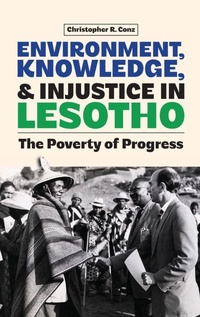
Environment, Knowledge, and Injustice in Lesotho
The Poverty of Progress
Published on 16. July 2024
Book
Hardback
282 pages
978-1-84701-330-9 (ISBN)
Description
Shows that a fraught historical process was at work in which Basotho drew on local and global sources of knowledge and how this small nation surrounded by South Africa can serve as a valuable case-study for wider conversations about 'progress' and 'modernization' in the Global South.
Both place-based environmental history and global intellectual history, this book explores the politics of environment, agriculture, poverty, development, and science in Lesotho. Drawing on diverse experiences with this landlocked, mountainous nation, and based on bilingual archival and oral history research in Sesotho and English, the book examines how Basotho intellectuals, farmers, migrant workers, chiefs, experts, and politicians formed vernacular ideas of tsoelopele (progress) amid the structural violence of colonialism and capitalism in southern Africa. Rather than a unidirectional flow of 'enlightened' knowledge from Europe to Africa, the study shows that a fraught historical process was at work in which Basotho drew on local and global sources of knowledge, from ancestral agricultural practices to colonial soil science and from African American missionaries to African nationalists in Ghana. Basotho ideas about tsoelopele, it is argued, informed the many political, social, and environmental innovations that enabled survival within a sea of white supremacy and that underpin approaches to development in independent Lesotho. Throughout, the book shows how this small nation surrounded by South Africa can serve as a valuable case-study for wider conversations about 'progress' and 'modernization' in the Global South.
Both place-based environmental history and global intellectual history, this book explores the politics of environment, agriculture, poverty, development, and science in Lesotho. Drawing on diverse experiences with this landlocked, mountainous nation, and based on bilingual archival and oral history research in Sesotho and English, the book examines how Basotho intellectuals, farmers, migrant workers, chiefs, experts, and politicians formed vernacular ideas of tsoelopele (progress) amid the structural violence of colonialism and capitalism in southern Africa. Rather than a unidirectional flow of 'enlightened' knowledge from Europe to Africa, the study shows that a fraught historical process was at work in which Basotho drew on local and global sources of knowledge, from ancestral agricultural practices to colonial soil science and from African American missionaries to African nationalists in Ghana. Basotho ideas about tsoelopele, it is argued, informed the many political, social, and environmental innovations that enabled survival within a sea of white supremacy and that underpin approaches to development in independent Lesotho. Throughout, the book shows how this small nation surrounded by South Africa can serve as a valuable case-study for wider conversations about 'progress' and 'modernization' in the Global South.
Reviews / Votes
Poverty of Progress centers the moral vision of tsoelopele--or "progress"--which guided Sotho farmers as they navigated colonialism and economic dependence on South Africa. Focusing on innovators and their husbandry practices, Conz delivers a readable and astute history of farming as an intellectual project and political act. * Professor Nancy Jacobs, Department of History, Brown University * This book is a consummate study of local agricultural knowledge and its co-evolution with colonial rule. And it breaks new ground. His intensive field interviews and archive-based evidence and stories show the intersection between local knowledge and colonial imposed policies in soil science and farm management. Lesotho is small, but it admirably illustrates a much larger issue for southern Africa and the world's rural histories. This study gives a voice to farmers who sought to sustain their views and practices in a rapidly changing world. * James McCann, Professor Emeritus of History and African Studies, Boston University, Author of Green Land, Brown Land, Black Land: An Environmental History of Africa *More details
Language
English
Place of publication
Oxford
United Kingdom
Target group
College/higher education
Product notice
Cloth over boards
Illustrations
3 maps and 11 b/w illus.
Dimensions
Height: 240 mm
Width: 161 mm
Thickness: 20 mm
Weight
593 gr
ISBN-13
978-1-84701-330-9 (9781847013309)
Copyright in bibliographic data and cover images is held by Nielsen Book Services Limited or by the publishers or by their respective licensors: all rights reserved.
Schweitzer Classification
Other editions
Additional editions
Book
approx. 08/2026
Boydell & Brewer
€37.50
Not yet published
E-Book
07/2024
1st Edition
Boydell & Brewer Ltd
€48.99
Available for download
E-Book
07/2024
1st Edition
De Gruyter
€48.99
Available for download
Person
CHRISTOPHER R. CONZ is a Visiting Assistant Professor of History at the College of the Holy Cross in Worcester, Massachusetts, USA and a Research Fellow in the Department of History at the University of the Free State in South Africa.
Content
List of Illustrations
Acknowledgements
List of Abbreviations
Selected Sesotho Terms Used
Introduction
1. Making a Place in the Mountains
2. Animals, Pests, and the Politics of Veterinary Knowledge
3. Forestry in an Imperial Watershed
4. Soil, Progress, and Preserving the Status Quo
5. Agriculture, Knowledge, and Paths of Progress
6. Nutrition in the Era of Decolonization
Conclusion
Bibliography
Acknowledgements
List of Abbreviations
Selected Sesotho Terms Used
Introduction
1. Making a Place in the Mountains
2. Animals, Pests, and the Politics of Veterinary Knowledge
3. Forestry in an Imperial Watershed
4. Soil, Progress, and Preserving the Status Quo
5. Agriculture, Knowledge, and Paths of Progress
6. Nutrition in the Era of Decolonization
Conclusion
Bibliography