

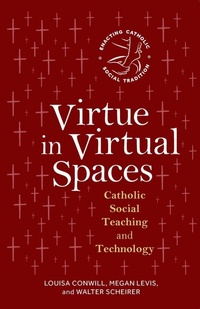
Virtue in Virtual Spaces
Catholic Social Teaching and Technology
Published on 9. September 2024
Book
Paperback/Softback
138 pages
979-8-4008-0026-9 (ISBN)
Description
2025 Catholic Media Association Second Place Award, Catholic Social Teaching
2025 Catholic Media Association Second Place Award, Pastoral Ministry - Parish Life
Explore new modes of creation to bring virtue back into virtual spaces.
At its best, the internet channels the world into a global village of sorts, where digital citizens learn from each other, explore new modes of creation, and help others work through dilemmas in both physical and virtual spaces. Virtue in Virtual Spaces argues that the internet doesn't have to be the cultural wasteland of click-bait, partisan politics, and vulgar content that we see too often today.
Technology has tremendous potential for good because of the inherent goodness of human creation and creativity which can be achieved through the development and use of technology. The authors draw from writing on virtue ethics and Catholic Social Teaching to demonstrate this potential goodness of technology. Eight of the main themes of Catholic Social Teaching are used to build a framework for designing technology to promote human flourishing. In this book, readers will engage with the philosophies behind their favorite social media platforms, examine how the design features in these platforms shape habits and imagination, and gain dialogue-based skills to bring virtue back into virtual spaces.
2025 Catholic Media Association Second Place Award, Pastoral Ministry - Parish Life
Explore new modes of creation to bring virtue back into virtual spaces.
At its best, the internet channels the world into a global village of sorts, where digital citizens learn from each other, explore new modes of creation, and help others work through dilemmas in both physical and virtual spaces. Virtue in Virtual Spaces argues that the internet doesn't have to be the cultural wasteland of click-bait, partisan politics, and vulgar content that we see too often today.
Technology has tremendous potential for good because of the inherent goodness of human creation and creativity which can be achieved through the development and use of technology. The authors draw from writing on virtue ethics and Catholic Social Teaching to demonstrate this potential goodness of technology. Eight of the main themes of Catholic Social Teaching are used to build a framework for designing technology to promote human flourishing. In this book, readers will engage with the philosophies behind their favorite social media platforms, examine how the design features in these platforms shape habits and imagination, and gain dialogue-based skills to bring virtue back into virtual spaces.
Reviews / Votes
"Evangelization is an essential mission of the church entrusted to us by Christ. Technology's threat to evangelization in this digital age also offers us opportunities to advance the church's mission to evangelize, especially to young adults. Under the theoretical framework of Catholic Social Teaching, this book offers remarkable guidelines for evangelizing the culture through technology, emphasizing the three elements of 'think, build, and do.""This is a groundbreaking integration of CST and tech ethics. This book applies virtue-based theology to digital design and culture, offering a prophetic response to how technology shapes human dignity, participation, and solidarity - a well-needed space into which CST ought to be integrated."
Catholic Media Association
More details
Series
Language
English
Place of publication
Collegeville, MN
United States
Target group
College/higher education
Professional and scholarly
Product notice
Paperback (trade)
Dimensions
Height: 216 mm
Width: 140 mm
Thickness: 8 mm
Weight
184 gr
ISBN-13
979-8-4008-0026-9 (9798400800269)
Copyright in bibliographic data and cover images is held by Nielsen Book Services Limited or by the publishers or by their respective licensors: all rights reserved.
Schweitzer Classification
Other editions
Additional editions

Louisa Conwill | Megan Levis Scheirer | Walter J. Scheirer
Virtue in Virtual Spaces
Catholic Social Teaching and Technology
E-Book
09/2024
LITURGICAL PRESS
€17.49
Available for download
Persons
Louisa Conwill is a PhD student in computer science and engineering at the University of Notre Dame. Her research focuses include computer vision, human-computer interaction, and technology ethics, and she has a particular interest in how the teachings of the Catholic Church can inform technology ethics. A graduate of Brown University, Louisa worked as a software engineer for Amazon Alexa and served as a campus missionary with the Fellowship of Catholic University Students (FOCUS) before starting her graduate studies at Notre Dame.
Megan Levis Scheirer is an assistant professor of the practice with the University of Notre Dame's Institute for Social Concerns and College of Engineering. She holds a PhD in bioengineering and recently completed a postdoctoral fellowship with Notre Dame's Technology Ethics Center and the Department of Computer Science and Engineering. Her research interests relate to questions concerning how technology shapes the cultural understanding of what it means to be human and how technology can be designed to encourage virtue and the common good. Levis is also working to bring character formation into engineering curricula.
Walter Scheirer is the Dennis O. Doughty Collegiate Associate Professor in the Department of Computer Science and Engineering at the University of Notre Dame. He is a global technology leader, serving as the chair of the IEEE Computer Society Technical Community on Pattern Analysis and Machine Intelligence and as a board member of the Computer Vision Foundation. Scheirer is also a cultural critic and historian, commenting on the social context of emerging technologies from the realistic perspective of a technologist, and promoting technology development informed by Catholic Social Teaching that upholds the common good.
Megan Levis Scheirer is an assistant professor of the practice with the University of Notre Dame's Institute for Social Concerns and College of Engineering. She holds a PhD in bioengineering and recently completed a postdoctoral fellowship with Notre Dame's Technology Ethics Center and the Department of Computer Science and Engineering. Her research interests relate to questions concerning how technology shapes the cultural understanding of what it means to be human and how technology can be designed to encourage virtue and the common good. Levis is also working to bring character formation into engineering curricula.
Walter Scheirer is the Dennis O. Doughty Collegiate Associate Professor in the Department of Computer Science and Engineering at the University of Notre Dame. He is a global technology leader, serving as the chair of the IEEE Computer Society Technical Community on Pattern Analysis and Machine Intelligence and as a board member of the Computer Vision Foundation. Scheirer is also a cultural critic and historian, commenting on the social context of emerging technologies from the realistic perspective of a technologist, and promoting technology development informed by Catholic Social Teaching that upholds the common good.
Content
Contents
Preface ix
Glossary of Terms xiii
Chapter One
Introduction 1
Chapter Two
Historical Background of Catholic Social Teaching 22
Chapter Three
Dialogue and Social Technologies 35
Chapter Four
A Framework for Technology Design Based on Catholic Social Teaching 51
Chapter Five
Case Studies 76
Chapter Six
Conclusion 104
Bibliography 111
Preface ix
Glossary of Terms xiii
Chapter One
Introduction 1
Chapter Two
Historical Background of Catholic Social Teaching 22
Chapter Three
Dialogue and Social Technologies 35
Chapter Four
A Framework for Technology Design Based on Catholic Social Teaching 51
Chapter Five
Case Studies 76
Chapter Six
Conclusion 104
Bibliography 111