

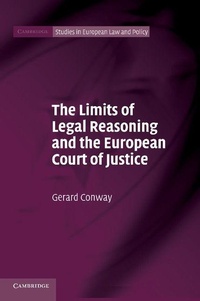
The Limits of Legal Reasoning and the European Court of Justice
Published on 2. January 2014
Book
Paperback/Softback
346 pages
978-1-107-66035-9 (ISBN)
Description
The European Court of Justice is widely acknowledged to have played a fundamental role in developing the constitutional law of the EU, having been the first to establish such key doctrines as direct effect, supremacy and parallelism in external relations. Traditionally, EU scholarship has praised the role of the ECJ, with more critical perspectives being given little voice in mainstream EU studies. From the standpoint of legal reasoning, Gerard Conway offers the first sustained critical assessment of how the ECJ engages in its function and offers a new argument as to how it should engage in legal reasoning. He also explains how different approaches to legal reasoning can fundamentally change the outcome of case law and how the constitutional values of the EU justify a different approach to the dominant method of the ECJ.
Reviews / Votes
'Conway's study is timely, well argued, intelligent and provocative ... [His] highly intelligent book provides an excellent entry to the study of the decision making of the Court of Justice. He shows that the Court has a predisposition towards a meta-communautaire reading of the treaties in those cases where it matters most.' Gunnar Beck, International and Comparative Law Quarterly 'With the help of case studies of landmark decisions, Conway ... demonstrates impressively where the reasoning of the Court on the interpretation of EU law seemed to fail to articulate alternative choices and thereby create a sense of inevitability of the Court's solution ... [The] Limits of Legal Reasoning [and the European Court of Justice] is in my view definitely a much-needed, thought-provoking contribution to EU law scholarship, whether you find yourself in agreement with the Court's conclusions or not.' B. Pirker, European Law Blog (europeanlawblog.eu) 'Gerard Conway has ... written an undeniably important book. Praise is due for his searching, tightly knit dissertation, which succeeds in rekindling a fire that has petered out too soon. The principal critique of the Court's creative jurisprudence is well founded, and his alternative theorems merit further scholarly discussion.' Henri De Waele, European Law Review 'Conway normatively discusses the limits of legal reasoning of the Court ... Such a proposition might be perhaps difficult to digest in some of the more traditional quarters of EU law scholarship. It could be seen, however, rather than the indictment of what and how the Court has done in the past, as the suggested recipe for the future. Conway's own conclusion confirms that his main argument is prospective: in a transformed, differentiated and sceptical Union of today, the linear narrative of further integration translated into one-sided reasoning of the Court becomes more of a problem than a solution.' M. Bobek, European Law Review '... well worth studying closely ... based on thorough research and knowledge of the case law and of EU law, and also of the relevant literature.' Joxerramon Bengoetxea, European Constitutional Law ReviewMore details
Series
Language
English
Place of publication
Cambridge
United Kingdom
Target group
College/higher education
Product notice
Paperback (trade)
Illustrations
Worked examples or Exercises
Dimensions
Height: 229 mm
Width: 152 mm
Thickness: 19 mm
Weight
502 gr
ISBN-13
978-1-107-66035-9 (9781107660359)
Copyright in bibliographic data and cover images is held by Nielsen Book Services Limited or by the publishers or by their respective licensors: all rights reserved.
Schweitzer Classification
Other editions
Additional editions
Book
01/2012
1st Edition
Cambridge University Press
€133.70
Shipment within 15-20 days
Person
Gerard Conway is a lecturer in law at Brunel University in London. He has also been a visiting lecturer at the University of Buckingham.
Content
1. Introduction and overview: interpretation and the European Court of Justice; 2. Reading the Court of Justice; 3. Reconceptualising the legal reasoning of the Court of Justice: interpretation and its constraints; 4. Retrieving a separation of powers in the EU; 5. EU law and a hierarchy of interpretative techniques; 6. Levels of generality and originalist interpretation in EU law; 7. Subjective originalist interpretation in EU law; 8. Conclusion.